
ISO/IEC 27090 is not a management system standard and does not set certifiable requirements. It explicitly builds on the established practice of ISO/IEC 27001 and 27002 and adds threats that affect only AI systems. For implementation, this means no second management system, no second risk methodology, no second documentation system. The AI content is built into the context, risk assessment, Statement of Applicability, operation, internal audit and management review of the existing ISMS — organisations that do not yet have one build both in one go.
ISO 27001 and ISO 27090 implemented together — AI security in one ISMS
Available since October 2026, ISO/IEC 27090 describes nine AI-specific attack types and how to detect and defend against them, but it is not certifiable. ISO/IEC 27001 provides the certifiable management framework. This guide shows how to combine the two into one ISMS — in nine phases from the combined gap analysis through the measures plan, roadmap, implementation, migration and training to the internal audit, management review and an optional certification audit — with a mapping navigator, gap check and evidence list.
ISO/IEC 27001:2022 × ISO/IEC 27090:2026 · one ISMS
- 01Gap analysis
- 02Measures
- 03Roadmap
- 04Implement
- 05Migration
- 06Training
- 07Audit
- 08Review
9phases to the certificate1risk register and SoA0certificates to 27090
9AI-specific compromise types in ISO/IEC 27090 — from data poisoning to output injection
93Controls in Annex A of ISO/IEC 27001:2022 — the foundation that ISO/IEC 27090 builds on
1ISMS with one risk register and one Statement of Applicability — instead of two systems
0Certificates “to ISO 27090”: the ISMS is certified to ISO/IEC 27001, optionally complemented by ISO/IEC 42001
Published on 14 October 2026, ISO/IEC 27090 is the first standard from subcommittee ISO/IEC JTC 1/SC 27 dedicated specifically to the security of AI systems. It deliberately does not establish a management system of its own: the standard builds on the established practice of ISO/IEC 27001 and 27002 and adds threats that exist only in AI — poisoned training data, manipulated inputs, stolen models, prompt injection. For organisations with an ISMS, that is the good news: they do not need a second system. The nine compromise types feed into the existing risk assessment as a threat catalogue, the countermeasures go into the Statement of Applicability as AI-specific extensions of existing controls or as additional controls, and the internal audit, management review and certification audit cover them as well. Organisations that do not yet have an ISMS build both in one go. This page shows how that works in practice — with work steps, results, pitfalls and evidence for each phase.
Why now: the standards and deadlines bringing ISMS and AI together
From the new edition of ISO/IEC 27001 to the high-risk obligations of the EU AI Act — select a milestone for details.
25 October 2022
ISO/IEC 27001:2022 published
The third edition restructures Annex A: 93 controls in four themes instead of the previous 114, including eleven new ones such as threat intelligence, configuration management, monitoring activities and secure coding. The German edition, DIN EN ISO/IEC 27001, followed in January 2024.
18 December 2023
ISO/IEC 42001:2023 published
The certifiable standard for AI management systems becomes available. ISO/IEC 27090 later refers to it for implementing an AI governance programme and names two of its controls: on documenting design and development, and on the operation and monitoring of AI systems.
February 2024
Amendment 1:2024 to ISO/IEC 27001
“Climate action changes”: organisations must determine whether climate change is a relevant issue for their ISMS; interested parties can have climate-related requirements. The amendment introduces no new controls.
31 October 2025
Transition period for ISO/IEC 27001:2013 ends
Since then, only certificates to ISO/IEC 27001:2022 have been valid. Anyone adding AI content now builds on the current edition — the extension is a planned change to the ISMS, not a transition.
3 July 2026
ISO/IEC 27000:2026
The sixth edition of the vocabulary standard for the 27000 family replaces the 2018 version; ISO/IEC 27090 takes its definitions of confidentiality, integrity and availability from it.
14 October 2026
ISO/IEC 27090:2026 published
First edition, 56 pages, in English only: the ISO/IEC JTC 1/SC 27 guidance on security threats and compromises to AI systems — the subcommittee’s first standard dedicated specifically to the security of AI systems. Not certifiable; no German edition exists.
2 December 2027
EU AI Act: high-risk AI under Annex III
From this date, the obligations for high-risk AI systems under Annex III apply, including accuracy, robustness and cybersecurity. ISO/IEC 27090 helps with implementation but does not give rise to a presumption of conformity.
11 December 2027
Cyber Resilience Act applies in full
The main obligations of the Cyber Resilience Act take effect for products with digital elements — including AI functions in such products. An ISMS with an AI profile provides the processes and evidence for this but does not replace product conformity.
2 August 2028
EU AI Act: high-risk AI under Annex I
The obligations now also apply to high-risk AI in products covered by the EU harmonisation legislation listed in Annex I — such as medical devices.
The essentials in nine key statements
Click a card to read the key statement in detail — or expand them all.
Where ISO 27090 fits into the ISMS
The clauses of ISO/IEC 27001 and its Annex A — each tab shows what the AI content of ISO/IEC 27090 changes and in which phase this is addressed. The mapping is a VamiSec working interpretation.
- Add AI to the internal and external issues: your own AI strategy, dependence on model providers, threat landscape, EU AI Act and standardisation.
- Identify interested parties with AI requirements: customers asking about AI security, supervisory authorities, affected persons, model and data suppliers.
- Define the scope deliberately: which AI systems, data pipelines and model interfaces are included — and where do the interfaces with providers lie?
4.1 Context4.2 Interested parties4.3 Scope27090: Scope
- Extend the information security policy to cover AI or issue an AI security policy as part of the ISMS.
- Assign roles: an owner for each AI system, AI security leads in the ISMS team, contacts in ML engineering.
- Top management makes its commitment visible: resources for AI security, risk appetite for AI, decision rights on model changes.
5.1 Leadership5.2 Policy5.3 Roles27090 5.2 AI governance
- Risk assessment for each AI system covering the nine compromise types and the AI variants of conventional attacks.
- Risk treatment: controls from Annex A plus additional AI controls from ISO/IEC 27090 — compared against Annex A.
- Extend the Statement of Applicability, set up a risk treatment plan with owners and deadlines, formally accept residual risks.
- Manage the AI extension as a planned change to the ISMS.
6.1.2 Risk assessment6.1.3 Risk treatment & SoA6.3 Planning of changes27090 clause 6
- Plan resources for AI security — staff, tools, external testing such as red teaming.
- Extend competence profiles per role to cover AI and provide target-group-specific training; build awareness of the secure use of generative AI among all staff.
- Define communication on AI risks and reporting channels; bring AI documents under the control of documented information.
7.1 Resources7.2 Competence7.3 Awareness7.5 Documented information
- Implement and control risk treatment for AI — including outsourced services such as model APIs and hosted training environments.
- Repeat the risk assessment when the model, training data, system prompt, retrieval source or intended purpose changes.
- Migrate operational processes: extend change, incident, vulnerability and supplier management to cover AI cases.
8.1 Operational control8.2 Risk assessment8.3 Risk treatment27090 clause 7
- Monitor AI security metrics: inventory coverage, logging, red team findings, time to detection.
- Internal audit with AI-focused samples; management review covering an AI status update, incidents and decisions.
- Resolve nonconformities with root cause analysis; continually incorporate lessons learned from red teaming and incidents.
9.1 Monitoring & measurement9.2 Internal audit9.3 Management review10 Improvement
- Organisational controls: extend inventory, acceptable use, classification, suppliers, cloud services and incident management to cover AI.
- People controls: awareness, education and training on AI threats; reporting of anomalous AI behaviour.
- Technological controls: access, logging, monitoring, secure development life cycle, separation of environments, change management and data leakage prevention — each with an AI-specific extension.
- ISO/IEC 27090 itself names the ISO/IEC 27002 controls on logging, monitoring and secure system architecture as anchors; all other mappings are working interpretations.
A.5 OrganisationalA.6 PeopleA.8 Technological27002 8.15 · 8.16 · 8.27
Interactive
Nine phases from gap to certificate
Select a phase in the ring or in the list to see its goal, typical pitfalls, standard anchors, work steps, guiding question and the deliverables you need for audit and certification. Project governance sits at the core, and the outer ring covers evidence across all phases. Timings are orientation values for a combined implementation from scratch.
Phase 1 · Weeks 1–4 · ISO/IEC 27001 clauses 4–10 and Annex A × ISO/IEC 27090
Combined gap analysis
Assess in a single pass how mature the ISO/IEC 27001 ISMS is and how well the AI systems are secured, measured against the content of ISO/IEC 27090 — with an AI inventory, interviews, spot checks and a dual maturity rating per requirement.
BasisISO/IEC 27001:2022 4.1–4.3, 6.1.2, Annex A 5.9; ISO/IEC 27090:2026 5.1, 5.2, clause 6; approach: VamiSec methodology
Typical pitfalls
- Shadow AI in standard software, SaaS and developer tools goes undetected (critical)
- Analysis only against Annex A rather than also against clauses 4 to 10 — management gaps stay invisible (critical)
- Business units and ML engineering are missing from the interviews — AI is assessed as a purely IT topic (medium)
- ISO/IEC 27090 misread as a checklist instead of a source of threats and measures (medium)
- Data protection not involved, even though training data can be personal data (low)
Standard anchors
ISO/IEC 27001 4.1–4.3ISO/IEC 27001 6.1.2Annex A 5.9ISO/IEC 27090 5.1, 5.2ISO/IEC 27090 clause 6ISO/IEC 27003 (guidance)
Work steps
- Kick-off with top management: objectives, intention to certify, provisional scope
- AI inventory across all sourcing channels, cross-checked against procurement, licences, code repositories and network data
- Document review: policy, risk methodology, risk register, Statement of Applicability, processes
- Interviews with the ISMS team, IT operations, ML engineering, development, procurement, data protection and business units
- Technical spot checks on access to models and data, logging, and input and output filters
- Dual maturity rating per requirement: the ISMS requirement and its AI-specific extension
- Gap register with priority, effort and owners; management summary
Guiding question for management & CISO
Do we know which AI systems we use, who is accountable for them and which of the nine compromise types are relevant to each of them?
Deliverables & evidence
- AI inventory (first version) with owners
- Gap register ISO/IEC 27001 × ISO/IEC 27090
- Maturity heat map per clause and AI system
- Management summary with priorities
- Recommendation on scope and certification path
Phase 2 · Months 1–3 · ISO/IEC 27001 6.1.2, 6.1.3, 6.2 × ISO/IEC 27090 clause 6
Combined measures plan
The gaps become a single, risk-based measures plan: a risk assessment per AI system covering the nine compromise types, risk treatment with controls from Annex A and from ISO/IEC 27090, an extended Statement of Applicability and a risk treatment plan with owners.
BasisISO/IEC 27001:2022 6.1.2, 6.1.3, 6.2, 8.2, 8.3; ISO/IEC 27090:2026 5.1, 6.2–6.10, Annex B; mapping to Annex A: VamiSec working interpretation
Typical pitfalls
- A second, parallel AI register alongside the ISMS risk register (critical)
- Residual risks not formally accepted by the risk owners (critical)
- Sections of ISO/IEC 27090 adopted one-to-one as controls, without any link to risk (medium)
- Measures without an owner or deadline (medium)
- Exclusions of Annex A controls not justified (medium)
Standard anchors
ISO/IEC 27001 6.1.2ISO/IEC 27001 6.1.3ISO/IEC 27001 6.2ISO/IEC 27090 5.1ISO/IEC 27090 6.2–6.10, Annex BISO/IEC 27005 (guidance)
Work steps
- Risk assessment per AI system covering the nine compromise types and the AI variants of conventional attacks
- Appoint risk owners from the business
- Select measures: AI-specific extension of existing controls or additional AI controls with their own identifier
- Cross-check against Annex A and justify every applicability decision
- Multi-mapping per measure: Annex A, ISO/IEC 27090, optionally ISO/IEC 42001 and the EU AI Act
- Risk treatment plan with deadlines; have residual risks formally accepted
- Set measurable objectives for AI security
Guiding question for management & CISO
Can an auditor trace, for every AI measure, which risk it treats, where it comes from and who is accountable for it?
Deliverables & evidence
- Risk register with AI risks per system
- Extended Statement of Applicability
- Risk treatment plan with owners and deadlines
- Documented acceptance of residual risks
- Mapping table of measures
Phase 3 · Months 2–3 · ISO/IEC 27001 5.1, 5.3, 6.2, 6.3, 7.1, 7.4
Implementation concept & roadmap
The implementation concept makes the measures plan manageable: a project organisation with roles, work packages, dependencies, budget, communication and metrics — and a roadmap in waves that keeps the ISMS working throughout the restructuring.
BasisISO/IEC 27001:2022 5.1, 5.3, 6.2, 6.3, 7.1, 7.4; wave model and timings: VamiSec orientation values
Typical pitfalls
- No visible mandate from top management — business units do not prioritise the project (critical)
- Too little time scheduled for operational evidence before the audit (critical)
- All measures started at once, resources overloaded (medium)
- Extension not managed as a planned change — an existing certificate comes under pressure (medium)
Standard anchors
ISO/IEC 27001 5.1, 5.3ISO/IEC 27001 6.2, 6.3ISO/IEC 27001 7.1, 7.4Annex A 5.8
Work steps
- Set up a steering committee with management, CISO, AI security lead and business units
- RACI per work package: governance, technology, supply chain, training, migration, audit
- Roadmap in waves: immediate actions, governance, technology, migration and training, verify and decide
- Plan budget and resources, including external assessments such as red teaming
- Communication plan for employees, customers and suppliers
- Define metrics for progress and effectiveness
Guiding question for management & CISO
Who decides, who delivers — and how will we know in 90 days that we are on track?
Deliverables & evidence
- Implementation concept with project organisation
- Roadmap with waves and milestones
- RACI matrix
- Budget and resource plan
- Set of metrics
Phase 4 · Months 3–9 · Annex A × ISO/IEC 27090 5.3–5.7, clauses 6 and 7
Implementing the combined measures
Organisational and technical measures are implemented — guided by the compromise types rated high and with zero trust as the common thread: protect data and models, constrain applications and agents, detect misuse, test effectiveness.
BasisISO/IEC 27090:2026 5.3–5.7, 6.2–6.11, 7.2–7.9; ISO/IEC 27002:2022 8.15, 8.16, 8.27 (cited by ISO/IEC 27090); other mappings: VamiSec working interpretation
Typical pitfalls
- Protection via prompt rules only, rather than permissions, approvals and isolation (critical)
- No logging of inference — misuse and exfiltration go unnoticed (critical)
- Agents with permanent, overly broad tool permissions (critical)
- Measures tested individually, interactions overlooked (medium)
- Model switches and retraining without a change procedure or revalidation (medium)
Standard anchors
ISO/IEC 27090 5.3 Zero TrustISO/IEC 27090 5.4, 5.7ISO/IEC 27090 6.2–6.11ISO/IEC 27090 7.2–7.9Annex A 8.15, 8.16, 8.27Annex A 8.25–8.32
Work steps
- Put the information security policy, AI security policy and generative AI usage rules into force
- Authenticate and authorise each individual access to training data, models and retrieval sources
- Check each agent action; grant tool permissions per task and for a limited time
- Input and output controls against prompt injection and output injection
- Logging and monitoring of inputs and outputs, model version and tool calls; throttling
- Protect the development environment, sign model artefacts, prove data provenance
- Red teaming before go-live and after significant changes; test measures in combination
Guiding question for management & CISO
Would we notice prompt injection, model exfiltration or poisoned training data today — and who would respond, and how?
Deliverables & evidence
- Approved, versioned policies
- Authorisation concepts and configurations
- Logging and monitoring evidence
- Red team and acceptance reports with handling of findings
- Change tickets with revalidation
Phase 5 · Months 6–10 · ISO/IEC 27001 7.5, 8.1 · Annex A 5.9, 5.33
Migration of processes & data
Existing ISMS processes take on the AI cases, and existing data moves into a shared data model with multi-mapping — with a trial run, sign-off and the evidence history preserved.
BasisISO/IEC 27001:2022 7.5, 8.1; Annex A 5.9, 5.33, 8.32; approach: VamiSec methodology
Typical pitfalls
- Migration shortly before the audit — evidence history and audit trail are lost (critical)
- Legacy issues carried over as is: duplicates, orphaned measures, missing owners (medium)
- Mapping to one framework only — this rules out reuse for ISO/IEC 42001, the EU AI Act or NIS2 (medium)
- Parallel AI processes remain in place alongside the ISMS (medium)
Standard anchors
ISO/IEC 27001 7.5ISO/IEC 27001 8.1Annex A 5.9Annex A 5.33Annex A 8.32
Work steps
- Process map: extend asset, risk, change, supplier, incident and vulnerability management to cover AI
- Take stock of all registers, measure lists, evidence and audit findings
- Define the target data model with multi-mapping
- Clean-up: merge duplicates, add owners and validity dates
- Trial run with spot checks, sign-off by the responsible business owners
- Cutover on a fixed date, short parallel operation, archiving in line with retention obligations
Guiding question for management & CISO
After the migration, will we find every measure, every risk and every piece of evidence in exactly one place — with its history?
Deliverables & evidence
- Process map (target state) with AI extensions
- Migration concept and sign-off record
- Framework mapping table
- Archive concept for legacy data
Phase 6 · Months 6–10 · ISO/IEC 27001 7.2, 7.3 · Annex A 6.3, 6.8
Target-group-specific training
Each target group learns which AI threats it has to prevent, detect or report — from executive management through ML engineering, development, operations, procurement and data protection to internal auditors and all employees.
BasisISO/IEC 27001:2022 7.2, 7.3, 7.5; Annex A 6.3, 6.8; content derived from ISO/IEC 27090 clauses 5 to 7; formats: VamiSec recommendation
Typical pitfalls
- ML engineering without hands-on exercises on data poisoning and model theft (critical)
- No evidence of attendance or effectiveness (critical)
- One-size-fits-all training — it misses management and specialists alike (medium)
- Top management is merely informed, not enabled to make decisions (medium)
Standard anchors
ISO/IEC 27001 7.2ISO/IEC 27001 7.3Annex A 6.3Annex A 6.8
Work steps
- Competence profiles per role: target vs. actual
- Briefing for top management: accountability, risk appetite, decisions
- Specialist training for ML engineering, development and operations, with exercises
- Workshops for procurement, data protection and legal
- Training for internal auditors on auditing AI measures
- Awareness for everyone: secure use of generative AI and reporting channels
- Measure effectiveness: knowledge tests, exercise scenarios, reporting rate
Guiding question for management & CISO
Does every role know which AI threats it has to prevent, detect or report — and can we prove it?
Deliverables & evidence
- Training concept and competence matrix
- Attendance records per target group
- Results of knowledge tests and exercises
- Training coverage as a metric
Phase 7 · Months 9–11 · ISO/IEC 27001 9.2, 10.2 · ISO 19011 · ISO/IEC 27007
Internal audit
Independent auditors check whether the AI measures are implemented and effective — with AI-focused samples, effectiveness tests and corrective actions. The audit criteria are ISO/IEC 27001 and your own Statement of Applicability, not ISO/IEC 27090.
BasisISO/IEC 27001:2022 9.2, 10.2; ISO 19011:2026; ISO/IEC 27007:2020
Typical pitfalls
- Auditors audit their own implementation — objectivity is compromised (critical)
- AI audited only through document review, without sampling (medium)
- Audit criteria “based on ISO/IEC 27090” instead of the Statement of Applicability (medium)
- Findings closed without root cause analysis (medium)
Standard anchors
ISO/IEC 27001 9.2ISO/IEC 27001 10.2ISO 19011ISO/IEC 27007
Work steps
- Extend the audit programme to AI systems and AI measures on a risk basis
- Use auditors with AI expertise or technical experts
- Samples: permissions, logs, change tickets, red team findings, supplier assessments
- Effectiveness tests, such as a targeted prompt injection test case
- Classify findings, analyse root causes, track corrective actions
Guiding question for management & CISO
Has someone independent verified that the AI measures are not just described but actually work?
Deliverables & evidence
- Audit programme and audit plans
- Audit reports with AI-focused samples
- Corrective action plan
- Effectiveness check of the corrections
Phase 8 · Month 11 · ISO/IEC 27001 9.1, 9.3, 10.1
Management review
Top management reviews the combined ISMS with AI-specific inputs — metrics, incidents, red team results, regulatory developments — and takes documented decisions on risk appetite, resources and certification.
BasisISO/IEC 27001:2022 9.1, 9.3, 10.1
Typical pitfalls
- Slide presentation without a documented decision (critical)
- AI topics missing from the inputs (medium)
- No metrics, only project status (medium)
Standard anchors
ISO/IEC 27001 9.1ISO/IEC 27001 9.3ISO/IEC 27001 10.1
Work steps
- Add an AI status update to the inputs: inventory, risks, incidents, red team results, regulatory developments
- Report AI security metrics
- Prepare decision papers rather than status reports
- Record decisions on risk appetite, resources, scope and certification
- Set objectives for the next cycle
Guiding question for management & CISO
What decision is top management taking on AI risks today — and is it documented?
Deliverables & evidence
- Minutes with decisions
- Metrics report
- Updated objectives
- Go/no-go decision on the certification audit
Phase 9 · optional · ISO/IEC 27001 by an accredited body · ISO/IEC 17021-1, 27006-1
Optional: certification audit
An accredited certification body audits the ISMS against ISO/IEC 27001 in two stages — with the AI systems in scope and the AI measures in the Statement of Applicability. There is no ISO/IEC 27090 certificate.
BasisISO/IEC 27001:2022; ISO/IEC 27006-1:2024; accreditation status of ISO/IEC 42001 in Germany: DAkkS database, 22 October 2026
Typical pitfalls
- Marketing claim “ISO 27090 certified” — misleading (critical)
- Stage 2 audit too early, without operational evidence (critical)
- The scope leaves out the AI systems customers ask about (medium)
- No complete cycle of internal audit and management review before the audit (medium)
Standard anchors
ISO/IEC 27001ISO/IEC 17021-1ISO/IEC 27006-1ISO/IEC 42001 (optional)
Work steps
- Select a certification body; agree on scope and audit duration
- Stage 1 audit: documentation and certification readiness
- Stage 2 audit: effectiveness on site, with AI-focused samples
- Resolve nonconformities on time
- Plan surveillance audits and recertification; bring new AI systems into scope
- Optional: consider a combined audit with ISO/IEC 42001
Guiding question for management & CISO
Do we need the certificate for customers, tenders or supervisory authorities — and does the scope cover the AI systems people ask about?
Deliverables & evidence
- Stage 1 and stage 2 audit reports
- Corrective action plan
- Certificate with scope
- Surveillance audit plan
Cross-cutting · across all phases · ISO/IEC 27001 5.1, 5.3, 7.4
Project governance, roles & communication
The combined project needs governance that holds the management system and AI expertise together: a steering committee, clear roles, communication with employees, customers and suppliers, and change management that builds acceptance.
BasisISO/IEC 27001:2022 5.1, 5.3, 7.4; Annex A 5.2, 5.8
Typical pitfalls
- AI security depends on a single person in the data science department (critical)
- Business units treat the project as IT box-ticking (medium)
- Customers and suppliers learn about new requirements too late (low)
Standard anchors
ISO/IEC 27001 5.1, 5.3ISO/IEC 27001 7.4Annex A 5.2Annex A 5.8
Work steps
- Steering committee with fixed dates and decision rights
- Roles framework with owners per AI system
- Internal and external communication plan
- Regular progress reports with metrics
Guiding question for management & CISO
Is anyone holding the management system and AI expertise together — with the mandate and the time to do so?
Deliverables & evidence
- Project charter and steering committee minutes
- Roles framework and RACI
- Communication plan
Cross-cutting · across all phases · ISO/IEC 27001 7.5 · Annex A 5.33, 5.37
Documented information & evidence
Every phase produces evidence that must hold up in the audit later: controlled, versioned documents, records of implementation and effectiveness, and an evidence matrix that links each measure to its proof.
BasisISO/IEC 27001:2022 7.5; Annex A 5.33, 5.37
Typical pitfalls
- Evidence scattered across emails, chats and file shares (critical)
- Documents without versioning or approval (medium)
- Retention periods for evidence not defined (medium)
Standard anchors
ISO/IEC 27001 7.5Annex A 5.33Annex A 5.37
Work steps
- Evidence matrix: measure, proof, storage location, owner, validity
- Document control for the AI policy, model cards, provenance records and test reports
- Generate evidence automatically where possible — for example from logging and the ticketing system
- Define rules for retention and archiving
Guiding question for management & CISO
Could we show any auditor the proof for every AI measure tomorrow?
Deliverables & evidence
- Evidence matrix
- Document control rule
- Archiving and retention concept
Combined gap analysis
Guide
The approach in detail: from integration principle to certificate
Eleven chapters: the integration principle, the nine phases with work steps, tables and evidence, plus effort, typical mistakes and success factors.
The integration principle: why one ISMS is enough
ISO/IEC 27001 and ISO/IEC 27090 are not competing standards but two layers of the same task: one governs the management system, the other the AI-specific content.
ISO/IEC 27001 is a requirements standard: it specifies what an information security management system must achieve, which is why it can be certified. ISO/IEC 27090 is a guidance standard: it describes which threats specifically affect AI systems, how to recognise them and how to defend against them. It does not call for a management system of its own; instead, it builds on the established practice of ISO/IEC 27001 and 27002 — two sentences in its principles section, worded as requirements, call for information security controls to be implemented on a risk basis and for AI-specific compromises to be considered across the entire life cycle.
| Aspect | ISO/IEC 27001:2022 | ISO/IEC 27090:2026 | Combined model |
|---|---|---|---|
| Document type | Requirements standard for management systems | Guidance with descriptions of threats and measures | 27001 provides the system, 27090 supplies the AI content |
| Certifiable | Yes, by accredited certification bodies | No — no certificate, no audit “against 27090” | 27001 certificate with the AI systems in scope |
| Core elements | Clauses 4 to 10 and 93 controls in Annex A | Nine compromise types, cross-cutting topics, Annexes A to C | One risk register, one Statement of Applicability |
| Risk logic | Risk assessment and treatment, compared against Annex A | Threats with consequences, detection and defence per type | The nine types as the threat catalogue for risk assessment |
| Language version | German edition DIN EN ISO/IEC 27001:2024-01 | English only, no German edition | Keep terms bilingual in the glossary |
| Audit basis | Audit criteria for certification and internal audit | Not used as audit criteria; acts via the Statement of Applicability | Auditors check the AI measures as part of the SoA |
Comparison: VamiSec, as of 10/2026.
Two anchor points carry the entire model
First, the risk assessment: the nine compromise types are assessed for every AI system in scope — in the same register and with the same methodology as all other information security risks. Second, the Statement of Applicability: ISO/IEC 27001 accepts controls from any source and requires a comparison with Annex A. The mitigation guidance of ISO/IEC 27090 thus becomes ISMS controls that are implemented, monitored, audited and examined as part of the certification audit.
- No second management system, no second risk methodology, no second document control
- Every measure exactly once, mapped multiple times — to Annex A, ISO/IEC 27090 and, where needed, ISO/IEC 42001 or the EU AI Act
- Internal audit, management review and certification audit also cover the AI measures
- Organisations without an ISMS build it and the AI profile in one project
Combined gap analysis: ISMS maturity and AI coverage in a single pass
The gap analysis answers two questions at once: to what extent does the ISMS meet the requirements of ISO/IEC 27001? And how well are the AI systems secured, measured against the content of ISO/IEC 27090?
Separate analyses lead to duplicate interviews and contradictory results. That is why we examine every requirement in clauses 4 to 10 and every relevant Annex A control just once — assessing at the same time whether its AI-specific extension is covered. In addition, we look at the AI-specific content of ISO/IEC 27090 that has no direct counterpart in ISO/IEC 27001: the nine compromise types, zero trust for models and agents, red teaming, interactions between measures and the decline in their effectiveness over time.
- Scoping and context
Kick-off with management and the ISMS team: goals of the initiative such as a certificate, customer requirements or the EU AI Act, provisional scope, interested parties with AI-related requirements.
- AI inventory
Record all AI systems — developed in-house, operated in your own tenant, used as an API or SaaS, or embedded in standard software; cross-checking against procurement, licence records, code repositories and network data uncovers shadow AI.
- Document review
Policy, risk methodology, risk register, Statement of Applicability, process descriptions, supplier assessments and existing AI policies.
- Interviews and sampling
CISO and ISMS team, IT operations, ML engineering and data science, software development, procurement, data protection and business units; technical sampling of access rights to models and data, logging, and input and output filters.
- Rating by maturity level
Each requirement is rated on four levels from “Not in place” to “Effective & verified” — twice: for the ISMS requirement and for its AI-specific extension.
- Gap register and management summary
Gaps with risk, effort, owners and priority; heat map by clause and by AI system; the ten most important gaps for management.
What the gap analysis delivers
- First version of the AI inventory with owners and criticality
- Gap register ISO/IEC 27001 × ISO/IEC 27090 with maturity levels
- Relevance rating of the nine compromise types per AI system
- Heat map and management summary with priorities and a rough effort estimate
- Recommendation on scope and certification path
Combined measures plan: one register, one Statement of Applicability
The gaps become a single measures plan — risk-based, with clear owners, and mapped multiple times rather than maintained multiple times.
The basis is the risk assessment: for each AI system in scope, the relevant compromise types are rated according to likelihood and consequences. Risk treatment then selects measures — from Annex A, from ISO/IEC 27090 or derived in-house — and compares them against Annex A so that no necessary control is overlooked. The result is an extended Statement of Applicability that states the source, justification and implementation status of every measure.
Two routes into the Statement of Applicability
AI-specific extension of existing controls
Where an Annex A control already covers the core of the threat, it is given an AI-specific extension — for example, logging is extended to inputs and outputs, model version and tool calls, supplier relationships to model providers, and change management to model changes and retraining.
Additional AI controls
Where there is no counterpart, a separate control is created with an identifier, description, source in ISO/IEC 27090, reference to the risk treated and an owner — for example, throttling model usage to counter exfiltration, or revalidating measures after retraining.
| Compromise type | Combined measure (example) | Anchor point in Annex A (VamiSec mapping) |
|---|---|---|
| Data Poisoning | Provenance records and integrity checks per dataset, data limitation | Inventory, data masking, secure development life cycle |
| Evasion | Robustness tests with manipulated inputs, detection of malicious inputs | Monitoring activities, security testing in development and acceptance |
| Membership Inference | Data minimisation, output limitation, joint assessment with data protection | Privacy and PII protection, data masking, data leakage prevention |
| Model Exfiltration | Rate limits and throttling, monitoring of query patterns, logging | Logging, monitoring activities, access control |
| Model Inversion | Output limitation, data limitation, inference tests | Privacy and PII protection, data masking |
| Direct Model Poisoning | Protected development environment, signatures and checksums for model artefacts | Separation of environments, access to source code, secure development life cycle |
| Sensitive Model Output | Output filters, data limitation in training and in context | Data leakage prevention, classification |
| Prompt Injection | Separation of instructions and data, input filters, approvals for consequential actions | Application security requirements, secure coding, monitoring |
| Output containing injection attacks | Treat outputs as untrusted, encode and validate them, allowlists | Application security requirements, secure coding |
The mapping to Annex A is a VamiSec working interpretation; ISO/IEC 27090 itself names only the ISO/IEC 27002 controls on logging, monitoring and secure system architecture as direct anchors.
Prioritise instead of doing it all at once
- No-regret measures first: AI inventory, owners, access protection, logging, usage rules for generative AI
- Then by risk: the most critical AI systems and the compromise types rated high
- Take deadlines into account: customer audits, the next surveillance audit, high-risk obligations under the EU AI Act from December 2027
- Have residual risks formally accepted by the risk owners — not by the project team
Implementation concept & roadmap
The implementation concept makes the measures plan manageable: who decides, who delivers, in what order, with what budget — and how management can tell that progress is being made.
ISO/IEC 27001 requires changes to the ISMS to be carried out in a planned manner — and the AI extension is such a change; good practice is to define the purpose, potential consequences, resources and responsibilities in advance. This protects an existing certificate, because the ISMS remains functional throughout the restructuring, and gives a build from scratch a clear structure. The concept covers project organisation, work packages, dependencies, budget, communication and metrics.
| Role | Task in the combined project |
|---|---|
| Steering committee (management) | Mandate, budget, risk appetite for AI, decision on scope and certification |
| ISMS manager / CISO | Overall steering, methodology, Statement of Applicability, audit preparation |
| AI security lead | Subject-matter lead for the AI measures, interface to ML engineering and development |
| Owner per AI system | Risk evaluation, implementation in their own area, acceptance of residual risks |
| IT operations and SOC | Logging, monitoring and incident handling for AI systems |
| Procurement and supplier management | AI requirements for vendors, contracts, assessments |
| Data protection and legal | Privacy risks arising from training data and outputs, regulatory obligations |
Roadmap in waves
- Wave 0 · Weeks 1–4Mandate and immediate actions
Confirm the scope, complete the AI inventory, appoint owners, publish usage rules for generative AI, clean up access to models and data, switch on logging for the most critical systems.
- Wave 1 · Months 2–4Governance and methodology
Adopt the information security policy and the AI security policy, launch the risk treatment plan from phase 2, define supplier requirements.
- Wave 2 · Months 3–8Technical measures
Zero trust for data, models and agents, input and output controls, protection of the development environment, monitoring and throttling, red teaming of the most critical systems.
- Wave 3 · Months 6–10Migration and training
Migrate processes and data, deliver target-group-specific training, track metrics, collect evidence.
- Wave 4 · Months 9–12Verify and decide
Internal audit, corrective actions, management review and the decision on the certification audit.
The timings are orientation values from projects for a combined build from scratch with a manageable number of AI systems. With an existing, certified ISMS, much of waves 1 and 4 is not needed — the AI extension can then often be incorporated by the next surveillance audit.
Metrics for steering
- Share of AI systems with an owner, a risk assessment and an entry in the Statement of Applicability
- Share of critical AI systems with inference logging and monitoring
- Open findings from red teaming and audits by age and severity
- Training coverage per target group
- Schedule adherence of work packages against the roadmap
Implementing the combined measures
Implementation is both organisational and technical — and every measure leaves behind evidence that the internal audit and certification will need later on.
On the organisational side, implementation starts with rules that affect everyone: the policy extended to cover AI, usage rules for generative AI, the classification of training, prompt and output data, and a change procedure that treats model changes, retraining and changes to system prompts or retrieval sources like software changes. On the technical side, implementation follows the compromise types that were rated high in the risk assessment.
Zero trust as the common thread
ISO/IEC 27090 carries over to AI the zero trust principles that ISO/IEC 27002 describes for secure system architectures: access to training data, models and retrieval sources is individually authenticated and authorised, AI applications are given clear boundaries, actions by AI agents are checked individually, permissions are granted only for the task at hand and for a limited time, and system behaviour is continuously monitored. These principles run through all of the standard’s mitigation guidance.
Data and models
Provenance records and integrity checks for datasets, data limitation, protected and separated development environments, signatures and checksums for model artefacts.
Application and runtime
Separation of instructions and data, input and output filters, treating outputs as untrusted, approvals for consequential actions, throttling against mass queries.
Detection and response
Logging of inputs and outputs, model version and tool calls; monitoring for misuse, exfiltration patterns and drift; playbooks for AI incidents within existing incident management.
Testing and upkeep
Red teaming before go-live and after significant changes, testing all measures together because of possible interactions, revalidation after retraining — because the effectiveness of measures can decline over time.
Evidence to start collecting now
- Approved, versioned policies and usage rules
- Configurations and permission concepts for models, data and agents
- Logging and monitoring evidence with sample analyses
- Red teaming and acceptance test reports with remediation of findings
- Change tickets for model changes and retraining, including revalidation
Migration of processes & data
The AI extension does not create a parallel world: existing ISMS processes are extended and existing data is transferred into a common data model — with a complete evidence history.
Migration takes place on two levels. At the process level, the existing ISMS processes take on the AI cases, rather than a separate AI process universe emerging alongside the ISMS. At the data level, registers, measures and evidence are transferred from spreadsheets, wikis and legacy tools into a consolidated data model in which every measure exists exactly once and points to several frameworks.
| Existing ISMS process | AI extension |
|---|---|
| Asset and inventory management | AI systems, models, datasets, prompts, tool permissions; AI bill of materials (AI-BOM) |
| Risk management | Threat catalogue with the nine compromise types, reassessment when models or data change |
| Change management | Model changes, retraining, changes to system prompts and retrieval sources, with revalidation |
| Supplier management | Model providers, dataset sources, ML libraries and MLOps tools, with an AI questionnaire |
| Incident management | Detection indicators per threat type, AI playbooks, evidence preservation including prompts and model version |
| Vulnerability management | Security advisories for ML frameworks, model servers and AI clients, pinned versions |
| Logging and monitoring | Inputs and outputs, tool calls, query patterns, drift |
| Control of documented information | AI policy, model cards, provenance records, red team reports |
Data migration in five steps
- Stocktake
Which registers, lists of measures, evidence and audit findings exist where — and in what quality?
- Target data model
One model for assets, risks, controls, evidence and suppliers, with multiple mappings to ISO/IEC 27001, ISO/IEC 27090 and, where needed, ISO/IEC 42001, the EU AI Act, NIS2 or DORA.
- Clean-up
Merge duplicates, add owners and validity periods, resolve orphaned measures — not every legacy item deserves to be migrated.
- Trial run and sign-off
Test migration with spot checks, sign-off by the business owners, reconciliation of record counts.
- Cutover and archive
Cutover date, brief parallel operation, archiving of legacy data in line with retention obligations — the evidence history must be preserved for the next audit.
Target-group-specific training
ISO/IEC 27001 requires competence for security-relevant roles and awareness among all employees. For AI, this means that each target group learns which threats it has to prevent, detect or report.
The content is derived from the compromise types and the measures defined in phase 2 — which is why it differs markedly from role to role. A one-size-fits-all course misses the mark both for executive management, which has to evaluate risks and approve resources, and for ML engineering, which is expected to prevent specific attacks on data and models.
| Target group | Focus areas | Format (suggested) |
|---|---|---|
| Executive management and board | Accountability, risk appetite for AI, core threats, regulatory framework, decisions in the management review | Briefing, 90–120 minutes, annually |
| CISO, InfoSec officer and ISMS team | ISO/IEC 27090 in detail, risk methodology, extending the Statement of Applicability, audit preparation | Workshop, 1–2 days |
| ML engineering and data science | Data poisoning, direct model poisoning, data provenance, secure ML pipeline, protecting the development environment, red teaming | Training with exercises, 1–2 days |
| Software development | Prompt injection, output handling, secure RAG and agent architectures, testing | Training with exercises, 1 day |
| IT operations and SOC | Inference logging, detecting misuse and exfiltration, throttling, AI playbooks | Training, ½–1 day |
| Procurement and supplier management | Questions for model providers, contract clauses, AI bill of materials, assessing dataset sources | Workshop, ½ day |
| Data protection and legal | Membership inference, model inversion, sensitive outputs, interplay with the GDPR and the EU AI Act | Workshop, ½ day |
| Internal auditors | Auditing AI measures, sampling, evaluating evidence, audit questions per compromise type | Training, 1 day |
| All employees | Safe use of generative AI, no confidential data in unapproved services, reporting anomalies | E-learning, 30–45 minutes, annually and as needed |
Formats and durations are VamiSec recommendations; they depend on the number and criticality of the AI systems.
Proving effectiveness
- Competence profile per role: target vs. actual
- Attendance records and short knowledge checks
- Practical evidence such as passed exercise scenarios
- Metrics in the management review: training coverage per target group, reported anomalies
Internal audit: checking AI measures independently
The internal audit shows management — and later the certification body — whether the AI measures are not only described but actually implemented and effective.
ISO/IEC 27001 requires internal audits at planned intervals, an audit programme covering frequency, methods, responsibilities and reporting lines, and auditors who are objective and impartial. Guidance on this is provided by ISO 19011 for auditing management systems and ISO/IEC 27007 for ISMS audits. The audit criteria are ISO/IEC 27001 and the organisation’s own requirements — for the AI measures, that means the Statement of Applicability. ISO/IEC 27090 is not used as audit criteria; it takes effect through the measures you have adopted from it.
Typical AI-related audit questions
- Are all AI systems in production listed in the inventory — and does the inventory match procurement and network data?
- Is there a current risk assessment covering the relevant compromise types for every AI system in scope?
- Do access rights to models, training data and retrieval sources match the permission concept? Sample check of the permissions.
- Are inputs and outputs, model version and tool calls logged and analysed? Sample check of the logs.
- Was the last model change preceded by testing and revalidation? Sample check of the change tickets.
- Have red teaming findings been addressed and tracked?
- Have model providers been assessed and contractually bound?
| Element | Combined approach |
|---|---|
| Audit programme | Risk-based: the most critical AI systems and the compromise types rated high come first; all clauses and relevant controls within the certification cycle |
| Auditors | Independent of the implementation; AI expertise within the team or brought in as technical experts |
| Methods | Interviews, document review, sampling, walkthrough of the ML pipeline, effectiveness tests such as a targeted prompt injection test case |
| Findings | Nonconformities, observations and opportunities for improvement, with root cause analysis and corrective actions |
| Timing | At least one complete cycle across the scope before the certification audit |
Management review: top management decides on AI risks
In the management review, top management takes stock and makes the decisions that move the ISMS forward. The combined model adds AI-specific inputs and decisions.
ISO/IEC 27001 specifies what top management must review at planned intervals: the status of actions from previous management reviews; changes in internal and external issues and in the needs of interested parties; feedback on information security performance, including nonconformities, measurement and audit results and the achievement of objectives; feedback from interested parties; the results of the risk assessment and the status of risk treatment; and opportunities for improvement. The outcome is a set of documented decisions.
| Input under ISO/IEC 27001 | AI extension (combined model) |
|---|---|
| Changes in issues and interested parties | New AI systems and shadow AI discoveries, customer requirements, EU AI Act deadlines, developments in standards such as the privacy standard ISO/IEC 27091 |
| Nonconformities and corrective actions | Open AI findings from audits and operations |
| Monitoring and measurement results | Metrics: inventory coverage, logging, time to detection, drift |
| Audit results | Internal audit results on AI measures, red team findings |
| Risk assessment results | AI risk situation per system, new threats from incidents and threat intelligence |
| Opportunities for improvement | Automated evidence, integration of an AI management system in line with ISO/IEC 42001 |
Decisions that should be in the minutes
- Risk appetite for AI and acceptance of residual risks for the most critical systems
- Resources for the next waves of the roadmap
- Scope adjustments for new AI systems
- Go or no-go for the certification audit
- Objectives and metrics for the next cycle
Certification audit: ISO 27001 with AI in scope
Organisations that need external proof have the combined ISMS audited by an accredited certification body. Certification is against ISO/IEC 27001 — the AI measures are audited along with it as part of the Statement of Applicability.
- Selecting the certification body
Choose an accredited body — in Germany, one accredited by DAkkS, the national accreditation body — and agree on scope, sites and audit duration. The requirements for certification bodies are set out in ISO/IEC 17021-1 and ISO/IEC 27006-1.
- Stage 1 audit
Review of the documentation and of certification readiness: scope including AI systems, risk assessment, Statement of Applicability, planning and performance of the internal audit and management review.
- Stage 2 audit
On-site assessment of effectiveness: interviews, walkthroughs and sampling — for AI systems, for example, authorisation concepts, logs, test reports and change records.
- Corrective actions and decision
Nonconformities are resolved within the deadlines set by the certification body; the body then decides on certification.
- Certificate and cycle
The certificate is valid for three years; surveillance audits take place in the following years, then recertification. New AI systems are added via the scope and the Statement of Applicability.
What the certificate says — and what it does not
The certificate attests to an ISMS in accordance with ISO/IEC 27001 for a defined scope. If that scope includes the AI systems, their security is part of the certified management system. The certificate does not support the statement “certified to ISO/IEC 27090”, and that statement must not be implied in communications either. The accurate wording is: “ISMS certified to ISO/IEC 27001; the measures for our AI systems are guided by ISO/IEC 27090.”
Optional: combined audit with ISO/IEC 42001
Organisations that also want to demonstrate how they manage AI as a whole — impact assessment, responsibilities, life cycle, data quality — can integrate an AI management system in line with ISO/IEC 42001. Both standards follow the same harmonised structure, and combined audits are possible. Please note: on 22 October 2026, no DAkkS-accredited certification body for ISO/IEC 42001 was listed in Germany; offers based on accreditation by other accreditation bodies should be checked individually.
Effort, common mistakes and success factors
What makes combined projects succeed — and where they most often fail in practice.
| Starting point | Typical path | Indicative duration |
|---|---|---|
| ISMS certified to ISO/IEC 27001, AI used but not built | AI extension as a planned change, included in the next surveillance audit | around 3–6 months |
| ISMS certified, own models or fine-tuning | Full-depth extension for data, models and development | around 6–9 months |
| No ISMS, AI in use | Building the ISMS and AI profile together | around 9–12 months to certification readiness |
| High-risk AI or critical function | ISMS with AI profile, plus ISO/IEC 42001 and alignment with the EU AI Act | project-dependent — start early |
Orientation values from projects; decisive factors are the number and type of AI systems, initial maturity and available resources.
Seven mistakes we often see
- A second register or a separate AI management system alongside the ISMS — duplicate maintenance, contradictory assessments
- ISO/IEC 27090 ticked off as a checklist instead of prioritised through the risk assessment
- Shadow AI in standard software and SaaS overlooked
- Protection only via prompt rules instead of permissions, approvals and isolation
- No logging of inference — incidents go unnoticed, audits lack evidence
- Migration shortly before the audit, so the evidence history is lost
- Advertising “ISO 27090 certified” — misleading and actionable under unfair competition law
Success factors
- Visible top-management mandate with a risk appetite for AI
- An owner for each AI system in the business unit, not just in IT
- One data model, multiple mappings
- Early no-regret measures for quick impact
- Red teaming as evidence of effectiveness
- Training by target group, not one-size-fits-all
Self-assessment
Combined gap check: ISMS maturity and AI coverage in a single pass
Phase 1 in miniature: up to 33 questions across eight action areas, each referenced to ISO/IEC 27001, its Annex A or ISO/IEC 27090. Four profile inputs determine the questions and the target level. The result — readiness index, radar chart, biggest gaps, roadmap and evidence list — is no substitute for a facilitated gap analysis, but shows you where you stand in around 15 minutes. The levels, target levels and mappings are VamiSec’s own classification.
0 / 33 questions answered
Your evaluation
Not all questions answered yet — the evaluation is provisional.
Your biggest gaps
Not all questions answered yet — the evaluation is provisional.
The button takes you to the form, where you can optionally include your result.
Your answers stay in your browser. Nothing is stored or transmitted unless you send it yourself via the form.
Free white paper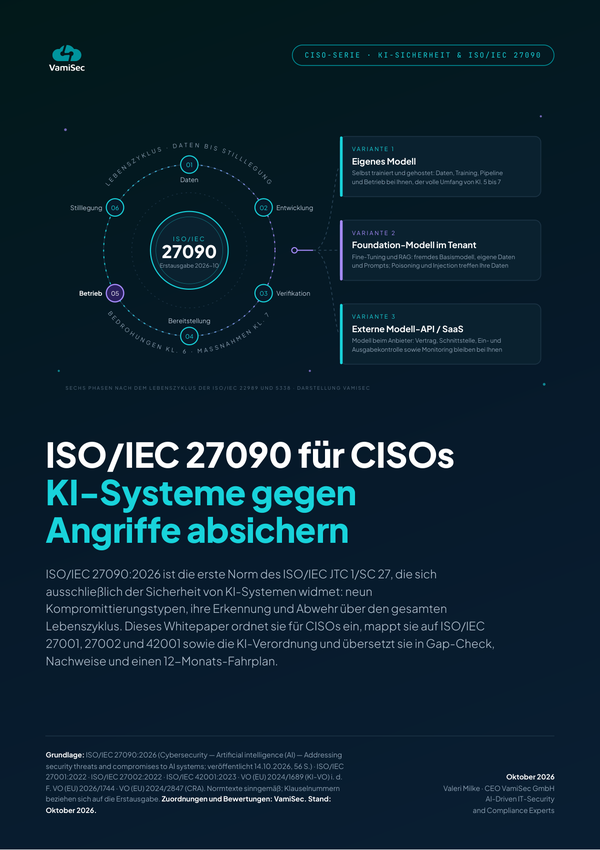
ISO/IEC 27090 for CISOs — the working basis for the combined project
Our white paper on ISO/IEC 27090 provides the building blocks you need for the combined approach: threat profiles for the risk assessment, SoA notes and a mapping matrix for the measures plan, audit questions and an evidence matrix for the internal audit and management review — with source references and a clear separation between standard, regulation and VamiSec recommendation.
- Management summary and key statements for board papers — guidance, not a certificate; status, structure and the state of play in DACH
- Nine threat profiles with detection and defence, life cycle mapping and a table of real-world cases 2023–2026
- Mapping matrix to ISO/IEC 27002, ISO/IEC 42001, the EU AI Act, NIST, MITRE ATLAS, OWASP and ETSI
- Self-assessment grid, SoA notes, audit questions for corporate internal audit and ISMS audits, evidence matrix, metrics and a 12-month timeline
What the white paper provides for the combined approach
Threat profiles for phase 1
Each of the nine compromise types with description, consequences, detection and defence in our own words, mapped to life cycle phase and asset — as a threat catalogue for the risk assessment.
SoA notes and mapping matrix for phase 2
Notes on how to record ISO/IEC 27090 as a source in the Statement of Applicability, and a matrix mapping the 27090 control families to ISO/IEC 27002, ISO/IEC 42001, the EU AI Act, NIST, MITRE ATLAS, OWASP and ETSI.
Timeline for phase 3
A 12-month timeline, starting with the first 100 days, that fits into the roadmap of the combined project.
Audit questions and evidence matrix for phases 7 and 8
Audit questions for corporate internal audit and ISMS audits, an evidence matrix and metrics — directly usable for the internal audit and the management review.
In depth
ISO/IEC 27090 in detail: nine threats, life cycle, navigator
This page shows the combined approach. What ISO/IEC 27090 describes in detail — status and structure, the nine compromise types with detection and defence, and the mapping to the AI life cycle — is explained in our deep dive on the standard, complemented by three sourcing scenarios, from your own model to an external API, and a reference navigator covering the EU AI Act, NIST, MITRE ATLAS and OWASP.
ISO/IEC 27090:2026published 14 October 2026, 56 pages
9compromise types in clause 6
3annexes: life cycle, AI variants, federated learning
- Status, development and structure of the standard, with all stages of standardisation
- Threats per life cycle phase with audit questions and evidence
- Reference navigator with mapping to the EU AI Act, NIST, MITRE ATLAS and OWASP
- ISO 27090 gap check specifically for AI systems
ISO/IEC 27090 is guidance; ISO/IEC 27001 and ISO/IEC 42001 are certifiable.
Glossary
Glossary: terms for the combined approach
27 terms from ISO/IEC 27001, ISO/IEC 27090 and the certification process, briefly defined in our own words; the technical term in the other language is given as an alternative.
27 of 27 terms
- ISMSInformationssicherheits-Managementsystem
- Information security management system based on ISO/IEC 27001: the rules, processes, roles and evidence an organisation uses to manage information security on a risk basis and improve it continually. In the combined model, the ISMS also covers AI security.
- Statement of ApplicabilitySoA, Erklärung zur Anwendbarkeit
- Document required by ISO/IEC 27001 that lists all necessary controls, justifies their inclusion, states their implementation status and justifies any exclusion of Annex A controls. This is where the AI controls derived from ISO/IEC 27090 are recorded.
- Annex AAnhang A
- Reference catalogue in ISO/IEC 27001:2022 with 93 controls in four themes — organisational, people, physical and technological. It is not exhaustive: additional controls from other sources such as ISO/IEC 27090 are expressly permitted.
- Risk assessmentRisikobeurteilung
- Identification, analysis and evaluation of information security risks against defined criteria. In the combined model, the nine ISO/IEC 27090 compromise types are assessed as threats for each AI system.
- Risk treatment planRisikobehandlungsplan
- Plan setting out how assessed risks will be treated — with measures, responsibilities and deadlines; the remaining residual risks are accepted by the risk owners.
- Gap analysisGap-Analyse
- Comparison of the current state with the target requirements. The combined gap analysis also assesses every ISO/IEC 27001 requirement for its AI-specific extension and adds the AI-specific content of ISO/IEC 27090.
- ScopeGeltungsbereich
- Boundaries and applicability of the ISMS. For a certificate to say anything about AI, the relevant AI systems, data pipelines and model interfaces must fall within it.
- AI systemKI-System
- Technical system that uses models to generate outputs such as predictions, content or decisions from inputs. ISO/IEC 27090 regards AI systems as integrated software components with all the classic vulnerabilities plus new threats from data, manipulated inputs and actions by AI models.
- AI inventoryAI-BOM, KI-Inventar
- Register of all AI systems with their models, datasets, prompts, interfaces, tool permissions and owners; the AI bill of materials (AI-BOM) adds the versions of models, datasets and libraries. Foundation of the AI governance programme in ISO/IEC 27090.
- Compromise typeType of compromise, Kompromittierungstyp
- Category of AI-specific attack in clause 6 of ISO/IEC 27090 — nine types, each with a description, consequences, detection and mitigation.
- Data PoisoningDatenvergiftung
- Manipulation of training, fine-tuning or retrieval data to change model behaviour in a targeted or untargeted way. Countermeasures are provenance records, integrity checks and data limitation.
- EvasionAdversarial attack, Umgehungsangriff
- Deliberately altered inputs that lead a model to produce incorrect results; the changes may be imperceptible to humans.
- Model ExfiltrationModel extraction, Modelldiebstahl
- Replicating or exfiltrating a model — including via legitimate queries. Countermeasures are throttling, rate limits, logging and monitoring of query patterns.
- Membership InferenceMitgliedschaftsinferenz
- Inferring whether a specific data record was used to train a model — a risk to confidentiality and data protection.
- Model InversionModellinversion
- Reconstructing features of the training data from a model’s outputs.
- Direct Model PoisoningDirekte Modellvergiftung
- Direct manipulation of a model or its artefacts during development or operation; countermeasures are protected development environments and signatures and checksums for model artefacts.
- Sensitive Model OutputSensible Modellausgabe
- Outputs that disclose information requiring protection — for example from training data or earlier inputs.
- Prompt InjectionPrompt-Injektion
- Content that manipulates a model’s behaviour as or within a prompt — directly, or indirectly via documents, web pages or emails that the model processes.
- Output injectionOutput containing injection attacks
- Model outputs that act as an attack in downstream systems, for example as code, a query or a link. Outputs are therefore always treated as untrusted, encoded and validated.
- Zero TrustZero trust principles
- Principle of never implicitly trusting any access. ISO/IEC 27090 applies it to training data, model access including RAG, the boundaries of AI applications, agent actions and continuous monitoring.
- Red TeamingAdversarial testing, Angriffssimulation
- Targeted attack simulation against AI systems to uncover vulnerabilities and test the effectiveness of controls — in the combined model, a key piece of evidence of effectiveness for audit and certification.
- ProvenanceProvenienz, Datenherkunft
- Verifiable origin and processing history of data and AI systems — a prerequisite for being able to contain poisoning and manipulation.
- Internal auditInternes Audit
- Planned, objective review of whether the ISMS meets the organisation’s own requirements and ISO/IEC 27001 and is effective; in the combined model, with AI-focused samples.
- Management reviewManagementbewertung
- Review of the ISMS by top management at planned intervals, with defined inputs and documented decisions on improvements and any need for change.
- NonconformityNichtkonformität
- Non-fulfilment of a requirement; it calls for correction, root cause analysis, corrective action and a review of its effectiveness.
- Stage 1 and stage 2 auditsStufe-1- und Stufe-2-Audit
- Two-stage initial certification: stage 1 reviews the documentation and certification readiness, stage 2 the effectiveness on site. The certificate is then valid for three years, with surveillance audits in the following years and a recertification.
- AIMSKI-Managementsystem
- AI management system based on ISO/IEC 42001 — certifiable and optionally combinable with the ISMS when the management of AI as a whole is to be demonstrated.
FAQ
Frequently asked questions on implementing ISO 27001 and ISO 27090 together
Short answers to typical questions from executive management, the CISO office, AI engineering, compliance and internal audit.
Yes — and it is the obvious way to go. ISO/IEC 27090 is guidance without a management system of its own; it builds on the practice of ISO/IEC 27001 and 27002 and adds nine AI-specific compromise types, together with detection and mitigation. In the combined approach, these types feed into the ISMS risk assessment and the countermeasures into the Statement of Applicability; internal audit, management review and the certification audit examine them too.
No. ISO/IEC 27090 sets no requirements for a management system and is not certifiable. For governance, you use the ISMS based on ISO/IEC 27001 — with a risk methodology, a risk register, a Statement of Applicability and document control. If you also want to demonstrate the management of AI as a whole, you can integrate an AI management system based on ISO/IEC 42001; both standards share the same harmonised structure.
No. ISO/IEC 27090 is guidance; there is neither a certificate nor an audit “against 27090”. It is the ISMS that is certified, against ISO/IEC 27001 — with a scope that includes the AI systems and a Statement of Applicability containing the controls derived from ISO/IEC 27090. Claims such as “ISO 27090 certified” or “27090 compliant” are misleading.
Not necessarily one after the other — but ISO/IEC 27090 needs a framework in which risks are assessed, measures are managed and evidence is maintained. If you have no ISMS, it is best to build the ISMS and AI profile in a single project; this avoids the duplicated effort of two separate initiatives. If you already have an ISMS, the integration is a planned change that fits into the ongoing certification cycle.
ISO/IEC 27001 requires the selected controls to be compared with Annex A, but allows controls from any source — Annex A is not exhaustive. The mitigation guidance in ISO/IEC 27090 is recorded either as an AI-specific extension of existing controls, such as extending logging to inputs, outputs and tool calls, or as additional controls with their own identifier, source, justification and status. Each control appears exactly once in the Statement of Applicability and is multi-mapped.
In a single pass instead of two: scoping with management, an AI inventory across all sourcing channels including shadow AI, a review of the ISMS documents, interviews with the ISMS team, operations, ML engineering, development, procurement, data protection and business units, technical sampling and a dual maturity rating per requirement — for the ISMS requirement and its AI-specific extension. The result is a prioritised gap register, a heat map and a management summary. The combined gap check on this page makes it easier to get started.
That depends on your starting point, the number and type of AI systems and the resources available. Orientation values from projects: with a certified ISMS and AI use only, about three to six months; with your own models or fine-tuning, about six to nine months; for a combined build from scratch to certification readiness, about nine to twelve months. Before the certification audit, you need operational evidence and at least one cycle of internal audit and management review.
At process level, the existing ISMS processes take on the AI cases — inventory, risk, change, supplier, incident and vulnerability management — instead of separate AI processes springing up alongside them. At data level, registers, controls, evidence and audit findings are transferred from spreadsheets, wikis or legacy tools into a shared data model with multi-mapping — with data cleansing, a trial run, sign-off and the evidence history preserved.
Executive management needs a decision briefing on accountability and risk appetite; the ISMS team needs the integration methodology; ML engineering and development need hands-on training on data poisoning, model theft, prompt injection and output handling; operations needs training in detecting misuse; procurement, data protection and legal need training on their respective interfaces; internal auditors need to learn how to audit AI controls; and all employees need awareness training on the secure use of generative AI. ISO/IEC 27001 requires competence and awareness for this — along with evidence.
Whether the AI controls in the Statement of Applicability are implemented and effective: completeness of the AI inventory, up-to-date risk assessments per system, access rights to models and data, logs of inputs, outputs and tool calls, change records for model switches, red team findings that have been addressed and model providers that have been assessed. The audit criteria are ISO/IEC 27001 and the organisation’s own requirements; ISO/IEC 27090 is not an audit criterion. Auditors must be objective and impartial — they do not audit their own implementation work.
Everything ISO/IEC 27001 requires for the management review — plus an AI status update: new AI systems and shadow AI findings, AI risks and incidents, metrics such as inventory coverage and logging rate, results of internal audit and red teaming, regulatory developments and changes at suppliers. What matters are the documented decisions: risk appetite, resources, scope and, where applicable, the go-ahead for the certification audit.
Yes, if the AI systems are within the scope. The auditor audits the ISMS against ISO/IEC 27001 — and therefore also the AI risks in the risk assessment and the AI controls in the Statement of Applicability: in the stage 1 audit on the basis of the documentation, and in the stage 2 audit for effectiveness. There is no separate audit against ISO/IEC 27090; the certificate remains an ISO/IEC 27001 certificate.
ISO/IEC 42001 is the certifiable standard for AI management systems and goes beyond security — covering, for example, impact assessment, responsibilities and data quality. ISO/IEC 27090 refers to it for implementing an AI governance programme and cites two of its controls, on development documentation and on operation and monitoring. In the combined model, ISO/IEC 42001 is an option: organisations that want to demonstrate the management of AI as a whole integrate it and have both systems audited together. On 22 October 2026, no DAkkS-accredited certification body for ISO/IEC 42001 was listed in Germany.
It helps with implementation but does not replace a conformity assessment. For high-risk AI, the EU AI Act requires, where appropriate, measures against data poisoning, model poisoning, evasion attacks and confidentiality attacks — threats covered by the ISO/IEC 27090 compromise types. Neither ISO/IEC 27090 nor an ISO 27001 certificate confers a presumption of conformity; the harmonised standard intended for this purpose, prEN 18282, is still at the draft stage. The high-risk obligations apply to Annex III systems from 2 December 2027 and to AI in products under Annex I from 2 August 2028.
Yes. ISO/IEC 27090 is aimed at organisations that develop or use AI systems. If you only use AI, the focus shifts: supplier assessment and contracts with model providers, rules on which data may go into which services, protection against data leakage, access control, logging and — for generative AI — protection against prompt injection and insecure output handling.
No. ISO/IEC 27090:2026 is only available in English; DIN, Austrian Standards and SNV distribute the original English ISO edition. ISO/IEC 27001, by contrast, is available in German as DIN EN ISO/IEC 27001:2024-01. For the combined project, we recommend a bilingual glossary so that the risk assessment, Statement of Applicability and training all use the same terms.
Standards & Sources
The content on this page is based on the following publicly available guides and studies.
ISO/IEC 27001:2022 — Information security, cybersecurity and privacy protection — Information security management systems — Requirements
Requirements standard for the ISMS: clauses 4 to 10 and Annex A with 93 controls; the basis for risk assessment, the Statement of Applicability, internal audit and management review.
ISO/IEC 27001:2022/Amd 1:2024 — Climate action changes
Adds consideration of climate-related issues to context and interested parties; no new controls.
DIN EN ISO/IEC 27001:2024-01 — Information security management systems — Requirements (German edition)
German edition of ISO/IEC 27001:2022; amended by DIN EN ISO/IEC 27001/A1:2024-11.
ISO/IEC 27002:2022 — Information security controls
Implementation guidance for the 93 controls; ISO/IEC 27090 refers to its clauses 5 to 8 and to logging, monitoring and secure system architecture.
ISO/IEC 27090:2026 — Cybersecurity — Artificial intelligence (AI) — Addressing security threats and compromises to AI systems
Guidance standard published on 14 October 2026, 56 pages, English only: nine compromise types with detection and mitigation; not certifiable.
ISO/IEC 27000:2026 — Overview and vocabulary of the 27000 family
Sixth edition of the vocabulary standard, dated 3 July 2026; source of the definitions of confidentiality, integrity and availability used in ISO/IEC 27090.
ISO/IEC 27003:2017 — Information security management systems — Guidance
Guidance on implementing the requirements of ISO/IEC 27001; a revision is currently at the draft stage.
ISO/IEC 27005:2022 — Guidance on managing information security risks
Guidance on information security risk management — the methodological basis for assessing the AI compromise types.
ISO/IEC 27006-1:2024 — Requirements for bodies providing audit and certification of information security management systems — Part 1: General
Together with ISO/IEC 17021-1, sets out the requirements for certification bodies, including the audit process and audit duration.
ISO/IEC 27007:2020 — Guidelines for information security management systems auditing
Guidance on ISMS audits, supplementing ISO 19011 — the basis for the internal audit with AI-focused samples.
ISO 19011:2026 — Guidelines for auditing management systems
Guidance on audit programmes, conducting audits and auditor competence; fourth edition, replacing ISO 19011:2018.
ISO/IEC 42001:2023 — Artificial intelligence — Management system
Certifiable standard for AI management systems; ISO/IEC 27090 refers to it for the AI governance programme and cites two of its Annex A controls.
ISO/IEC 22989:2022 and ISO/IEC 5338:2023 — AI terminology and AI life cycle processes
ISO/IEC 22989 is a normative reference of ISO/IEC 27090; together, both standards form the basis of the life cycle to which ISO/IEC 27090 assigns attacks.
ISO/IEC 23894:2023 — Artificial intelligence — Guidance on risk management
Guidance on AI risk management — useful for the methodology used to assess AI risks within the ISMS.
Regulation (EU) 2024/1689 (EU AI Act)
Requirements for high-risk AI, including accuracy, robustness and cybersecurity; ISO/IEC 27090 does not confer a presumption of conformity.
Regulation (EU) 2026/1744 (Digital Omnibus on the EU AI Act)
Fixed application dates for the high-risk obligations: 2 December 2027 for Annex III, 2 August 2028 for Annex I.
Database of accredited bodies
As of 22 October 2026: numerous accredited certification bodies for ISO/IEC 27001, none for ISO/IEC 42001.
ISO 27001 and ISO 27090 in one project — no duplicated effort
We start with the combined gap analysis and deliver the measures plan, roadmap and implementation as a single provider — through migration and target-group-specific training to the management review and, if you wish, certification readiness; the internal audit is carried out by a team independent of the implementation.