
Standards & management systems
From ISO 27001 and BSI IT-Grundschutz++ to C5 and TISAX — the standards and frameworks that make security certifiable.
ISO 27001, BSI IT-Grundschutz, NIS2, DORA, CRA and the EU AI Act: how to bring management systems, risk management and regulatory obligations into one audit-ready, integrated structure — without duplicating work.
Good governance is not paperwork — it is the operating system of your security: an integrated management system translates standards and regulation into clear responsibilities, measurable controls and evidence that holds up in an audit. These knowledge pages bundle our methodology on standards, EU regulation and day-to-day operations — from gap analysis and certification to vCISO and GRC as a Service.
Each topic leads to a dedicated knowledge page with deep dives, practical guides and the matching services.
From ISO 27001 and BSI IT-Grundschutz++ to C5 and TISAX — the standards and frameworks that make security certifiable.
NIS2, DORA, CRA, EU AI Act, KRITIS and MDR — obligations, deadlines and the path to demonstrable compliance.
Keeping compliance alive: external CISO and ISO roles, audits, training and automated evidence.
Third-Party-Risk-Management for your IT supply chain: from the regulatory obligations under NIS2 and DORA to the assessment of cloud providers (CSA CAIQ/CCM/STAR) and AI providers (CSA AI Controls Matrix v1.1).
In-depth knowledge pages on the topics that currently raise the most questions — with verified sources and concrete measures.
How to combine ISO/IEC 27001 and ISO/IEC 27090 into one ISMS: nine phases from the combined gap analysis through the measures plan, roadmap, implementation, migration and training to the internal audit, management review and optional certification audit — with a mapping navigator and gap check.
View knowledge pageOn 18 December 2025, BaFin published its non-binding guidance on ICT risks in the use of AI at financial entities. It is designed to help implement DORA’s requirements on ICT risk management and ICT third-party risk management for AI systems as well — along the entire AI lifecycle and with a case study on an LLM-based AI assistant. Throughout, this page separates what DORA and the RTS require, what BaFin describes as proven practice and what we recommend on top.
View knowledge pageWith EBA/GL/2026/09, the EBA replaces its 2019 Outsourcing Guidelines with a framework for the entire third-party risk arising from non-ICT services — focused on critical or important functions, a register modelled on the DORA register of information and a two-year transitional period. This page puts the Guidelines in context, draws the line to DORA and makes the requirements tangible with a Scope Navigator, a Register Builder and a Readiness Radar.
View knowledge pageThe NIST standard that turns regulations, standards, and frameworks from PDF into data: catalogs, profiles, mappings, and evidence — machine-readable, versionable, automatable.
View knowledge pageHow to systematically assess and manage the security of your IT, cloud, and AI supply chain – from supplier selection through to continuous monitoring.
View knowledge pageWith ISO/IEC 42001:2023, an international, certifiable standard for an Artificial Intelligence Management System (AIMS) exists for the first time. What the standard requires, what the documentation landscape looks like — and how you can efficiently integrate an AIMS into your existing ISMS.
View knowledge pageFrom August 2, 2026, the transparency obligations of Art. 50 AI Act apply to interactive AI systems, generative content, emotion recognition and deepfakes. The European Commission's draft guidelines of May 8, 2026 specify how providers and deployers are expected to implement these obligations.
View knowledge pageRisk management for AI the NIST way: the AI Risk Management Framework and the new Cyber AI Profile (NIST IR 8596) give organizations a structured, prioritized framework for securing AI systems, using AI for defense and thwarting AI-enabled attacks.
View knowledge pageWhat the standard requires, how the path to certification works and why an ISMS based on ISO/IEC 27001 holds up as evidence towards customers, partners and supervisory authorities.
View knowledge pageHow the BSI standards, the IT-Grundschutz Compendium and the safeguarding approaches interact – and what the ongoing modernisation towards Grundschutz++ means for your ISMS.
View knowledge pageHow to turn the handling of personal data into a certifiable management system – and what the independently certifiable revision ISO/IEC 27701:2025 means for ISMS operators and data processors.
View knowledge pageHow the automotive industry's assessment and exchange mechanism works: from governance by the ENX Association and the VDA ISA catalogue to assessment levels, labels and three years of validity.
View knowledge pageHow to merge ISO/IEC 27001, 27701 and 42001 as well as ISO 9001 and ISO 22301 into a single management system based on the Harmonized Structure – from document control to the combined certification audit.
View knowledge pageWhat Directive (EU) 2022/2555 requires of essential and important entities – and how Germany has implemented it in the BSIG through the NIS2UmsuCG.
View knowledge pageWhat Regulation (EU) 2022/2554 requires of financial entities and their ICT service providers – the five pillars, TLPT, the register of information and the oversight of critical third-party providers at a glance.
View knowledge pageWhat Regulation (EU) 2024/2847 requires from manufacturers, importers and distributors of products with digital elements – from security by design and SBOM to the reporting deadlines starting 11 September 2026.
View knowledge pageA deep dive into ENISA's free implementation guide of 30 July 2026: 22 principles as one-page playbooks with checklists, minimum evidence and release gates – including machine-processable attestation and an indicative CRA mapping.
View knowledge pageRisk classes, deadlines after the Digital Omnibus, roles and penalties: what Regulation (EU) 2024/1689 means for businesses – as of July 2026.
View knowledge pageWhat operators of critical facilities must implement under the amended BSI Act and the KRITIS-Dachgesetz – from thresholds and attack detection to verification obligations.
View knowledge pageWhich cybersecurity requirements the MDR imposes on manufacturers – and how MDCG 2019-16, IEC 81001-5-1 and the AI Act set the framework for the entire product life cycle.
View knowledge pageHow to build an AI governance program in a structured way – from the AI inventory through risk classification and AI literacy to lifecycle controls along the AI Act, ISO/IEC 42001, the NIST AI RMF and BSI AIC4.
View knowledge pageWhat distinguishes a CISO from an ISB, what requirements ISO 27001 and NIS2 place on assigning the role – and when filling it externally as a vCISO or vISB makes sense.
View knowledge pageHow managed GRC models organise the ongoing operation of ISMS, risk management and compliance evidence – from the service components and meaningful metrics to the limits of transferring responsibility.
View knowledge pageHow ISO certifications actually work: from audit typology through Stage 1 and Stage 2 to surveillance audits, recertification and the accreditation chain behind it all.
View knowledge pageHow to answer the growing volume of security questionnaires from customer assessments and third-party risk management in a structured way – and request them purposefully – using standard catalogs, answer libraries, AI-assisted answer generation and a trust center.
View knowledge pageHow to provide certificates, attestations, subprocessor lists and pentest summaries in a structured way – publicly where possible, NDA-protected where necessary.
View knowledge pageEach whitepaper has its own page with details and a direct download form.
 DORATLPT per DORA: How to Truly Protect Your Crown JewelsGo to whitepaper page
 BSI Grundschutz++BSI Grundschutz++ Methodology & ISO 27001 Upgrade PathGo to whitepaper page
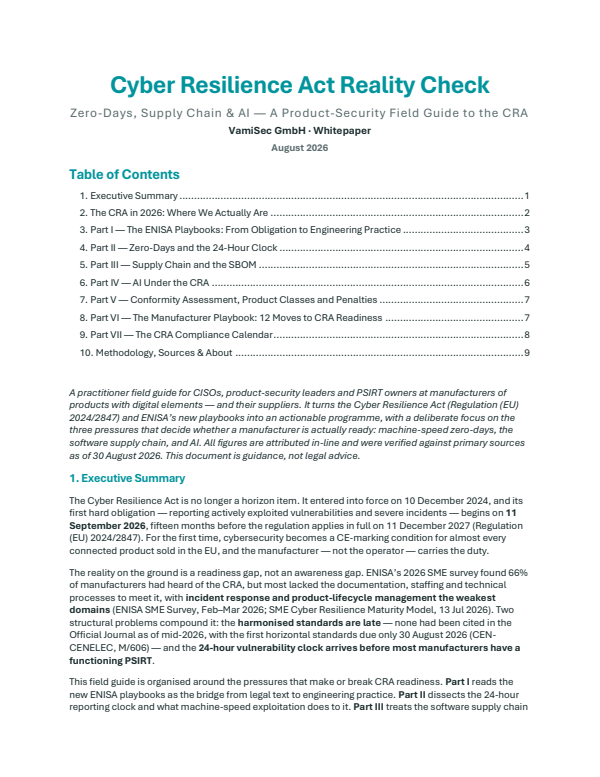 EU CRACRA Reality Check — Zero-Days, Supply Chain & AIGo to whitepaper page
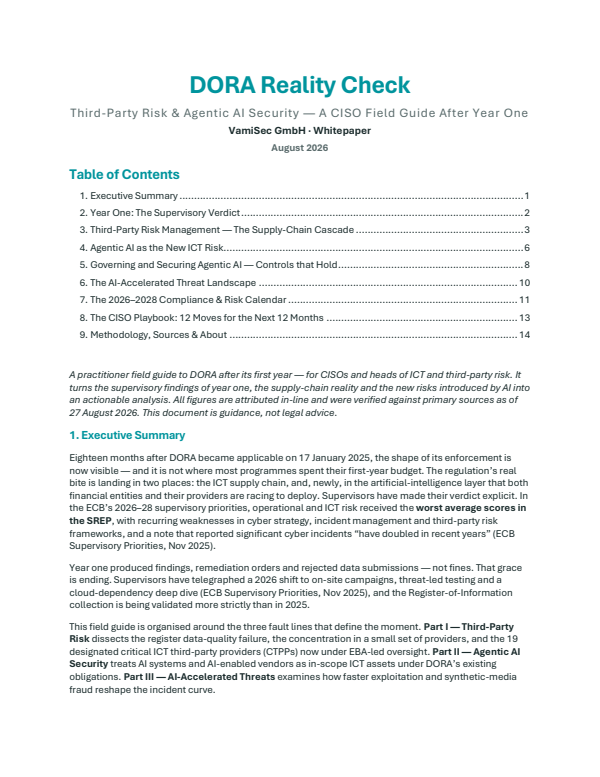 DORADORA Reality Check — Third-Party Risk & Agentic AIGo to whitepaper page
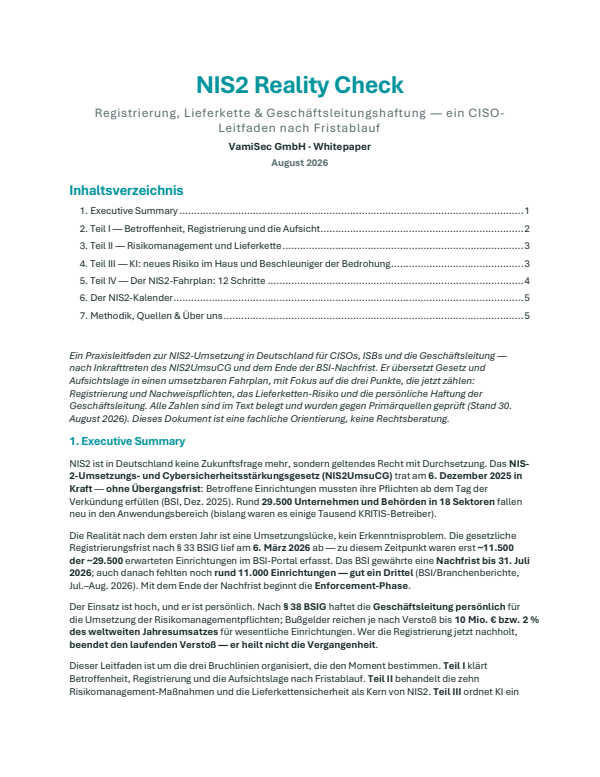 NIS2NIS2 Reality Check — Registration, Supply Chain & LiabilityGo to whitepaper page
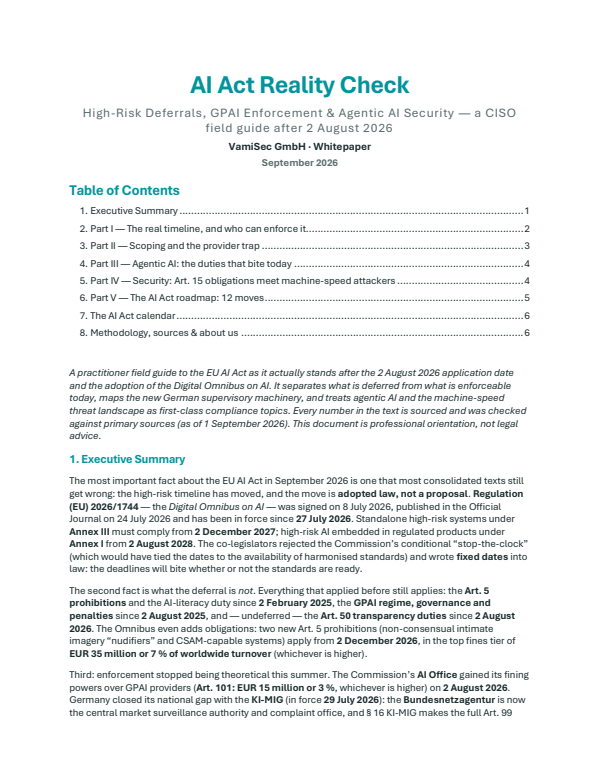 EU AI ActAI Act Reality Check — High-Risk Deadlines, GPAI & Agentic AIGo to whitepaper page
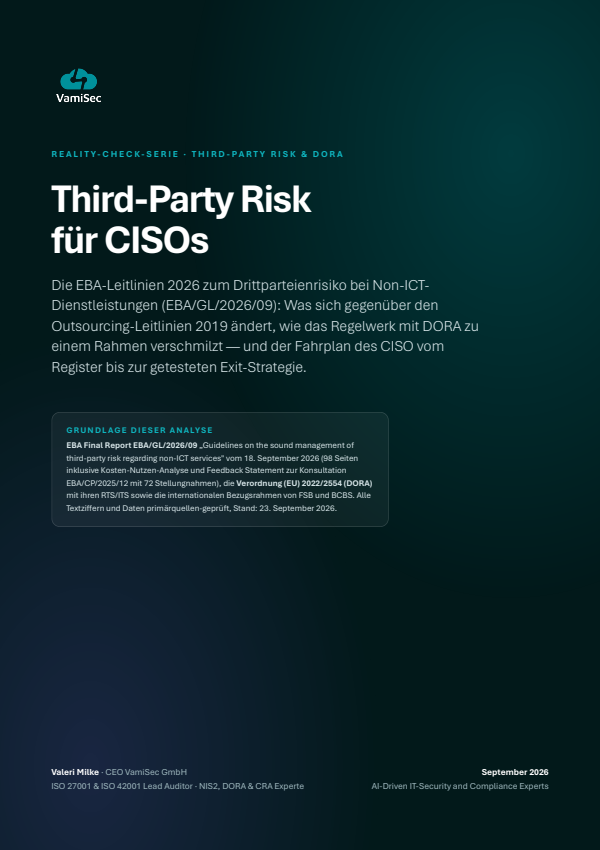 EBA / DORAThird-Party Risk für CISOs — EBA Non-ICT Guidelines 2026Go to whitepaper page
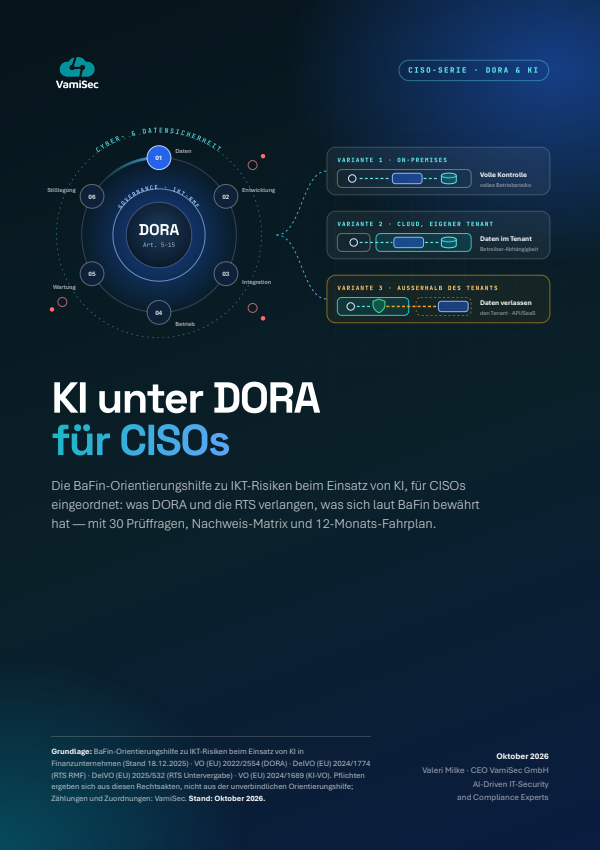 BaFin / DORA / AIKI unter DORA für CISOs — BaFin guidance on ICT risksGo to whitepaper page
In an initial consultation, we show you how your standards and regulatory requirements converge into one integrated, audit-ready management system.