
Goals
- Cybersecurity and consumer protection
- Unified reporting obligations at federal and EU level
- Risk management and supply chain security
- Preventing attacks through technical measures such as MFA
From applicability analysis through governance and technology to audit-ready implementation – efficient, integrated, and regulatory compliant. Per the German Federal Government's decision, the NIS2 directive came into force on December 6, 2025.
The EU NIS2 directive ensures responsible cybersecurity, protecting companies and consumers from cyberattack risks without hindering digital innovation and competitiveness.
With the NIS2 directive, the EU is tightening cybersecurity requirements for companies and organizations in critical and important sectors. For affected companies, this means: expanded obligations, stricter liability, and higher fines.
Cyber attacks on critical infrastructure hit supply, the economy, and trust alike. NIS2 establishes a unified European framework to address these risks in a binding way.
The NIS2 directive defines ten mandatory minimum measures that every affected company must demonstrably implement.
ENISA breaks every Art. 21 NIS2 measure down into concrete implementation advice, evidence examples and standard mappings. We have distilled the guidance for you — including a readiness check.
NIS2 covers entities from ten sectors of particular societal and economic importance — across industries, from energy to public administration.
NIS2 mandates a binding three-stage reporting corridor — from early warning to final report. The deadlines start when the incident becomes known.
Initial notification to BSI/authority — nature and presumed cause, affected services, and cross-border impact.
Detailed assessment — severity, impact, containment measures taken, and indicators of compromise (IoCs).
Complete analysis — root cause, course of events, final impact, and protective and improvement measures taken.
With the NIS2 gap analysis, we identify existing gaps between your ISMS and the EU NIS2 directive requirements. We examine all relevant areas, from risk management to incident reporting and supply chain documentation obligations. We also consider ISO 27001 and AI Act requirements to leverage synergies.
Building clear responsibilities and decision-making pathways. NIS2 requires management accountability, training, and personal liability – we support you in building a robust NIS2 governance structure that can be combined with ISO 27001 and AI Act requirements.
Integrating NIS2 requirements into your existing ISMS per ISO 27001 and KIMS per ISO 42001 – with focus on efficiency and reuse of existing structures (asset, risk, supplier management, policies, awareness, audits). This creates an integrated approach that also considers the AI Act.
Implementing proven security measures from ISO 27001 combined with NIS2-specific controls, training, and reporting obligations. These synergies facilitate the parallel fulfillment of AI Act and NIS2 requirements.
Establishing an integrated, audited, and auditable management system for continuous improvement and sustainable NIS2 readiness.
Rather than treating NIS2 and EU AI Act in isolation, we pursue an integrated approach that unifies governance, risk, audit, and reporting processes. This creates scalable compliance structures that meet regulatory requirements while remaining operationally viable.
We identify existing gaps between your ISMS and the EU NIS2 directive requirements, examining all relevant areas including risk management, incident reporting, and supply chain documentation.
Building clear responsibilities and decision-making pathways. NIS2 requires management accountability, training, and personal liability.
Integrating NIS2 requirements into your existing ISMS per ISO 27001 and KIMS per ISO 42001, with focus on efficiency and reuse of existing structures.
Implementing proven measures from ISO 27001 combined with NIS2-specific controls, training, and reporting obligations.
Establishing an integrated, audited, and auditable management system for continuous improvement and sustainable NIS2 readiness.
Overview of NIS2 requirements mapped to ISO 27001 controls and the integrated management system.
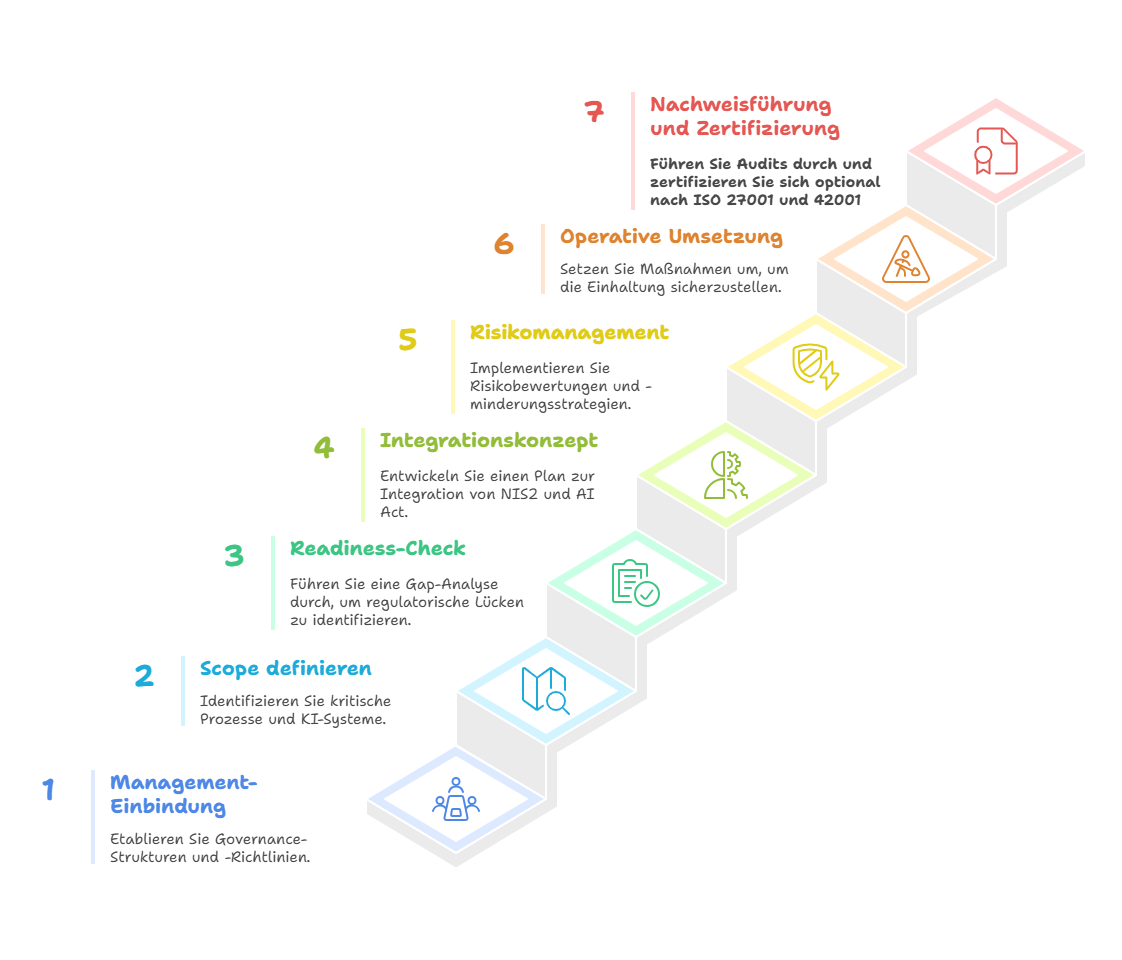
Deadlines and milestones for NIS2, AI Act, CRA, and ISO 27001 at a glance.
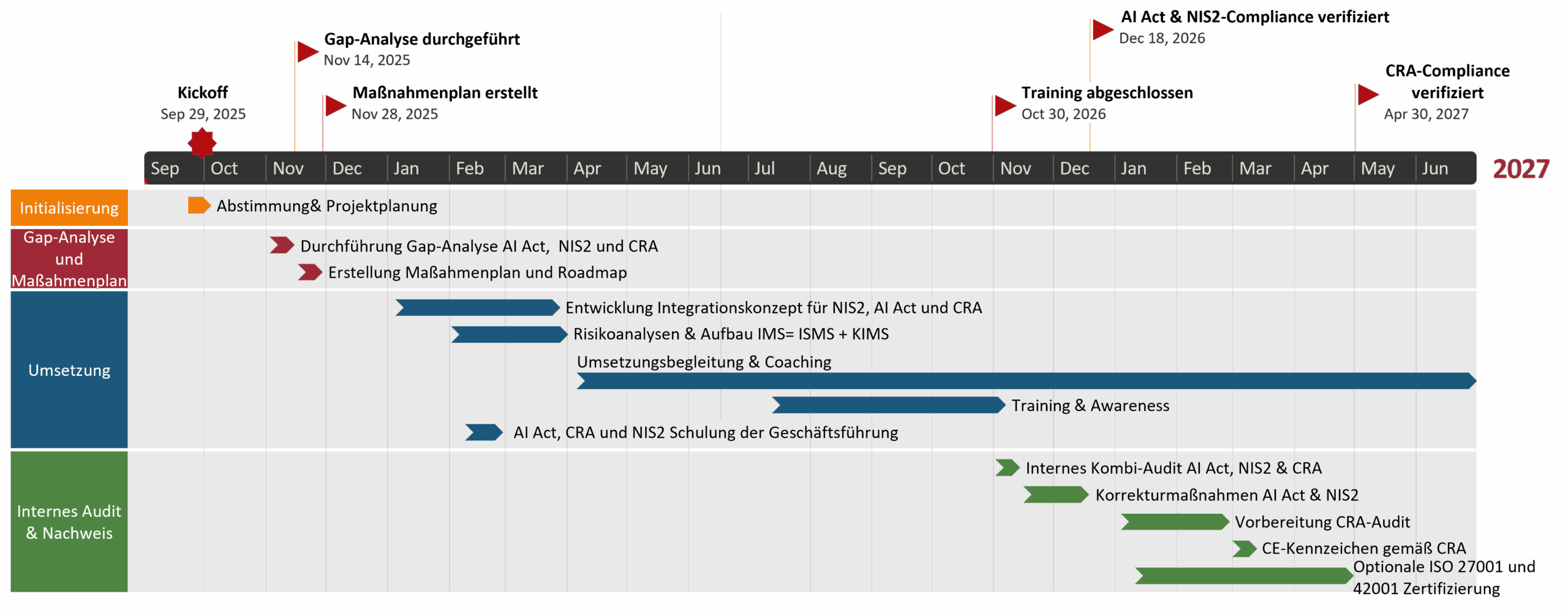
Harmonized fines under NIS2 (Art. 34)
The NIS2 directive introduces a unified European fines regime that significantly tightens previous national practice. Entities that fail to meet their statutory obligations face substantial financial sanctions.
Entities from the sectors in Annex I (e.g. energy, transport, health, digital infrastructure) face the highest fines:
Whichever is higher applies.
Entities from the Annex II sectors also face substantial sanctions:
Whichever is higher applies.
This split derives from Art. 3 in conjunction with Annexes I and II of the NIS2 directive. In Germany, implementation is via the NIS2UmsuCG (§ 60).
NIS2 directly obligates management: governing bodies must approve risk management measures, oversee their implementation, and participate in regular cybersecurity training. Violations can result in fines of up to EUR 10 million or 2% of global annual revenue.
From political agreement to national implementation — the key milestones of the NIS2 directive.
EU Council and Parliament agree on the final NIS2 text.
NIS2 officially enters into force; the 21-month period for national implementation begins.
Germany’s NIS2 implementation act (NIS2UmsuCG) is approved by the Cabinet.
The Bundestag adopts the implementation act including obligations and supervisory structure.
NIS2 obligations apply bindingly in Germany to all covered entities.
Four areas where organizations typically have the biggest NIS2 gaps — and what we see most often in the field.
NIS2 obligates executive management to clear responsibility, decision-making capability, and demonstrable steering — with personal liability risks.
Complete, traceable risk register and comprehensive technical safeguards along ISO/IEC 27001 and NIS2 minimum requirements.
Assessment and protection of service providers, cloud and IT vendors with contractual requirements and continuous monitoring.
Meeting the 24h / 72h / 1-month deadlines and operating BCP/DRP structures with regular exercises.
A NIS2 control is only "done" once it has passed all four stages — documented, operational, demonstrable, and effective.
Documented, versioned, approved by management, and communicated to the workforce.
Operationally implemented, mapped in systems, standardized, and repeatable.
Evidence generated, versioned, centrally stored, and archived in an audit-proof manner.
Effectiveness measured via KPIs — deviations automatically trigger escalation.
Contact us for an individual consultation and security solution tailored to your requirements.
Valeri Milke, CEO of VamiSec
"Only when all instruments are well-tuned does your organization become secure and compliant."