Implement AI Act Compliance Efficiently – With Integrated ISMS & KIMS per ISO 27001 and ISO 42001
Efficient, secure, and legally compliant implementation of the new AI regulation. By the deadline of August 1, 2026.
EU AI Act
The EU AI Act is the first comprehensive law regulating AI in the EU. It aims to ensure the safe and transparent use of AI, minimize risks, and promote innovation. The law sets binding rules for the development, deployment, and use of AI systems based on their risk potential. The goal is to protect fundamental rights, safety, and ethical standards in the handling of AI.
For companies, the AI Act means: New obligations, clear documentation requirements, and high penalties for non-compliance. VamiSec supports you with legally compliant and efficient implementation.
4 Risk Levels of the EU AI Act
The AI Act classifies AI systems by their risk potential. The higher the risk, the stricter the requirements.
Prohibited AI systems (e.g., social scoring, manipulative techniques)
Strict requirements for documentation, risk management, and conformity (Art. 43)
Transparency obligations (e.g., chatbots, deepfakes, generative AI)
No additional obligations – voluntary codes of conduct recommended
Your AI Act Compliance at a Glance
AI Act Gap Analysis
Identifying existing gaps between your ISMS and EU AI Act requirements – from risk classification to data management and documentation obligations.
Governance Structure & AI Officer
Building clear responsibilities and decision-making pathways. On request, we provide an external vAI Officer as an independent point of contact for oversight and compliance.
Synergistic Integration Concept
Integrating the AI Management System (AIMS) into your existing ISMS – with focus on efficiency and reuse of existing structures (asset, risk, supplier management, policies, awareness, audits).
Technology & Organization in Harmony
Implementing proven security measures from ISO 27001 & ISO 42001 combined with AI Act-specific controls, training, and registry management.
Operations & Improvement
Establishing an integrated, audited, and auditable management system for continuous improvement and sustainable AI Act readiness.
AI Act & ISO 42001 Gap Analysis
After the assessment, we create a consolidated roadmap to AI Act readiness – from gap analysis to optional ISO 27001 and ISO 42001 certification.
Integrated Management System: ISMS + KIMS
ISO 27001 (ISMS) and ISO 42001 (AIMS) together form the foundation for sustainable AI Act and NIS2 compliance.
Conformity Assessment under the EU AI Act
Proof of safety, transparency, and legal conformity of AI systems. Comparable to CE marking — a mandatory certification for high-risk AI.
Technical Documentation
Complete documentation of the AI system, including training data, algorithms, and risk assessments.
Data & Quality Management
Evidence of the origin, completeness, and quality of the data used.
Risk Management Processes
Systematic analysis and treatment of risks such as bias, discrimination, erroneous decisions, or manipulation.
Cybersecurity & Robustness
Protective measures against attacks on AI models and data integrity.
Transparency & Traceability
Ensuring that AI decisions are explainable (Explainable AI).
Continuous Monitoring
Processes for tracking AI performance in operation and adapting to risks or changes.
Integrated into Your Existing Compliance Structures
Our Synergistic Approach – in 5 Steps
AI Act Gap Analysis
Identifying existing gaps between your ISMS and EU AI Act requirements – from risk classification to data management and documentation obligations.
Governance Structure & AI Officer
Building clear responsibilities and decision-making pathways. On request, we provide an external vAI Officer as an independent point of contact for oversight and compliance.
Synergistic Integration Concept
Integrating the AI Management System (AIMS) into your existing ISMS – with focus on efficiency and reuse of existing structures.
Technology & Organization in Harmony
Implementing proven measures from ISO 27001 & ISO 42001 combined with AI Act-specific controls, training, and registry management.
Operations & Improvement
Establishing an integrated, audited, and auditable management system for continuous improvement and sustainable AI Act readiness.
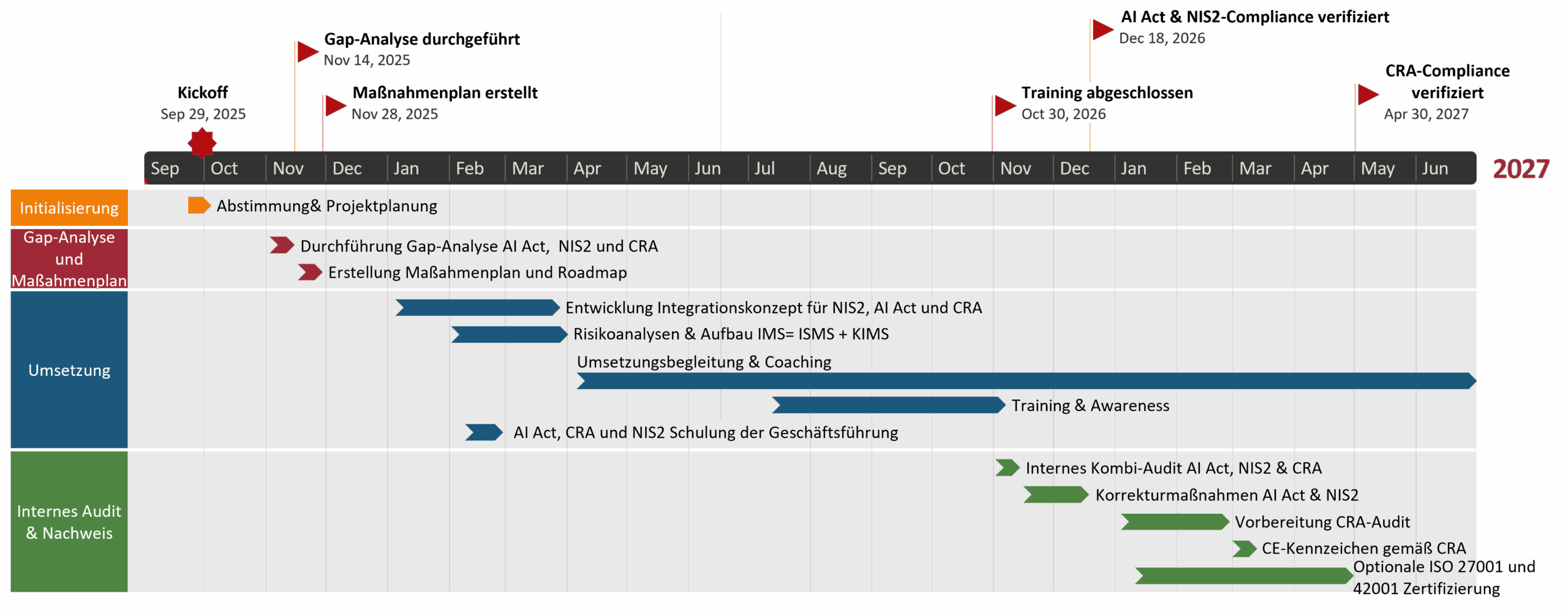
Regulatory Roadmap: AI Act, NIS2, CRA & ISO 27001
Overview of deadlines and milestones for an integrated compliance strategy.
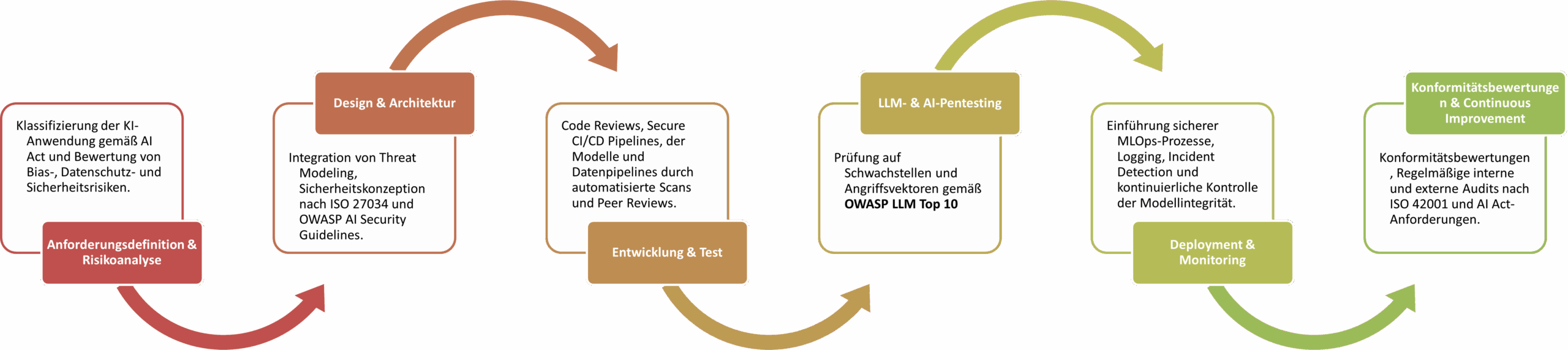
AI Secure Development Lifecycle (AI-SDLC)
Secure development lifecycle for AI systems according to the AI Act and ISO 42001.
EU AI Act – Timeline and Deadlines
GPAI Models and Their Role in the AI Act
GPAI models, such as ChatGPT by OpenAI or MS Copilot, are AI systems with general-purpose capabilities. They are characterized by their broad applicability across various tasks. The AI Act sets special requirements for transparency, documentation, and risk classification for these systems.
Role of the AI Officer
Monitoring compliance with all guidelines, standards, and laws. Coordinating risk assessment and documentation of AI systems. Ensuring data quality and traceability. Close collaboration with the CISO for unified security and compliance processes.
AI-MIG: National Implementation
With the AI Market Surveillance and Innovation Promotion Act (KI-MIG), the German government has introduced a national law for implementing the AI Act. The Federal Network Agency becomes the central AI regulatory authority in Germany.
Virtual AI Officer by VamiSec
On request, we provide an external virtual AI Officer as an independent point of contact for oversight and compliance — comparable to the vCISO model, but specialized in AI governance.
EU AI Act & AI Governance — Hands-on Day Training
This practice-oriented training provides a holistic overview of the EU AI Regulation and effective AI governance in the enterprise. Topics range from the regulatory framework and risk classification to practical implementation.
The training structure is flexibly designed and can be delivered as a compact 1-day course or adapted to your individual time requirements.
Request Training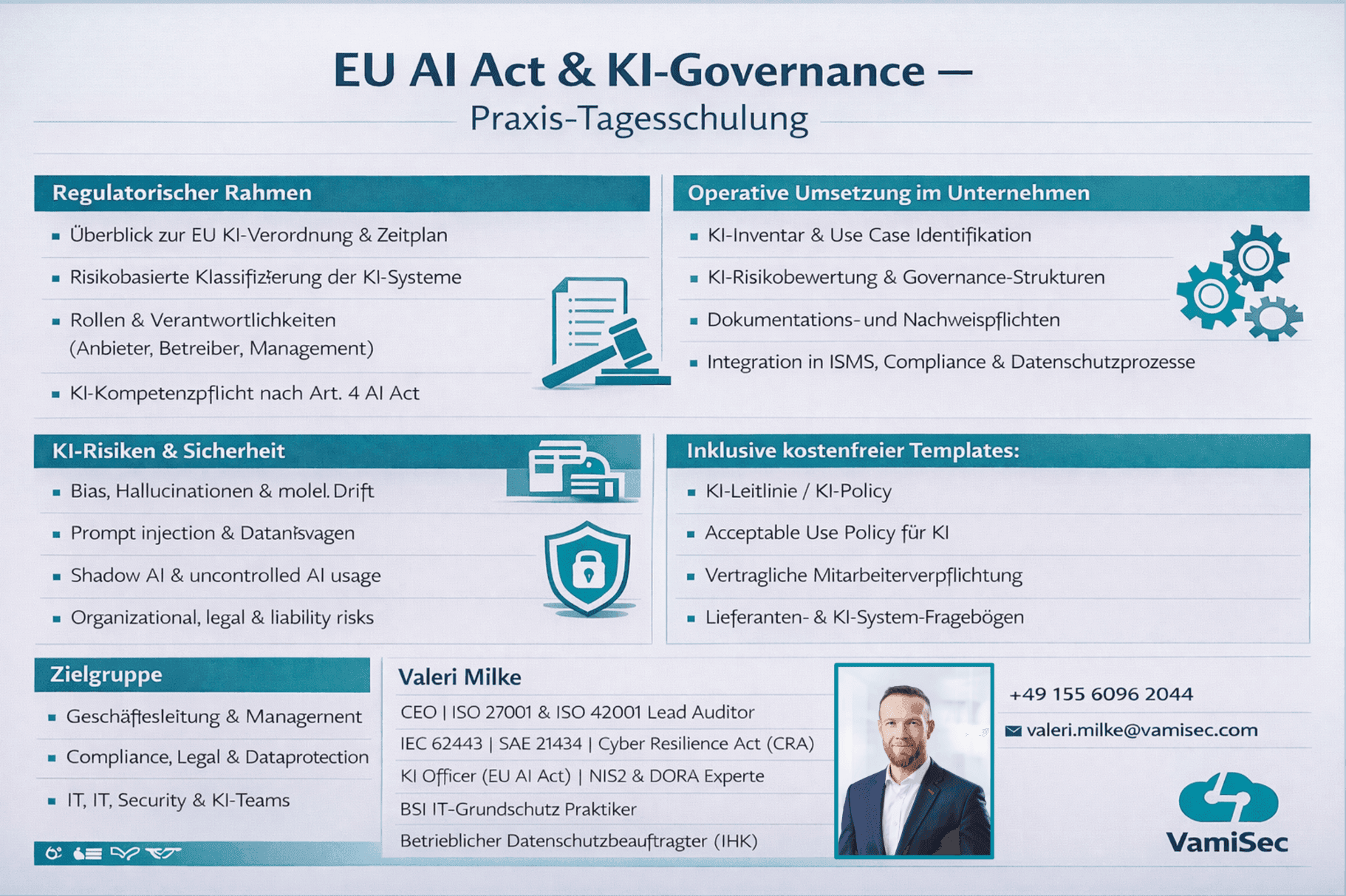
Our Services for Your AI Compliance
Provider vs. Deployer — the Right Role Assignment
Providers are companies that develop, adapt, or market AI systems. Deployers are organizations that use and control an AI system without modifying it. Role assignment is made per AI use case and significantly determines the scope of your compliance obligations.
Frequently Asked Questions
AI Act & ISO 42001 Gap Analysis
After the assessment, we create a consolidated roadmap. Schedule your free initial consultation now.
Book Initial Consultation