

ISO/IEC 27090:2026 is an ISO/IEC guidance standard published on 14 October 2026 (56 pages, JTC 1/SC 27) that describes nine AI-specific attack types together with detection and countermeasures – it is not certifiable. The standard was developed by Working Group WG 4 "Security controls and services" of Subcommittee SC 27, whose secretariat is held by DIN. The road was long: project start in September 2022, Committee Draft in January 2024, DIS ballot from April 2025, FDIS ballot from June 2026, publication as a first edition with stage code 60.60. The English title is "Cybersecurity — Artificial intelligence (AI) — Addressing security threats and compromises to AI systems"; the document is published in English only. There is no German version: DIN Media and SNV distribute the ISO original, a British adoption BS ISO/IEC 27090:2026 is announced for 31/10/2026, and no DIN adoption project exists. The SC 27 Journal calls 27090 the subcommittee's first standard dedicated specifically to the security of AI systems. Decisive for its classification: it is an International Standard with the character of guidance, not a management system standard. There is no "ISO 27090" certificate and no audit "against 27090"; the audit benchmark remains ISO/IEC 27001 and ISO/IEC 42001. Readers of the standard receive threat descriptions, detection approaches and mitigations that are adopted into the existing management system on a risk basis.
ISO/IEC 27090: Identifying, assessing and controlling security threats to AI systems
ISO/IEC 27090:2026 is the guidance standard from ISO/IEC JTC 1/SC 27 on security threats and compromises to AI systems, published on 14/10/2026 as a first edition of 56 pages. The standard describes nine AI-specific attack types with their consequences, detection and mitigation across the entire AI life cycle and is not certifiable. This page puts the standard in context, shows threats by life-cycle phase, maps them to ISO/IEC 27001, 42001, the AI Act, NIST and OWASP, offers a Gap Check for self-assessment and the whitepaper "ISO/IEC 27090 for CISOs".
You receive the download link immediately on the page and by e-mail; the PDF is in German.
- 01Data
- 02Development
- 03Verification
- 04Deployment
- 05Operation
- 06Retirement
AI systems are now part of production IT: as a foundation model consumed via API, as fine-tuning in your own tenant, as a RAG assistant over internal documents or as an agent with tool access. Attacks on them follow patterns of their own that classic security controls do not cover: poisoned training data, models copied through legitimate queries, prompt injection via third-party content. ISO/IEC 27090 is the first standard from ISO/IEC JTC 1/SC 27 dedicated specifically to the security of AI systems; it builds on the practice of ISO/IEC 27001 and 27002, refers to ISO/IEC 42001 for the management system and sets no certifiable requirements of its own. In regulatory terms it arrives at the right time: the high-risk obligations of the AI Act, with their resilience requirements against Data Poisoning, Model Evasion and confidentiality attacks, apply from 02/12/2027 for Annex III and from 02/08/2028 for Annex I, the main obligations of the Cyber Resilience Act from 11/12/2027; 27090 does not, however, establish a presumption of conformity. Throughout, this page separates what the standard describes, what regulation and other frameworks require and what we recommend. The check "Does ISO/IEC 27090 apply to me?" clarifies your role, the life-cycle navigator assigns threats and mitigations to the phases, the sourcing variants lab compares your own model, a tenant model and an external API, and the Threat & Control Navigator maps the standard to ISO/IEC 27002, 42001, the AI Act, NIST AI 100-2, MITRE ATLAS, OWASP and ETSI — as a VamiSec working interpretation wherever the standard itself sets no reference. The Gap Check shows your maturity across seven fields of action, and the whitepaper "ISO/IEC 27090 for CISOs" delivers the mapping matrix, real-world cases, roadmap and audit questions for the board and internal audit.
From the 2022 project start to the 2027/2028 high-risk obligations
The milestones of ISO/IEC 27090 and of the environment it acts upon — from the management system standard ISO/IEC 42001 through the AI Act to the Cyber Resilience Act.
Project start for ISO/IEC 27090
The project is approved and registered in the work programme of ISO/IEC JTC 1/SC 27; WG 4 "Security controls and services" is responsible. The working title still speaks of "security threats and failures".
ISO/IEC 42001:2023 published
The certifiable management system standard for AI (AIMS, 51 pages) is released. 27090 later refers to it in Clause 5.2 for implementing the AI governance programme and cites A.6.2.3 and A.6.2.6.
Committee Draft in consultation
The Committee Draft registered the day before enters the comment period; the comment deadline is 21/03/2024. Approval for the DIS follows only on 29/01/2025 — a year in which the title still speaks of "threats and failures".
AI Act enters into force
Regulation (EU) 2024/1689 enters into force. Art. 15(5) requires high-risk AI to be resilient against Data Poisoning, Model Poisoning, Adversarial Examples and Model Evasion as well as confidentiality attacks and model flaws — without naming 27090.
DIS ballot starts
The Draft International Standard (46 pages) enters the twelve-week ballot running until 10/07/2025; in parallel, the British draft 25/30463618 DC is published. In the surrounding landscape: NIST AI 100-2 E2025 (final 24/03/2025) and ETSI TS 104 223 (23/04/2025).
FDIS ballot starts
The Final Draft (56 pages) enters the eight-week ballot running until 19/08/2026 and switches to the status "under publication" on the ballot day. The ballot result is not public.
ISO/IEC 27090:2026 published
The first edition is published with stage code 60.60 (ISO ID 56581, IEC publication 117332), 56 pages, English only. A British adoption BS ISO/IEC 27090:2026 is announced for 31/10/2026; there is no German-language version, DIN Media and SNV distribute only the ISO original.
High-risk obligations for Annex III
Following the Digital Omnibus (Regulation (EU) 2026/1744), the high-risk obligations of the AI Act, including Art. 9 and Art. 15, apply to Annex III systems. There is no presumption of conformity via 27090; prEN 18282 is still in draft.
CRA main obligations
The main obligations of the Cyber Resilience Act apply; the reporting obligations have already applied since 11/09/2026. For high-risk AI that is a product with digital elements, CRA Art. 12 opens the route to Art. 15 conformity.
High-risk obligations for Annex I
The high-risk obligations also apply to AI systems that fall under the Annex I harmonisation legislation as safety components.
Nine key statements on ISO/IEC 27090 — from status to audit
Click a card to read the key statement with references — the sequence runs from the status of the standard through threats and mitigations to regulation, agents and audit.
Threats along the AI life cycle: six phases, two cross-cutting topics
ISO/IEC 27090 maps attacks on AI systems to the life cycle: attacks during development and training are set against attacks during inference and operation; Annex A links them to phases and assets. The phase model follows ISO/IEC 22989 and 5338, from conception to retirement. For each phase or cross-cutting topic you see attack types, anchors in 27090, 27002 and 42001, mitigations, a question for the CISO and evidence. The six-phase split, phase mapping, ratings, mitigations and questions are VamiSec assessments; 27002 and 42001 anchors are VamiSec mappings wherever 27090 does not name them.
Data & acquisition
ISO/IEC 27090 does not start security work at the model but at governance and data: an AI governance programme under Clause 5.2 inventories AI systems, analyses their risks and manages them; threat modelling under 5.6 is something we place at the start of every initiative. The standard's longest threat description is devoted to data poisoning: manipulated training data, and in practice also fine-tuning and retrieval corpora, alter model behaviour, and detecting poisoned data is considered an open research question because automated methods cannot reliably separate it from outliers. 27090 therefore relies on data provenance, integrity protection and data limitation, and reminds us that with continuous learning, operational data becomes training data.
ReferenceISO/IEC 27090:2026, 5.2, 5.3, 5.6, 6.2, 6.11.2, 6.11.4; Annex A (mapping of attacks to life cycle and assets); statement on detecting data poisoning based on FDIS review
Typical threats
- Data poisoning: manipulated training, fine-tuning or retrieval data alter model behaviour, whether targeted or untargeted (6.2) (high)
- Backdoor attacks via triggers in the training data that only fire in operation (high)
- Direct training data leak: exfiltration of datasets from storage, pipelines or notebooks (Annex B) (high)
- Unclear data provenance: purchased or public datasets without provenance evidence (6.11.4) (medium)
- Sensitive data in training that later resurfaces through membership inference, model inversion or sensitive output (medium)
- Out-of-distribution data and quality defects — not necessarily attacks, but a robustness risk (7.7.1) (low)
Standard anchors
Mitigations with 27090 anchor and mapping
- Inventory AI systems, models and training, fine-tuning and retrieval datasets as assets — with model source, owner and purpose (27090 5.2; ISO/IEC 27002 5.9).
- Threat modelling before data acquisition: record attacker goals, affected assets such as model, training and test data, output and service, and protection goals per use case (27090 5.6).
- Document data provenance and verify integrity: source, licence, hash or signature per dataset; treat purchased datasets like supplier deliverables (27090 5.5, 6.11.4).
- Data limitation: only data the purpose requires goes into training; remove or pseudonymise sensitive attributes beforehand (27090 6.11.2); evaluate differential privacy as a complementary technique against later inference (VamiSec mapping).
- Protect training data on zero-trust principles: every access to data stores and pipelines is authenticated, authorised and logged (27090 5.3; ISO/IEC 27002 8.27).
- Look for poisoning indicators even though no method is reliable: outlier and distribution analyses, sampling, comparison with reference datasets — as a basis for decisions, not as a release (27090 6.2.3).
- VamiSec recommendation: feed operational data back into training only through an approval process with quarantine; the standard explicitly names the operational data vector.
For every production model, can you demonstrate where each training, fine-tuning and retrieval dataset came from, who approved it and that it has remained unchanged since approval?
Evidence you can present
- AI inventory with model source, datasets, owners and risk rating (27090 5.2)
- Threat model document per AI system with assets, attacker goals and protection goals
- Provenance register of datasets: source, licence, integrity evidence, approval
- Evidence of data limitation: purpose limitation, removed or protected attributes
- Access and logging concept for data stores and training pipelines
Development & training
Development and training decide whether a model enters operation with its integrity intact. ISO/IEC 27090 describes direct model poisoning for this phase: the model itself, for instance its weights, is manipulated directly, during development or later in operation. With one of the two sentences in Clause 5.1 phrased as a requirement, the standard demands risk-based implementation of information security controls such as those of ISO/IEC 27002 and recommends software engineering practice in line with NIST SSDF, protection of the development environment and supply chain management for pre-trained models, datasets and tools. It names hardening the software stack against direct model theft as an efficient starting point.
ReferenceISO/IEC 27090:2026, 5.1, 5.4, 5.5, 6.3.4, 6.7, 7.2, 7.6
Typical threats
- Direct model poisoning: manipulation of weights, training code or model artefacts in development or operation (6.7) (high)
- Trojanised pre-trained models, packages or MLOps tools from repositories and registries (5.5, Annex B) (high)
- Direct model theft from the development environment: weights, checkpoints, notebooks (Annex B) (high)
- Compromised CI/CD pipelines and build environments inject code into releases (7.6) (high)
- Evasion susceptibility without adversarial training — and side effects when mitigations contradict each other (6.3.4, 7.2) (medium)
- Sensitive data in checkpoints, logs and experiment tracking (medium)
Standard anchors
Mitigations with 27090 anchor and mapping
- Extend secure development under ISO/IEC 27002 8.25 to 8.28 to model code, training scripts and pipelines; NIST SSDF as reference (27090 5.4).
- Separate development, test and production environments and harden the training environment: isolated networks, minimal privileges, no production data without approval (27090 7.6; ISO/IEC 27002 8.31).
- Sign and hash model artefacts; verify integrity at every transition between environments; consider trusted execution environments for sensitive training runs (27090 6.7.4).
- Vet pre-trained models, datasets, libraries and MLOps tools before use: provenance, signature, scan for embedded code, pin the version (27090 5.5).
- Apply adversarial training and robustness techniques against evasion — and test their interactions with other mitigations together before the model goes into operation (27090 6.3.4, 7.2).
- Document training runs reproducibly: data snapshot, hyperparameters, code version, result (ISO/IEC 42001 A.6.2.3).
- VamiSec recommendation: banish secrets and API tokens from notebooks and pipelines and issue them short-lived; the LiteLLM incidents in March and October 2026 each began with stolen tokens.
Could you prove today that the weights of your production model come exactly from a documented training run — and that nobody has been able to alter them unnoticed since?
Evidence you can present
- Secure development policy with AI extension for model code, pipelines and notebooks
- Signature and hash register of model artefacts per version
- Training logs with data snapshot, code version, parameters and approval (ISO/IEC 42001 A.6.2.3)
- Vetting reports on pre-trained models, packages and tools before use
- Architecture and access concept for the training environment with network and privilege separation
Verification & validation
Before release, the organisation checks whether model and mitigations withstand the modelled threats. ISO/IEC 27090 positions threat modelling and red teaming as practices in their own right in Clause 5 and warns in Clause 7 that mitigations can obstruct one another: the example given is adversarial training that increased susceptibility to patch attacks; the standard therefore recommends testing all mitigations together before a system goes into operation. In 27090, validation is not a one-off gate: the standard recommends repeating it after retraining before a model returns to operation.
ReferenceISO/IEC 27090:2026, 5.6, 5.7, 6.3 to 6.6, 7.2, 7.4 (example in 7.2 and revalidation recommendation in 7.4 based on FDIS review); context: NIST AI 100-2 E2025 Section 3.6, OWASP GenAI Red Teaming Manual 1.0
Typical threats
- Evasion attacks: imperceptibly altered inputs flip classification or output — undetected without tests (6.3) (high)
- Backdoors and poisoning that standard metrics do not reveal because they only respond to triggers (high)
- Mitigations that weaken each other or degrade model performance so much that they are switched off in operation (7.2) (medium)
- Manipulated test and evaluation data feign robustness (medium)
- Membership inference and model inversion remain untested because only quality metrics are checked (6.4, 6.6) (medium)
- Prompt injection and output injection paths remain untested because the integration only comes into being after model release (6.9, 6.10) (medium)
Standard anchors
Mitigations with 27090 anchor and mapping
- Derive the test plan from the threat model: one test case per threat type from Clause 6 with success criterion, test data and owner (27090 5.6).
- Adversarial testing against evasion, membership inference, model inversion and model extraction with documented attack budgets (27090 5.7, 6.3 to 6.6).
- Red teaming of the overall system — prompt injection, output injection, data exfiltration, privilege escalation — before go-live (27090 5.7); repeating it after changes to model, system prompt or retrieval source is VamiSec practice.
- Test all mitigations in combination and log their interactions; quantify performance losses caused by mitigations and decide on them deliberately (27090 7.2).
- Protect test data like training data: provenance, integrity, access — otherwise tests feign a robustness that does not exist in operation.
- Use the tools and benchmarks named in NIST AI 100-2 (AgentDojo, Garak, PyRIT) and draw on the OWASP GenAI Red Teaming Manual 1.0 as methodology — context, not standard content.
- Anchor revalidation as a fixed step before every return to operation after retraining or a change of mitigations (27090 7.4; ISO/IEC 42001 A.6.2.4).
Has your production AI system passed a documented adversarial test against the threats in Clause 6 — and when was it last repeated after a model or prompt change?
Evidence you can present
- Test concept mapping threat type → test case → success criterion
- Reports of adversarial tests and red team exercises with findings and retests
- Log of combined tests including interactions and performance trade-off (27090 7.2)
- Release decision with residual risks, signed by business unit and information security
- Revalidation evidence after retraining or changes (ISO/IEC 42001 A.6.2.4)
Deployment & integration
With deployment, the model becomes a software component of a larger system; that is how ISO/IEC 27090 explicitly sees it, and that is how the attack surfaces arise that shape the documented incidents of 2025 and 2026: prompt injection via documents, emails or web pages, and outputs that themselves carry injection attacks against downstream systems. Added to this is model extraction via legitimate queries, which the standard already states as a basic premise in its introduction. The standard responds with zero-trust principles for AI: authenticate and authorise model accesses including retrieval queries individually, draw application boundaries and authorise every agent action individually.
ReferenceISO/IEC 27090:2026, 5.1, 5.3, 6.5, 6.9, 6.10, 7.7 to 7.9; context: OWASP LLM01 and LLM10 (2026), ASI01 and ASI05, MITRE ATLAS AML.T0051 and AML.T0053
Typical threats
- Prompt injection, direct or indirect via content the system reads — documents, emails, web pages, tickets (6.9) (high)
- Output carrying injection attacks: model outputs trigger commands, queries or data exfiltration in downstream systems (6.10) (high)
- Model extraction via the query interface — possible, according to the standard, even with intact standard controls (6.5) (high)
- Retrieval queries and agent actions with blanket privileges instead of individual authorisation (5.3) (high)
- Access to connected systems via tools and APIs the model can control (medium)
- Denial of service and resource exhaustion via the model interface (Annex B, 7.8) (medium)
Standard anchors
Mitigations with 27090 anchor and mapping
- Zero-trust architecture for the AI system: authenticate users, services, retrieval sources and agents, authorise every action, grant privileges just in time and task-specifically (27090 5.3; ISO/IEC 27002 8.27).
- Separate instructions from data: mark external content as untrusted, protect system prompts, filter inputs and check them for malicious patterns (27090 6.9.4, 7.7).
- Treat outputs like input from the internet: encoding, allowlists for actions and targets, no direct execution of model outputs in shell, SQL or browser (27090 6.10.4).
- Throttle queries, limit volume and patterns per identity, minimise disclosed details and model size to make extraction harder (27090 6.5.4, 7.8, 7.9).
- Draw application boundaries: the AI system receives only the data sources and tools the use case needs; every document query is authenticated and authorised individually (27090 5.3).
- Plan human-in-the-loop as a control point for actions with external effect — sending, deletion, payment, privilege changes (VamiSec reading of 5.3 and 6.11.3; ISO/IEC 42001 A.9).
- VamiSec recommendation: before go-live, play the incident patterns EchoLeak, ForcedLeak and “Comment and Control” through against your own integration; all three combine prompt injection with an output path to the outside.
Can your AI system execute an action with external effect without an identity having authorised it — and is every retrieval query authenticated and authorised individually?
Evidence you can present
- Architecture and data flow diagram with trust boundaries, retrieval sources and tools
- Authorisation concept for model, retrieval and agent actions with just-in-time provisioning (27090 5.3)
- Configuration of input and output filters including test evidence against injection patterns
- Rate-limiting and quota rules per identity with alerting (27090 7.8)
- Go-live approval with red team findings and human-in-the-loop rules
Operation & monitoring
Operation is where the inference attacks that ISO/IEC 27090 describes in Clause 6 converge: evasion, membership inference, model extraction, model inversion, sensitive model output and prompt injection. The standard stresses that detection is difficult but essential, gives each threat clause its own part on detection and dedicates a separate clause in Clause 7 to logging and monitoring. Added to this is Clause 6.11.3 on controlling undesired model behaviour in operation, in our reading the anchor for guardrails, thresholds and human oversight (wording only in the full version). With continuous learning, operation also turns back into a training phase: operational data can become training data.
ReferenceISO/IEC 27090:2026, Introduction, 6.3 to 6.9, 6.11.3, 7.4, 7.5, 7.7, 7.8
Typical threats
- Model extraction via legitimate queries — succeeds, according to the standard, even with intact standard controls (6.5) (high)
- Sensitive model output: training data or earlier inputs appear in responses (6.8) (high)
- Prompt injection during live operation, including via content that only enters retrieval sources after go-live (6.9) (high)
- Evasion: deliberately altered inputs bypass classification, filters or decisions (6.3) (medium)
- Membership inference and model inversion via repeated queries (6.4, 6.6) (medium)
- Operational data flows unchecked into retraining and becomes a poisoning vector (6.2) (medium)
Standard anchors
Mitigations with 27090 anchor and mapping
- Build logging and monitoring anchored in 27090 7.5; VamiSec minimum fields: requests, responses, model version, retrieval hits, tool calls and authorisation decisions, logged tamper-proof (ISO/IEC 27002 8.15, 8.16).
- Define detection signals per threat type — the standard provides a dedicated detection clause for every attack type (27090 6.2.3 to 6.10.3); examples from our practice: query patterns for extraction, distribution deviations for evasion, output inspection for sensitive output.
- Check inputs for out-of-distribution and adversarial patterns without treating every deviation as an attack; grade thresholds and responses (27090 7.7).
- Throttle queries and enforce quotas per identity; filter outputs and check them for sensitive content before they reach the user (27090 6.5.4, 6.8.4, 7.8).
- Control undesired model behaviour: guardrails, thresholds for misbehaviour, restricted privileges for agents and a defined stop mechanism (27090 6.11.3, VamiSec reading).
- Secure continuous learning: operational data enters retraining only via approval and integrity checks; return to operation only after revalidation (27090 6.2, 7.4).
- Feed monitoring insights back into threat model and test plan; compare model behaviour against baselines to spot decay early (27090 7.4; ISO/IEC 42001 A.6.2.6).
Would you notice today if someone extracted your model through thousands of seemingly legitimate queries or your assistant disclosed confidential data — and who then responds, within what time?
Evidence you can present
- Logging concept for AI systems with fields, retention and tamper protection (27090 7.5)
- Security monitoring use cases per threat type with thresholds and alerting paths
- Rate-limiting, quota and output filter configuration with change history
- Operating policy on guardrails, agent privileges and stop mechanism (27090 6.11.3, VamiSec reading)
- Evidence of the retraining approval process including revalidation (27090 7.4)
Reassessment & retirement
ISO/IEC 27090 does not treat mitigations as a one-off project: Clause 7 addresses the continuity of mitigations across the entire life cycle and the decay of model and mitigations over time. Models drift, attack techniques evolve, and retraining can cancel out protective effects; the standard recommends ongoing monitoring, retraining where needed and revalidation before a model returns to operation. For the end of the life cycle, retirement in ISO/IEC 22989 terms, 27090 contains no dedicated clause; here the ISMS processes and the guidance on data limitation and provenance apply, supplemented by VamiSec practice.
ReferenceISO/IEC 27090:2026, 6.11.2, 6.11.4, 7.2 to 7.4 (7.4 recommendations based on FDIS review); ISO catalogue FAQ on retraining and updates; context: ETSI TS 104 223 Principles 11 and 13, Art. 25 AI Act
Typical threats
- Decay of protective effect: mitigations that worked at go-live no longer take hold after model or data drift (7.4) (high)
- Retraining or updates introduce poisoning or cancel out adversarial robustness (6.2, 7.3) (high)
- Outdated model versions, endpoints and keys remain reachable (medium)
- Historical training data, prompt logs and checkpoints outlive retirement (medium)
- Fine-tuning or a change of purpose can turn the deployer into a provider under the AI Act — without a new risk analysis following (medium)
- Mitigations remain tied to individuals or projects and end with the project (7.3) (low)
Standard anchors
Mitigations with 27090 anchor and mapping
- Maintain every mitigation with an owner, review cycle and succession rule so that it survives phase transitions, retraining and team changes (27090 7.3).
- Measure decay: compare model quality, filter false positives and attack success against the baseline in regular retests; set thresholds for retraining and reassessment (27090 7.4).
- Treat retraining as a change with risk analysis, data approval, combined testing and revalidation, with the same gates as at the first go-live (27090 7.2, 7.4; ISO/IEC 27002 8.32).
- Reassess on changes to model, purpose, data sources or tools; check whether fine-tuning or a change of purpose shifts the role under the AI Act (context: Art. 25 AI Act).
- Plan retirement: block endpoints and keys, deactivate model versions, delete or archive checkpoints, prompt logs and training data according to the retention rule (ISMS processes; 27090 6.11.2).
- Retain provenance and model documentation beyond retirement wherever evidence obligations exist (27090 6.11.4; ISO/IEC 42001 A.6.2.7).
- VamiSec recommendation: at least annually and after every retraining, reassess the status of all threat types from Clause 6 per AI system and update the risk register.
Do you know which of your safeguards still work since the last retraining — and is there evidence for every retired model that endpoints, keys, checkpoints and data have been cleaned up?
Evidence you can present
- Mitigation register with owner, review cycle and status per life cycle phase (27090 7.3)
- Retest and drift reports with baseline comparison and retraining decision (27090 7.4)
- Change records for retraining and updates with revalidation evidence
- Retirement log: blocked endpoints, deactivated versions, deletion evidence
- Updated role and risk assessment after a change of purpose or model
Supply chain & model sourcing
Hardly any organisation trains its model from scratch: pre-trained models, purchased datasets, libraries, MLOps tools and model APIs come from third parties. ISO/IEC 27090 dedicates a separate clause to supply chain management with AI-specific threats, complex supply chains, concrete attack vectors and mitigation strategies, refers to controls A.6.2.3 and A.6.2.6 of ISO/IEC 42001 for the actors in the supply chain, and treats supply chain attacks in Annex B as the AI variant of conventional attacks. How real this is was shown on 21 October 2026: the Python package litellm 1.107.0 carried a credential stealer in all seven wheels that also harvested the credentials of AI tools, the project's second incident within seven months.
ReferenceISO/IEC 27090:2026, 5.1, 5.5.1 to 5.5.5, 6.7, 7.6, Annex B; real-world cases: litellm 1.107.0 (21/10/2026), LiteLLM 1.82.7/1.82.8 (24/03/2026), Ultralytics 8.3.41/8.3.42 (09/12/2024)
Typical threats
- Trojanised packages and models from registries and repositories — with the credentials of AI tools as a new theft target (5.5, Annex B) (high)
- Pre-trained models with backdoors or manipulated weights that no standard check detects (5.5, 6.7) (high)
- Compromised CI/CD pipelines and build environments of upstream projects (5.5.4, 7.6) (high)
- Unannounced model changes by the provider alter behaviour and protective effect during live operation (medium)
- Use of your inputs by the provider for training without contractual restriction (medium)
- Tool and protocol risks in agentic supply chains — tool poisoning, rug pulls, shadow tools — which 27090 does not treat as types in their own right (medium)
Standard anchors
Mitigations with 27090 anchor and mapping
- Extend supplier management under ISO/IEC 27002 5.19 to 5.21 to model providers, data suppliers and tool vendors; anchor requirements and audit rights contractually (27090 5.5.5).
- Maintain an AI bill of materials (AIBOM): models with version and provenance, datasets, packages, tools and APIs per AI system; link it to the SBOM (anchor 27090 5.5, 6.11.4; the term AIBOM does not come from the standard).
- Verify pre-trained models and datasets before use: signature, hash, scan for embedded code, provenance of the uploader; no automatic updates without checks (27090 5.5.4, 6.7.4).
- Pin versions, monitor advisories and registry quarantines, distrust very recent releases; the PyPI rule that releases accept no new files after 14 days closes only part of the window.
- Clarify contractually whether and how the provider uses inputs for training, how model changes are announced and which tests against evasion and injection it can evidence (ISO/IEC 42001 A.10.3; practice after Kertos).
- Issue secrets in build and operating environments short-lived and narrowly scoped; include the credentials of AI tools in the secrets inventory (27090 7.6).
- VamiSec recommendation: for agentic tool chains, close the gaps in 27090 with the OWASP Agentic Top 10 (ASI04) and MITRE ATLAS — review tool descriptions, pin tools, alert on changes.
For every production AI system, can you say within a day which models, packages, datasets and tools are in it, in which version — and would you have known on 21/10/2026 whether litellm 1.107.0 was running in your environment?
Evidence you can present
- AIBOM per AI system with versions, provenance and integrity evidence
- Supplier assessments and contracts with model providers: training use, change notification, audit rights
- Vetting records for pre-trained models, datasets and packages before use
- Advisory monitoring and pinning rules with evidence of response to incidents
- Secrets inventory with lifetimes and scopes, including the credentials of AI tools
Governance, monitoring & incidents
ISO/IEC 27090 is not a management system standard but builds on existing management systems: Clause 5.2 describes an AI governance programme that inventories AI systems, analyses and manages risks, and refers to ISO/IEC 42001 for the management system. The two sentences in 5.1 phrased as requirements form the core: information security controls such as those of ISO/IEC 27002 are to be implemented on a risk basis, and AI-specific compromises are to be considered across the entire life cycle; no certifiable requirements arise from this. Clause 7 adds interactions, continuity, decay, and logging and monitoring. 27090 contains no dedicated clause on incident management; detection is covered per threat in Clause 6, response remains with the ISMS.
ReferenceISO/IEC 27090:2026, 5.1, 5.2, 7.1 to 7.5; ISO/IEC 27001:2022 6.1; context: CRA Art. 14 (reporting obligations since 11/09/2026), Art. 9 AI Act, Art. 17 to 19 DORA
Typical threats
- AI systems are missing from the asset inventory and the risk register — the nine threat types are never assessed per system (5.2) (high)
- Mitigations from 27090 appear nowhere in the Statement of Applicability; auditors find no evidence (ISO/IEC 27001 6.1) (high)
- No detection capability for AI attacks: logs without model version, retrieval hits or tool calls (7.5) (high)
- The incident process knows no AI incident classes; reporting deadlines under CRA, NIS2 or DORA are missed (medium)
- Mitigations contradict each other or decay unnoticed because nobody manages them in combination (7.2 to 7.4) (medium)
- Unclear roles between provider and deployer — 27090 does not define them, the AI Act and contracts do (medium)
Standard anchors
Mitigations with 27090 anchor and mapping
- Set up an AI governance programme: inventory of all AI systems including embedded models and models sourced via API, risk analysis per system, mitigation management (27090 5.2; ISO/IEC 27002 5.9).
- Include the nine threat types from Clause 6 per AI system in the risk assessment under ISO/IEC 27001 6.1 and cite 27090 mitigations as a control source in the Statement of Applicability — Annex A of 27001 is not exhaustive.
- Where an AIMS under ISO/IEC 42001 exists: map 27090 mitigations to controls A.6.2.3, A.6.2.6 and A.6.2.8 and extend the impact assessment under A.5 with attack scenarios.
- Organise logging and monitoring as a cross-cutting function: uniform fields across all AI systems, connection to security monitoring, retention under ISMS rules (27090 7.5; ISO/IEC 27002 8.15, 8.16).
- Extend incident management: AI incident classes along Clause 6, playbooks for prompt injection, data exfiltration and supply chain incidents, review of reporting obligations (CRA reporting has been running since 11/09/2026 with an early warning within 24 hours).
- Manage mitigations in combination: document interactions, ensure continuity across the phases, measure and report decay (27090 7.2 to 7.4).
- VamiSec recommendation: define roles per AI system — who secures model and life cycle, who is responsible for integration, data access and monitoring — and establish reporting lines to executive management with key figures.
Is every production AI system in your organisation listed in the risk register with its threats — and can you show an auditor in the Statement of Applicability which 27090 mitigations you have implemented where?
Evidence you can present
- AI inventory with owner, model source, sourcing variant and criticality (27090 5.2)
- Risk register with assessment of the nine threat types per AI system
- Statement of Applicability with 27090 mitigations as an additional control source (ISO/IEC 27001 6.1)
- Logging standard for AI systems and evidence of connection to security monitoring (27090 7.5)
- Incident policy with AI incident classes, playbooks and review of reporting deadlines
Data & acquisition
Three sourcing variants compared: own model, foundation model in your tenant, external model API
ISO/IEC 27090 does not distinguish between operating models; it addresses all actors in the supply chain that develop or use AI systems. In practice, however, the attack surfaces from Clause 6 shift depending on whether you train and host a model yourself, adapt a foundation model in your own tenant through fine-tuning and retrieval, or integrate an external model API or a SaaS assistant. The three variants, the risk profiles and the assessments are a working model by VamiSec — not a requirement of the standard; hybrid forms are common.
Those who train and operate models themselves carry every attack surface from Clause 6 on their own: data poisoning in their own pipeline, direct model poisoning and direct model theft in the development environment, extraction and inversion via their own interface. In our assessment, the greatest risk lies in development and training — where training data, weights and pipelines reside and where the skills and operational effort are highest.
Control and responsibility sit entirely in-house: you determine data, training, hosting and interfaces — and must implement and evidence every mitigation of the standard yourself.
Risikoprofil
- Attack surface: data & traininghigh
- Model theft & extractionmedium
- Data leakage & prompt riskslow
- Loss of control & opacitylow
- Supply chain dependencymedium
- Operational & skills efforthigh
VamiSec assessment along the threat types of ISO/IEC 27090 — not a rating by the standard; 1 = low, 3 = high.
What matters in this variant
- All attack targets of the standard — training data, test data, model, output, service — are within your own area of responsibility; Annex A helps to map them to each life cycle phase.
- Data poisoning and direct model poisoning are not a supplier question here, but a question of your own pipeline, environment and access security (6.2, 6.7, 7.6).
- Direct model theft from storage, checkpoints or backups is the AI variant of classic data theft — the standard regards hardening the software stack as an efficient starting point against it (5.1, Annex B).
- Continuous learning from operational data turns operation into a training phase: without an approval process, user inputs become a poisoning vector.
- The supply chain does not disappear: pre-trained base models, libraries and MLOps tooling remain external dependencies (5.5).
Mitigations anchored in 27090
- Secure training data and pipelines according to zero-trust principles; document provenance for each data set; verify integrity before every training run (27090 5.3, 6.2.4, 6.11.4).
- Isolate the development environment, sign and hash model artefacts, encrypt checkpoints and backups and keep them access-restricted (27090 6.7.4, 7.6).
- Protect your own inference interface against extraction and inversion: rate limiting, query logging, minimising the details returned, reviewing model size (27090 6.5.4, 7.8, 7.9).
- Data limitation and differential privacy in training where sensitive data is included — against membership inference and inversion (27090 6.11.2; mapping to 6.4 and 6.6 according to VamiSec).
- Build or commission red teaming and adversarial testing as a capability of your own; retest after every retraining (27090 5.7, 7.4).
- VamiSec recommendation: limit key-person and skills risk — operations manual for training and inference, deputies, documented restart procedures for model and pipeline.
The base model comes from the provider; fine-tuning, retrieval sources and operation sit in your own tenant. In our assessment, the main risk shifts to two places: the adaptation layer — poisoned fine-tuning or retrieval data, document queries with blanket permissions — and the dependency on the model provider, whose base model you can neither inspect nor version yourself. Anyone who substantially modifies a third-party model through fine-tuning should also check whether they move from deployer to provider under the AI Act.
You control the tenant, adaptation data, retrieval sources and access; the platform or model provider supplies the base model and infrastructure — the standard's supply chain guidance therefore applies in both directions.
Risikoprofil
- Attack surface: data & trainingmedium
- Model theft & extractionmedium
- Data leakage & prompt risksmedium
- Loss of control & opacitymedium
- Supply chain dependencyhigh
- Operational & skills effortmedium
VamiSec assessment along the threat types of ISO/IEC 27090 — not a rating by the standard; 1 = low, 3 = high.
What matters in this variant
- Data poisoning here primarily affects the adaptation layer: fine-tuning data sets and retrieval corpora that change model behaviour without any training of your own (6.2).
- Retrieval queries are explicitly part of the zero-trust examples in 27090: every document query is authenticated and authorised individually — blanket index permissions are the typical mistake (5.3).
- The base model is a pre-trained component from the supply chain: backdoors or model changes by the provider can only be addressed through contracts, tests and monitoring (5.5, 6.7).
- Model extraction and sensitive output concern the adapted model — it contains your corporate knowledge and deserves the same interface controls as a model of your own (6.5, 6.8).
- Context: fine-tuning third-party models can cross the threshold to provider status under Art. 25 AI Act — with the provider obligations of the AI Act.
Mitigations anchored in 27090
- Treat fine-tuning and retrieval data like training data: approval, provenance, integrity checks, quarantine for new sources (27090 6.2.4, 6.11.4).
- Couple retrieval with user permissions: authorise document access per request with the identity of the requester, separate indexes by data class (27090 5.3).
- Pin base model versions, test provider updates before adoption, compare behavioural baselines after every update (27090 5.5, 7.4).
- Secure contractually: no use of your data for provider training, notification of model changes, exportability of adaptation data and weights (ISO/IEC 42001 A.10.3; ISO/IEC 27002 5.20).
- Rate-limit and log the adapted model's interface and equip it with output filters; repeat prompt injection tests against retrieval content (27090 6.5.4, 6.8.4, 6.9.4).
- VamiSec recommendation: verify the tenant boundary technically — private connectivity, no public endpoints, regular evidence that telemetry and prompts do not leave the tenant.
When sourcing via an external API or a SaaS assistant, model, training and operation sit with the provider. In our assessment, the main risk is the leakage of inputs, context documents and outputs across the control boundary — and the fact that you can neither detect nor prevent poisoning, backdoors or model changes, but only limit them contractually and through input and output controls. AI features in standard software often fall into this variant without users noticing.
The provider controls the model and the processing; you steer through contracts, upstream input filters, output control and limiting what the system may see and do — the standard addresses you as a user in the supply chain, not as a developer.
Risikoprofil
- Attack surface: data & traininglow
- Model theft & extractionlow
- Data leakage & prompt riskshigh
- Loss of control & opacityhigh
- Supply chain dependencyhigh
- Operational & skills effortlow
VamiSec assessment along the threat types of ISO/IEC 27090 — not a rating by the standard; 1 = low, 3 = high.
What matters in this variant
- Of the nine threat types, what mainly remains on your side is prompt injection, output containing injection attacks and sensitive model output — everything that arises at the interface (6.8 to 6.10).
- Poisoning, backdoors, extraction and inversion concern the provider's model; the standard addresses all actors in the supply chain, and your levers are due diligence, contract and testing (5.5).
- Context data for retrieval, uploaded documents and tool results travel to the provider — whether it stores them or trains on them is governed solely by the contract.
- Embedded AI in standard software and browser assistants belongs in the inventory under 5.2, even if no project introduced it.
- Agentic features of external assistants with access to mail, files or CRM enable the attack patterns of EchoLeak and ForcedLeak — prompt injection plus an outbound output path.
Mitigations anchored in 27090
- Input filter in front of the interface: detect data classes, block or tokenise confidential content, limit uploads; enable user groups in tiers (27090 6.11.2; VamiSec practice).
- Control outputs before they take effect: encoding, allowlists for targets and actions, no automatic execution in connected systems (27090 6.10.4).
- Contract and due diligence: exclude training use, storage locations and retention periods, change notification, evidence of tests against evasion and injection, audit rights (27090 5.5.5; ISO/IEC 27002 5.19 to 5.21).
- Keep the assistant's access to corporate data and tools minimal; authorise every action with external effect, let permissions expire after the task (27090 5.3).
- Log and monitor usage — prompts, context sources, tool calls — as far as the provider offers interfaces for it; document remaining gaps (27090 7.5).
- VamiSec recommendation: actively inventory AI features in standard software and keep them disabled until data classes, contract and filters have been approved; use the providers' lockdown or restriction modes without treating them as full protection.
Own model
Which data may go into which variant?
Select a data class. The traffic light shows how VamiSec assesses the three sourcing variants for this class — conservatively, along the threats from Clause 6 and subject to your own data classification, risk analysis and contracts.
Published information or information approved for publication, e.g. product information, press releases, public standards and legal texts.
Acceptable: public data causes no leakage damage; what remains are integrity risks such as poisoning, which your own pipeline must cover anyway.
Acceptable: the data stays within the tenant, provided standard cloud controls and a reviewed provider contract are in place.
Acceptable, provided terms of use are enforced upstream, uploads are limited and outputs do not flow back into systems unchecked.
Information for internal use without customer or personal reference, e.g. policies, internal presentations, process descriptions, source code without secrets.
Acceptable with access control and logging at the interface; training and retrieval data stay within your own control boundary (27090 5.3).
Acceptable with permission-aware retrieval, separate indexes and training use by the provider contractually excluded (27090 5.3).
Only with additional measures: input filter, tiered enablement per user group, contractual exclusion of training use, clarified storage locations and retention periods.
Customer and personal data, contracts, non-public financial and product information, training data containing trade secrets — leakage causes tangible harm to customers or the organisation.
Acceptable if data limitation, differential privacy or pseudonymisation are applied in training and the interface is secured against extraction, inversion and sensitive output (27090 6.4 to 6.8, 6.11.2).
Only with additional measures: encryption with your own key management, indexes separated by data class, output filters, an assessed residual risk at the tenant boundary and clarified processing locations.
Only exceptionally after a case-by-case review with tokenisation or pseudonymisation before transmission, contractual leakage controls and logging — and not in assistants with tool access to mail or files.
Particularly sensitive data, e.g. credentials and keys, security architectures, insider information, special categories of personal data, model weights of high intrinsic value.
Only with additional measures: strict purpose limitation, separate training and inference environments, output filters, complete logging and approval by the data owner — membership inference and inversion can be mitigated, not ruled out.
Only after a documented case-by-case risk analysis: separate environment, no use in fine-tuning, retrieval only with individual approval and evidence that telemetry and prompts do not leave the tenant.
Not recommended: the main risk of this variant is leakage across the control boundary; in our assessment, strictly confidential data does not belong in an external model API or a SaaS assistant.
Confidential
VamiSec guidance along the threat types of ISO/IEC 27090 — not a requirement of the standard, which defines neither data classes nor sourcing variants; your data classification, risk analysis and contracts are decisive.
Threats that apply in every variant
Regardless of the sourcing variant, threats from ISO/IEC 27090 that arise at the interface, in use or in the supply chain remain — listed here per life cycle phase with the mitigation families the standard describes for them.
- 01Data & procurement
Every AI system needs an inventory, a risk analysis and a threat model — including a purchased assistant; retrieval and context data are a poisoning target in all variants. Mitigations: AI governance programme, data provenance and data limitation (27090 5.2, 5.6, 6.11.2, 6.11.4).
- 02Development & training
Even those who do not train still develop: prompts, retrieval pipelines, tool integrations and integration code are software with vulnerabilities of their own. Mitigations: software engineering practice for AI, protection of the development environment, secrets hygiene (27090 5.4, 7.6).
- 03Verification & validation
Prompt injection, output injection and data leakage can only be tested on the integrated system — regardless of who owns the model. Mitigations: tests derived from the threat model, red teaming, combined testing of mitigations (27090 5.6, 5.7, 7.2).
- 04Deployment & integration
The interface between model, data, tools and users is the main attack surface for injection and privilege escalation in all variants. Mitigations: zero-trust principles, application boundaries, input and output filters, rate limiting (27090 5.3, 6.9.4, 6.10.4, 7.7, 7.8).
- 05Operation & monitoring
Sensitive output, extraction via legitimate queries and unwanted model behaviour occur wherever a model responds. Mitigations: logging and monitoring, detection per threat type, guardrails and stop mechanisms (27090 6.8.4, 7.5; 6.11.3 according to VamiSec's reading).
- 06Reassessment & decommissioning
Models, prompts, retrieval sources and provider versions change; mitigations lapse if nobody keeps them up to date. Mitigations: continuity across the phases, measuring decay, revalidation before returning to operation, reassessment upon changes (27090 7.3, 7.4).
ISO/IEC 27090 in detail: 16 chapters from origins through threats and mitigations to the implementation roadmap
16 chapters walk through status and publisher, scope and boundaries, the structure of the standard, the threat model, the nine compromise types along the life cycle, the four mitigation families, supply chain and model sourcing, integration into ISMS and AIMS, the regulatory links to the AI Act, CRA, NIS2 and DORA, and the roadmap for 90 days and 12 months — each with its source reference and cleanly separated into what the standard describes, what regulation and other frameworks say, and what VamiSec recommends.
What ISO/IEC 27090 is: origins, status, publisher
ISO/IEC 27090:2026 has been published as an International Standard since 14 October 2026: a guidance standard from ISO/IEC JTC 1/SC 27 with 56 pages that describes nine AI-specific attack types together with detection and countermeasures, and that is not certifiable. Four years after the project started, the security subcommittee SC 27 has thus delivered its first standard devoted exclusively to the security of AI systems. Those who position it correctly avoid two mistakes: treating it as a basis for certification, or setting it aside as non-binding reading.
From project start in 2022 to publication in 2026
The project was approved on 15/09/2022, the Committee Draft consultation began in January 2024, and the DIS ballot on 16/04/2025. The Final Draft was balloted from 23/06 to 19/08/2026 and moved to the status “under publication” on the very day the ballot closed; publication followed on 14/10/2026 with stage code 60.60. The ballot result is not public, but the transition without referral back confirms approval. The title changed along the way: “Guidance for addressing security threats and failures” became “Addressing security threats and compromises to AI systems”, failures became compromises, and the document grew from 46 to 56 pages with 115 bibliography entries.
| Stage | Date | Meaning |
|---|---|---|
| 10.99 / 20.00 | 15/09/2022 | Project approved and registered in the SC 27 work programme |
| 30.20 / 30.60 | 24/01/2024 / 21/03/2024 | Committee Draft consultation started and closed |
| 40.20 / 40.60 | 16/04/2025 / 10/07/2025 | DIS ballot, concurrently the British draft 25/30463618 DC |
| 50.20 / 50.60 | 23/06/2026 / 19/08/2026 | FDIS ballot started and closed |
| 60.00 | 19/08/2026 | Under publication: approved without referral back |
| 60.60 | 14/10/2026 | International Standard published, first edition |
Source: life cycle in the ISO catalogue (ID 56581), as at 22/10/2026.
Publisher and committees
The standard was developed by ISO/IEC JTC 1/SC 27 “Information security, cybersecurity and privacy protection”, whose secretariat is held by DIN (Chair Dr Andreas Wolf); the responsible working group was WG 4 “Security controls and services” under Convenor Faud Khan of Canada's SCC, and no public source names the project editors. The SC 27 Journal of September 2026 describes 27090 as the subcommittee's first standard specifically on the security of AI systems. In Germany, the working committee NA 043-04-27-04 “IT security controls and services” mirrors WG 4; as at 22/10/2026 its project list contains neither an adoption project nor a comment on 27090.
Purchase, language, national editions
The standard is published in English only. ISO charges CHF 204, DIN Media sells the ISO original as ISO/IEC 27090:2026-10 for EUR 218.32 net, and in the IEC Webstore it is listed as publication 117332. There is no German edition: DIN Media and SNV sell only the English ISO original, no ÖNORM adoption is known, and the British adoption BS ISO/IEC 27090:2026 is announced for 31 October 2026. Previews with the table of contents, Introduction, Clauses 1 to 4, 5.1 to 5.3 and the bibliography can be viewed free of charge; Clauses 5.4 to 7, Table 1 and the annexes are available only in the full version, and statements on this page about them rely on the table of contents and FDIS analyses and are marked as such.
Guidance standard, not a management system standard
ISO/IEC 27090 is an International Standard with the character of a guidance document. ISO's own explainer speaks of security guidelines, not of requirements for an AI management system; for those, Clause 5.2 refers to ISO/IEC 42001. There is no “ISO 27090” certificate, no audit “against 27090” and no presumption of conformity under the AI Act or the Cyber Resilience Act. Nevertheless, the standard is not a mere collection of recommendations: Clause 5.1 contains two documented “shall” statements, according to which information security controls, for instance from ISO/IEC 27002, shall be implemented on a risk basis and AI-specific compromises shall be considered across the entire life cycle. In practice this means: no certifiable requirements, but a clear expectation that the threats in Clause 6 are addressed in your own risk management.
Scope: what 27090 covers and what 27091, 42001 and 27001 take over
ISO/IEC 27090 applies to organisations of every kind and size that develop or use AI systems, and addresses threats and compromises specific to AI systems across their entire life cycle. Equally important is what the standard does not cover: data protection, the management system, functional safety and AI as an attack tool belong to other documents. This chapter draws the boundaries and positions the family of standards.
Scope: develop or use
Clause 1 describes the subject matter as follows: security-relevant threats and compromises specific to AI systems, their consequences, and detection and mitigation across the entire life cycle — applicable to companies, public authorities and non-profit organisations that develop or use AI systems. The Introduction speaks of developing or deploying, Clause 5.1 of actors along the supply chain. Clause 3 does not define the provider and deployer roles from the AI Act or the stakeholder roles from ISO/IEC 22989; any assignment of mitigations to roles is therefore interpretation. The scope is not limited to generative AI.
Normative and informative references
The standard cites exactly two documents normatively: ISO/IEC 22989 undated, i.e. including future changes such as the ongoing amendment on generative AI, and ISO/IEC 23053:2022. ISO/IEC 27001, 27002, 42001, 23894, 5338 and 38507 appear only in the bibliography, but are explicitly named in 5.1 and 5.2 as the working basis. Clause 3 takes the protection goals from the new ISO/IEC 27000:2026, and threat, attack and vulnerability from ISO/IEC 27002:2022.
| Standard | Type and status | Role in relation to ISO/IEC 27090 |
|---|---|---|
| ISO/IEC 27090:2026 | Guidance standard, published 14/10/2026, 56 pp. | Threats, detection and mitigations for AI systems; not certifiable |
| ISO/IEC 27091 | FDIS registered since 13/07/2026, WG 5, 35 pp. | Privacy protection in AI systems; cited in the bibliography of 27090 |
| ISO/IEC 42001:2023 | Management system standard, certifiable, 51 pp. | AI management system; 5.2 refers to it, 5.1 names A.6.2.3 and A.6.2.6 |
| ISO/IEC 27001:2022 / 27002:2022 | Management system standard, certifiable / control catalogue, 152 pp. | Basis; 5.1 names 27001 6.1 as well as 27002 Clauses 5–8, 4.2, 8.15, 8.16, 8.27 |
| ISO/IEC 23894:2023 | Guidance standard for AI risk management, 26 pp. | Named in 5.1 for risk analysis, alternatively ETSI documents |
| ISO/IEC 5338:2023 | Guidance standard for AI life cycle processes, 39 pp. | Life cycle basis alongside 22989 (5.1) |
| ISO/IEC 22989:2022 / 23053:2022 | Concepts and terminology / ML framework | The only normative references; 22989 undated |
Status according to the ISO catalogue, as at 22/10/2026. For ISO/IEC 42001:2023 and 27002:2022 neither an amendment nor a revision is registered.
What is not covered
- Requirements for an AI management system: Clause 5.2 refers to ISO/IEC 42001.
- Privacy risks of AI systems: the subject of the sister standard ISO/IEC 27091.
- AI as a defensive tool, and threats that merely use AI, such as deepfakes or AI-assisted phishing.
- Attacks by AI on AI, and functional safety, for which ISO/IEC TR 5469 is the relevant document.
- A presumption of conformity under the AI Act or the Cyber Resilience Act: 27090 is not a harmonised standard, and no official mapping to prEN 18282 or ETSI TS 104 223 exists.
27090 and 27091: security and privacy as a pair
ISO/IEC 27091 “Cybersecurity and Privacy — Artificial Intelligence — Privacy protection” has not yet been published; the FDIS ballot had not started as at 22/10/2026. According to DIS-based summaries, it addresses privacy analysis, the privacy of AI models and privacy engineering across the life cycle. The overlap is visible: membership inference and model inversion appear in both standards, in 27090 as a security threat to the confidentiality of training data, in 27091 as a privacy risk. Publication in early 2027 is plausible, but it is not an ISO target date.
Structure of the standard: seven clauses, three annexes, 115 sources
ISO/IEC 27090 consists of seven clauses and three informative annexes on 56 pages: Clause 5 describes organisational practices, Clause 6 nine compromise types, Clause 7 the interactions between mitigations. The structure is fully documented via the freely accessible previews; the full texts of 5.4 to 7 and of the annexes are available only in the full version. This chapter is your reading guide.
| Part | Content | Pages |
|---|---|---|
| Foreword, Introduction | Core premise: classical vulnerabilities plus AI-specific threats; defence in depth | v–vii |
| 1 Scope · 2 Normative references · 3 Terms · 4 Abbreviated terms | Subject matter, two normative references, 30 terms (3.1–3.30), 15 abbreviations | 1–5 |
| 5 Application of information security | 5.1 General · 5.2 AI governance programme · 5.3 Zero trust principles · 5.4 Software engineering best practices · 5.5 Supply chain management · 5.6 Threat modelling · 5.7 Red teaming | 5–10 |
| 6 Types of potential compromise to AI systems | 6.1 General · 6.2–6.10 nine compromise types · 6.11 Considerations for AI systems | 10–32 |
| 7 Mitigations and their interactions | 7.2 Conflicting interactions · 7.3 Continuity · 7.4 Deterioration · 7.5 Logging and monitoring · 7.6 Development environment · 7.7 Malicious input detection · 7.8 Throttling · 7.9 Model size | 33–36 |
| Annex A (informative) | Mapping attacks to AI system life cycle and to assets | 37–43 |
| Annex B (informative) | AI-specific versions of conventional attacks: direct model theft, direct training data leak, model input leak; DoS and supply chain documented only from secondary sources | 44–48 |
| Annex C (informative) | Federated machine learning (C.1–C.3) | 49–50 |
| Bibliography | 115 entries, web sources with access date 18/02/2026 | 51–56 |
Documented via the table of contents and page references in the iTeh sample and the IEC and BSI previews; the subheadings of Annexes A and B are known only as PDF bookmarks. DoS and supply chain in Annex B are documented only from secondary sources (draft analysis).
Clause 5: 5.1 as the frame, six practices
Clause 5.1 sets the frame: AI systems are integrated software components to which the controls of ISO/IEC 27002 apply on a risk basis, and AI-specific compromises, including those listed in Table 1, are to be considered across the life cycle according to ISO/IEC 22989 and 5338. As an efficient starting point, the standard names hardening the software stack against direct model theft, with ETSI EN 304 223 and the NIST Secure Software Development Framework as examples. Clause 5.2 describes a governance programme with inventory, risk analysis and risk treatment; 5.5 structures supply chain management into five subclauses ranging from general and AI-specific threats to counter-strategies. Clause 5.3 adopts the six zero trust principles from ISO/IEC 27002 8.27, illustrates them with five examples up to the verification of agent actions, and announces that they feed into all mitigation subclauses of Clause 6.
Clause 6: nine types in a uniform pattern
| Subclause | Compromise type | Pages |
|---|---|---|
| 6.2 | Data poisoning attack | 13–17 (longest subclause) |
| 6.3 | Evasion attack (adversarial attack) | 17–20 |
| 6.4 | Membership inference | 20–21 |
| 6.5 | Model exfiltration (model stealing, model extraction) | 21–23 |
| 6.6 | Model inversion | 23–24 |
| 6.7 | Direct model poisoning | 24–25 |
| 6.8 | Sensitive model output | 25–26 |
| 6.9 | Prompt injection | 26–27 |
| 6.10 | Output contains injection attacks | 27–28 |
| 6.11 | Considerations: Data limitation · Undesired model behaviour in operation · Provenance | 28–32 |
Each type follows the same pattern: .1 description, .2 resulting failures, .3 detection, .4 mitigation.
Table 1 is referenced in 5.1 but does not appear there; in our reading it is located in 6.1 and, according to the FDIS analysis, lists twelve attack types, nine from Clause 6 and three from Annex B.
Clause 7 and the annexes
Clause 7 is short at four pages, but in our assessment it is the most important part of the standard for mitigation decisions. Clause 7.2 addresses conflicting interactions; the FDIS analysis cites as an example adversarial training that increased susceptibility to patch attacks, and recommends testing all mitigations together before deployment. Clause 7.3 addresses the continuity of mitigations across the life cycle, 7.4 describes the deterioration of model and mitigations, with monitoring, retraining where needed and revalidation before returning to operation; 7.7 separates out-of-distribution inputs, which are not necessarily attacks, from adversarial inputs. Annex A maps attacks to life cycle and assets, Annex B describes AI variants of conventional attacks, Annex C federated learning.
Terms, abbreviations, bibliography
Clause 3 defines 30 terms, including the three-way division of attacker knowledge into zero-, partial- and perfect-knowledge attacks instead of the black-, grey- and white-box metaphor. The attack types are found in 3.13 to 3.24, with prompt injection defined broadly enough that content acting as or within an input instruction also covers the indirect variant. Not defined are AI agent, compromise and predictive AI. Clause 4 lists 15 abbreviations from AI through DP, JIT, OOD and RAG to RT; MCP is missing, which under the ISO/IEC Directives is a strong indication that the Model Context Protocol does not appear in the text of the standard. Not cited are the NIST AI RMF, NIST AI 100-2, the OWASP Top 10 for LLM Applications, the OWASP Agentic Top 10 and the Model Context Protocol — precisely the documents with which this page supplements the standard.
The threat model: assets, attacker objectives, protection goals
ISO/IEC 27090 assumes that AI systems are subject to all classical vulnerabilities and, in addition, to threats arising from data, manipulated inputs and the behaviour of the models themselves. According to the FDIS analysis of Table 1, the standard orders compromises by which asset is affected first and which protection goal is violated first. This chapter reconstructs the model from the Introduction, Clause 3 and Clause 6 and marks where our reading begins.
Core premise of the Introduction
The Introduction sets out four ideas that carry the rest of the standard. First, practice under ISO/IEC 27001 and 27002 remains recommended, because AI systems are software and share all known vulnerabilities. Second, with continuous learning, operational data can become training data, turning operation into a poisoning vector. Third, a model can be exfiltrated via legitimate queries even though all standard controls are intact; rate limiting helps. Fourth, detection is difficult but indispensable, which is why the standard sets defence in depth as its guiding principle and gives each attack type its own detection subclause.
Assets and attacker objectives
According to the FDIS-based analysis of Table 1, the standard sorts its twelve attack types by the asset affected first: model, training data, test data, output and service. Added to this are the software stack into which the AI system is integrated, from 5.1, and the supply chain from 5.5, which according to the FDIS analysis comprises pre-trained models, purchased datasets, notebook platforms and MLOps tools. An AI inventory under 5.2 should therefore record, for each system, the model artefact, data, retrieval sources, system prompts, interfaces, tool permissions and pipeline. In our reading, six attacker objectives lie behind the nine types.
| Attacker objective | Compromise types | Asset affected first | Protection goal violated first |
|---|---|---|---|
| Corrupt the model | 6.2 Data poisoning · 6.7 Direct model poisoning | Training data, model | Integrity; with untargeted poisoning also availability |
| Deceive the model | 6.3 Evasion attack | Test data, output | Integrity of the output |
| Extract training data | 6.4 Membership inference · 6.6 Model inversion · 6.8 Sensitive model output | Training data, earlier inputs | Confidentiality |
| Steal the model | 6.5 Model exfiltration · Annex B Direct model theft | Model | Confidentiality of the model |
| Hijack the application | 6.9 Prompt injection · 6.10 Output contains injection attacks | Output, downstream systems | Integrity of the output, confidentiality of internal system information |
| Disrupt the service | Annex B Denial of Service · untargeted poisoning variants | Service | Availability |
Protection goals according to an FDIS-based secondary analysis, Annex B content according to draft analyses; the grouping by attacker objective is VamiSec's reading and not a structure of the standard.
Attacker knowledge and phases
In 3.10 to 3.12, Clause 3 distinguishes attacks without, with partial and with full knowledge of the model, in each case without credentials. This reveals the focus of the first edition: the typical attacker is a deliberately acting outsider. Gary Hinson has criticised that accidental threats, insiders and consequences beyond the organisation itself are under-represented; at least Table 1, according to the FDIS analysis, labels each type as an attacker or accident scenario. Insiders with legitimate permissions and misconfigurations are items you must add to the risk register yourself. In terms of timing, 5.1 orders attacks by whether they take hold during development and training, during inference and operation, or in both phases.
Threats across the life cycle: from data sourcing to decommissioning
ISO/IEC 27090 locates every compromise in the phase in which it takes hold, during development and training, during inference and operation, or in both, and bases its life cycle on ISO/IEC 22989 and ISO/IEC 5338. Because operational data becomes training data under continuous learning, the phases blur. This chapter maps the nine types and the Annex B attacks onto the six-phase model used on this page.
In 5.1 the standard refers to the life cycle under ISO/IEC 22989 and 5338, from inception to decommissioning, and in Annex A assigns attacks to life cycle stages and assets; the columns of that annex are not visible in the previews. The six phases on this page plus the cross-cutting areas of supply chain and governance are a VamiSec working model that follows these two standards but does not reproduce any stage designation from 27090.
- Phase 01 · Development/TrainingData and sourcing
Data Poisoning (6.2) and the Annex B types Direct Training Data Leak and Model Input Leak; sourced datasets form part of the supply chain under 5.5. Anchors: provenance (6.11.4), data limitation (6.11.2).
- Phase 02 · Development/TrainingDevelopment and training
Direct Model Poisoning (6.7) and backdoors (3.24) target the model artefact and the pipeline. Anchors: development environment (7.6), software engineering (5.4), zero trust for training data (5.3).
- Phase 03 · TransitionVerification and validation
This is where susceptibility to evasion, membership inference and model inversion becomes measurable before attackers exploit it. Anchors: red teaming (5.7), threat modelling (5.6), joint testing of all mitigations (7.2).
- Phase 04 · Inference/OperationDeployment and integration
Connecting the model to applications, retrieval sources and tools creates the attack surfaces for Prompt Injection (6.9) and output containing injection attacks (6.10). Anchors: application boundaries and model access including RAG (5.3), input filtering (7.7), throttling (7.8).
- Phase 05 · Inference/OperationOperation and monitoring
Evasion (6.3), Membership Inference (6.4), Model Exfiltration (6.5), Model Inversion (6.6) and Sensitive Model Output (6.8) all run through legitimate queries. Anchors: logging and monitoring (7.5), the detection sections 6.x.3, unwanted model behaviour in operation (6.11.3).
- Phase 06 · Both phasesReassessment and decommissioning
Model and mitigations decay over time (7.4): monitoring, retraining where needed, revalidation before returning the model to service. Retraining with operational data reopens the poisoning vector from 6.2. The publicly available version is silent on decommissioning; ETSI EN 304 223 has a dedicated principle for it.
| Phase | Threats (ISO/IEC 27090) | Mitigation anchors (ISO/IEC 27090) | ISO/IEC 27002 (interpretation) |
|---|---|---|---|
| 01 Data and sourcing | 6.2 · Annex B Training Data Leak, Model Input Leak | 6.11.2, 6.11.4, 5.5 | 5.34, 8.11, 8.12, 5.19–5.21 |
| 02 Development and training | 6.7 · Backdoor (3.24) · Annex B supply chain | 7.6, 5.4, 5.3 | 8.25, 8.31, 8.4, 8.28 |
| 03 Verification and validation | Measuring susceptibility to 6.3, 6.4, 6.6 | 5.6, 5.7, 7.2 | 8.29, 8.8, 5.7 |
| 04 Deployment and integration | 6.9, 6.10 | 5.3, 7.7, 7.8 | 8.26, 8.28, 8.27, 5.15 |
| 05 Operation and monitoring | 6.3, 6.4, 6.5, 6.6, 6.8 | 7.5, 6.x.3, 6.11.3, 7.8, 7.9 | 8.15, 8.16 (named in 5.1), 8.32 |
| 06 Reassessment and decommissioning | 6.2 again on retraining · decay (7.4) | 7.3, 7.4 | 8.32, 5.35, 8.10 |
| 07 Cross-cutting: supply chain | 5.5.2 AI-specific supply chain threats · Annex B | 5.5.1–5.5.5 | 5.19, 5.20, 5.21, 5.23 |
| 08 Cross-cutting: governance and incidents | all types in the risk register | 5.2, 7.5 | 5.9, 5.24–5.27, 27001 6.1 |
The standard itself names only ISO/IEC 27002 8.15, 8.16, 8.27 and 4.2 as well as 27001 6.1; all other control mappings are VamiSec interpretation.
Continuous learning: operation becomes the training phase
The Introduction and the ISO catalogue page stress the same point: retraining and updates need security attention because operational inputs can become training data. Clause 6.7 provides for direct model poisoning in development or operation, 7.3 addresses the continuity of mitigations, 7.4 describes the decay of model and mitigations, and 5.3 extends zero trust from the management of training data through to agent operation. For CISOs this means: every feedback loop of user data into a model, including via feedback functions, memory stores or RAG indexes, is a transition into the training phase and needs the same approvals as the original data sourcing.
Data-related attacks: poisoning, backdoors, data leaks
ISO/IEC 27090 devotes the longest threat section of the standard to Data Poisoning in 6.2 and complements it with Direct Model Poisoning in 6.7, Sensitive Model Output in 6.8 and the Annex B types Direct Training Data Leak and Model Input Leak. What these attacks have in common is that they use the AI system's data as the way in or as the prize. According to the FDIS analysis, the standard describes the detection of poisoning as an open research question.
6.2 Data Poisoning: integrity of the training data
Data Poisoning manipulates the data a model learns from and takes hold in development and training, and under continuous learning also in operation. Targeted variants corrupt the integrity of training data and output, untargeted ones hit availability; the standard treats backdoor attacks as a generic term, not as a compromise type of its own. The FDIS analysis describes the detection section as an admission: automated methods do not reliably separate poisoned data from outliers. Mitigation therefore shifts forward, to provenance, integrity checks along the pipeline and limiting the data that enters a model in the first place (6.11.4, 6.11.2). The standard does not treat the poisoning of a retrieval base as a type of its own; OWASP lists LLM05, LLM09 and ASI06 for it, MITRE ATLAS the technique AML.T0080, and the BaFin guidance explicitly names knowledge poisoning of a RAG base. VamiSec recommendation: approve RAG indexes, memory stores and feedback data in the same way as training data.
6.7 Direct Model Poisoning: manipulation of the model itself
Direct model poisoning under 3.18 targets not the data but the model directly, in development or in operation; what is affected is the integrity of the model. In our reading, the mitigation family comprises protection of the development environment under 7.6, signatures and checksums for model artefacts, and execution in a Trusted Execution Environment, which Clause 3 adopts from ISO/IEC 27071. Two cases show the mechanism: PoisonGPT from July 2023, a GPT-J-6B manipulated by model editing under the typosquat “EleuterAI” on Hugging Face, and nullifAI from February 2025, two models with corrupted pickle files and a reverse shell. Both are predominantly proof of concept. The boundary with the supply chain is fluid, which is why Chapter 13 of this page treats model sourcing separately.
6.8 and Annex B: data the model gives away
Sensitive Model Output under 6.8 means that a model discloses confidential training data or, under 3.22, also earlier inputs through its output, during inference; in our reading the mitigation consists of output filters and data limitation under 6.11.2. Annex B adds the conventional routes to the same result: direct theft of training data and the leak of model inputs, defined in 3.20 and 3.21. The most prominent example of 6.8 is EchoLeak, a zero-click vulnerability in Microsoft 365 Copilot through which internal data could be exfiltrated via the output (CVE-2025-32711, fixed May 2025). Membership Inference and Model Inversion are covered in Chapter 7 of this page.
| Attack | ISO/IEC 27090 | ISO/IEC 27002 / 42001 (interpretation) | NIST AI 100-2 / MITRE ATLAS | OWASP 2026 | Art. 15(5) AI Act |
|---|---|---|---|---|---|
| Data Poisoning | 6.2, 6.11.2, 6.11.4 | 8.11, 8.12, 5.34, 8.25 · A.7.3, A.7.5 | Poisoning · AML.T0020, AML.T0080 | LLM05, LLM09 · ASI06 | Data poisoning |
| Direct Model Poisoning / Backdoor | 6.7, 7.6 | 8.25, 8.31, 8.4 · A.6.2.5 | Supply chain, backdoor · AML.T0018 | LLM05 · ASI04 | Model poisoning |
| Sensitive Model Output | 6.8, 6.11.2 | 8.12, 8.11 · A.7.x, A.8 | Privacy, GenAI · AML.T0057 | LLM02, LLM08 | Confidentiality attacks |
| Direct Training Data Leak / Model Input Leak | Annex B (3.20, 3.21) | 5.34, 8.10, 8.12, 8.15 · A.7.x | Privacy attacks · AML.T0057 | LLM02 | Confidentiality attacks |
The standard itself names only ISO/IEC 27002 8.15, 8.16, 8.27 and 42001 A.6.2.3/A.6.2.6; all other columns are VamiSec working interpretation. ATLAS IDs as per version 2026.09.
Model-related attacks: evasion, extraction, inversion, membership inference
ISO/IEC 27090 describes four attacks that hit the trained model through its interface without altering it: Evasion in 6.3, Membership Inference in 6.4, Model Exfiltration in 6.5 and Model Inversion in 6.6. All four run during inference through legitimate queries, and classical access controls remain intact. That is why logging, throttling and the design of outputs move to the centre of the defence.
Evasion: deceiving rather than manipulating
Evasion is the classic attack on predictive models: an image, a transaction or a text is altered minimally and the classification flips. The standard places detection in 7.7, which separates out-of-distribution inputs from adversarial inputs. Mitigation includes adversarial training; the abbreviations EOT, RT and IDBT in Clause 4 point to input transformations as a further technique, but their assignment to 6.3.4 is our reading. The decisive point comes from 7.2: according to the FDIS analysis, the standard cites an adversarial training that increased susceptibility to patch attacks and therefore recommends testing all mitigations together before a model goes into operation. No verified production evasion incident has been made public to date.
Model Exfiltration: theft by query
The Introduction cites Model Exfiltration as the prime example of how all standard controls can be intact and the model still lost, because every single query is legitimate. Detection and defence rely on logging and monitoring under 7.5, for which the standard explicitly names ISO/IEC 27002 8.15 and 8.16, on throttling of model use under 7.8 and on optimising model size under 7.9. Alongside these, Annex B places direct model theft under 3.19, which 5.1 cites as the reason to harden the software stack first. The best-known case is an allegation: from 28/01/2025 onwards, OpenAI stated that DeepSeek might have improperly distilled its models; no evidence was published.
Membership Inference and Model Inversion: confidentiality of the training data
Both attacks exploit the fact that models partially memorise their training data and give it away through probabilities, confidence scores or phrasing. In our reading, mitigation applies at three points: differential privacy in training, whose abbreviation DP appears in Clause 4, limiting outputs to what is necessary, and data limitation under 6.11.2. For 2024 to 2026 no production incident is publicly documented; the bibliography points to the research basis with Carlini's work on extracting training data from language models. The AI Act groups these attacks under confidentiality attacks, the BaFin guidance under the umbrella term inference attacks, and recommends differential privacy against inferences drawn from repeated queries.
| Attack | Phase | Security objective | Detection and defence (ISO/IEC 27090) | Mapping (interpretation) |
|---|---|---|---|---|
| Evasion 6.3 | Inference | Integrity of test data/output | 7.7.2 adversarial inputs; adversarial training; 7.2; 5.7 red teaming | 27002 8.16, 8.29 · 42001 A.6.2.4 · ATLAS AML.T0015 · AI Act: Adversarial examples / model evasion |
| Membership Inference 6.4 | Inference | Confidentiality of training data | Differential privacy; output limitation; 6.11.2 | 27002 8.11, 8.12, 5.34 · ATLAS AML.T0024 · OWASP LLM02 · AI Act: Confidentiality attacks |
| Model Exfiltration 6.5 | Inference, legitimate queries | Confidentiality of the model | 7.5 logging (27002 8.15/8.16); 7.8 throttling; 7.9 model size | 27002 5.15 · ATLAS AML.T0024.002 · OWASP LLM06 · AI Act: Confidentiality attacks |
| Model Inversion 6.6 | Inference | Confidentiality of training data | Differential privacy; output limitation; 6.11.2 | 27002 8.11, 8.12 · ATLAS AML.T0024 · OWASP LLM02 · AI Act: Confidentiality attacks |
| Direct Model Theft (Annex B) | Development, deployment | Confidentiality of the model | 5.1 hardening of the software stack; 7.6 development environment | 27002 8.4, 8.25, 5.15 · 42001 A.6.2.5 |
Security objectives according to the FDIS-based secondary analysis; ATLAS IDs as per version 2026.09. Not an official mapping.
Generative AI and agents: prompt injection, tool use, limits of the first edition
ISO/IEC 27090 covers generative AI through Prompt Injection in 6.9, output containing injection attacks in 6.10 and Sensitive Model Output in 6.8, and anchors agents in the zero-trust examples of 5.3. Agentic systems with tool access, tool poisoning and the Model Context Protocol are not treated as compromise types of their own in the first edition. Anyone operating agents supplements the standard with OWASP, MITRE ATLAS and NIST AI 100-2 and should know exactly where the gap begins.
What the standard says about generative AI
Clause 3 defines foundation model, LLM and generative AI (3.27 to 3.29) and frames prompt injection in 3.23 so as to capture content that acts as or within an input instruction, which includes indirect injection via documents, web pages or emails. Clause 6.9 assigns the attack to inference; what is affected is the integrity of the output and the confidentiality of internal system information such as system prompts. In our reading, mitigation comprises input filtering from 7.7, the separation of instruction and data, and human approval for consequential actions. Clause 6.10 addresses the case in which the model output itself carries injection attacks against downstream systems; in our reading, the defence lies in output encoding and allowlists on the receiving side. RAG appears in Clause 4 and twice in 5.3, where every document query is to be authenticated and authorised individually.
What the standard says about agents, and what it does not
The word agent appears three times in the publicly available parts, exclusively in 5.3: in the example of verifying agent actions, in which every action is verified and authorised individually, access is granted just in time with limited scope and privileges expire once the task is complete, and in the life cycle formula extending to agent operation. The word tool is absent from the publicly available parts, MCP is absent from the list of abbreviations and the bibliography, AI agent is not defined, and neither the OWASP Top 10 for LLM Applications nor the Agentic Top 10 nor NIST AI 100-2 is cited. Heise sums it up: the first edition treats agentic systems with tool access only marginally. That is a consequence of the standardisation cycle: the Committee Draft dates from January 2024, and the wave of agentic incidents began in 2025.
| Gap in ISO/IEC 27090 | Complementary source |
|---|---|
| Tool Poisoning, Rug Pull, Tool Shadowing | Invariant Labs (01/04/2025); OWASP MCP03; ATLAS AML.T0110, AML.T0109; NSA guidance on the Model Context Protocol (May 2026) |
| Memory and context poisoning across sessions | OWASP ASI06; ATLAS AML.T0080; ZombieAgent PoC (ATLAS AML.CS0066); CSA analysis of ATLAS gaps (27/03/2026) |
| Excessive Agency, overly broad scope of action | OWASP LLM03:2026 and ASI02; principle of Least Agency; Human Control Points in the Five Eyes paper of 01/05/2026 |
| Agent identity, delegation, revocation | OWASP ASI03; Microsoft Entra Agent ID (19/05/2025); CSA recommendation of cryptographically bound identities |
| Inter-agent communication, cascading failures, rogue agents | OWASP ASI07, ASI08, ASI10; Hugging Face intrusion by evaluation agents in July 2026 (ATLAS AML.CS0068) |
| Protocol risks of the Model Context Protocol | OWASP MCP Top 10 (beta); NSA CSI: authorisation optional, least privilege, signed messages, audit logging; CVE-2025-6514 (CVSS 9.6), CVE-2025-49596 (9.4) |
| Runtime observability of agentic misbehaviour | ATLAS AML.M0037 Authority Expansion Controls, M0038 Scope Drift Detection, M0039 AI Honeypots; NIST AI 100-2 Section 3.5 |
VamiSec mapping as at 22/10/2026; ATLAS as per version 2026.09, OWASP Agentic Top 10 of 09/12/2025, OWASP LLM Top 10 2026 of August 2026.
Real-world cases 2025 to 2026: prompt injection is operational
The list of cases for 6.9 and 6.10 is long and predominantly real: EchoLeak in Microsoft 365 Copilot (zero-click, fixed May 2025), ForcedLeak in Salesforce Agentforce, in which CRM data flowed as an image request to an expired allowlist domain (CVSS 9.4), ShareLeak in Copilot Studio (CVE-2026-21520), the research demo Comment and Control from April 2026, in which an injection in the title of a pull request made a coding agent publish its own API key, and the vulnerability in the Claude Code GitHub Action (fixed on 05/05/2026). In March 2026, Unit 42 counted twelve cases of indirect prompt injection in the wild with 22 payload techniques. For 6.10, Amazon Q Developer 1.84.0 is instructive: injected code was meant to start an agent with full tool privileges and without confirmation and delete data, but failed on a syntax error (CVE-2025-8217).
Mitigations I: Governance, Risk Management and AI Inventory
ISO/IEC 27090 anchors AI security organisationally first: Clause 5 describes a governance programme with an inventory and a risk analysis before individual attacks are considered. The standard does not set up a new management system; it builds on the risk process of ISO/IEC 27001 and the controls of ISO/IEC 27002. This chapter places the building blocks from 5.1, 5.2 and 5.6 in context and shows what an AI inventory must contain so that the nine compromise types can be assessed at all.
The two mandatory sentences in 5.1 — and what they mean
In the freely accessible parts of the standard, our review found two sentences in the technical text that are worded as binding, both in 5.1 — not counting the formal Foreword boilerplate: information security controls as described in ISO/IEC 27002 are to be implemented on a risk basis, and AI-specific compromises, including those listed in Table 1, are to be considered across the entire life cycle. Everything else in the accessible parts is guidance; a total count for the whole document cannot be given because pages 8 to 50 are only available in the full version. In no case does the standard contain certifiable requirements. The message is clear: first the ISMS, then the AI-specific extension. 5.1 treats AI systems as integrated software components and names hardening the software stack against direct model theft as an efficient starting point.
5.2 Governance programme: inventory, risk analysis, risk treatment
Section 5.2 describes three building blocks: an inventory of AI systems, a risk analysis and the treatment of the identified risks. For governance, the standard refers to ISO/IEC 38507; for implementation as a management system, to ISO/IEC 42001. What it does not do: Clause 3 defines neither the AI Act roles of provider and deployer nor the stakeholder roles of ISO/IEC 22989. Anyone assigning responsibilities does so as their own interpretation and should flag this in the governance document.
| Building block | What ISO/IEC 27090 describes | ISO/IEC 27001/27002 | ISO/IEC 42001 Annex A | Further anchors |
|---|---|---|---|---|
| AI inventory | 5.2: inventory of AI systems; the ISO explainer explicitly includes third-party systems | 27002 5.9 Inventory of assets | A.4.3/A.4.4 Resources | ETSI EN 304 223 Principle 1; DORA Art. 8(4) (BaFin practice p. 17) |
| Risk analysis | 5.1/5.2: AI-specific compromises across the life cycle, Table 1 as a non-exhaustive list | 27001 6.1 (cited in the standard), specifically 6.1.2 | A.5.2–A.5.5 Impact assessment | AI Act Art. 9; ISO/IEC 23894; DORA Art. 8(2) |
| Threat modelling | 5.6; bibliography: Microsoft Threat Modeling AI/ML, OWASP Threat Modeling Process | 27002 5.7 Threat intelligence | A.5.2–A.5.5 | MITRE ATLAS v2026.09 as technique catalogue; ETSI Principle 3 |
| Roles in the supply chain | 5.1: actors along the supply chain, reference to 42001 Table A.1 | 27002 5.19–5.21 | A.6.2.3, A.6.2.6 (cited in the standard); A.10.3 | AI Act Art. 25; DORA Art. 28 |
Of the mappings to ISO/IEC 27001/27002 and 42001, the standard itself contains only the references to ISO/IEC 27002 Clauses 5–8, 4.2, 8.15, 8.16 and 8.27, to ISO/IEC 27001 6.1 and to ISO/IEC 42001 A.6.2.3 and A.6.2.6; all other mappings are VamiSec working interpretation.
What belongs in the AI inventory
- Model source and version: trained in-house, open-source model from a repository, foundation model in your own tenant or external API — the sourcing variant determines the attack surface.
- Training, fine-tuning and retrieval data sources with provenance, approval and owner; 6.11.4 treats the provenance of system and data as a topic in its own right.
- Query and API access: who may query the model and with which limits — the basis for defending against extraction (6.5) and inference attacks (6.4, 6.6).
- Tools, actions and permissions of agentic components; the legal analysis in arXiv 2604.04604 names a complete inventory of external actions and data flows as the first obligation.
- Owner, criticality and regulatory classification: high-risk under the AI Act, critical or important function under DORA, product with digital elements under the CRA.
The blind spot is called shadow AI: in the CSA/Token Security survey of 21/04/2026, 82 per cent of 418 respondents reported unknown AI agents, and according to the IBM report of 30/07/2025, AI access controls were missing in 97 per cent of AI-related security breaches. The studies are vendor-sponsored, but the direction is unambiguous: without an inventory, the risk analysis under 5.2 remains incomplete, and every mitigation only reaches the systems you know about.
Citation note: Table 1 is referenced in 5.1 but does not appear there; its location and content can only be viewed in the full version. This page counts the nine types from 6.2 to 6.10.
Mitigations II: Securing Data, Development and Training
ISO/IEC 27090 addresses Data Poisoning in 6.2, the longest section of Clause 6, and complements it with data limitation and provenance in 6.11 and protection of the development environment in 7.6. The development phase determines whether a model enters operation with manipulated data, a backdoor or a compromised tool. This chapter summarises the mitigations the standard describes for data, software engineering and training, and where they connect to existing controls.
Software engineering for AI (5.4): no special path
Section 5.4 transfers established software development practices to AI systems; the standard refers to the NIST Secure Software Development Framework (SP 800-218), and the bibliography also lists the NCSC guidelines for secure AI development. The stance is pragmatic: an AI system is software first, and anyone who does not harden their stack loses the model through conventional routes — Annex B lists direct model theft as an AI-specific variant of a classic attack. In ISO/IEC 42001, the counterpart in our reading is A.6.2.3, the documentation of design and development, which 27090 cites in 5.1.
Data-related defence: provenance, integrity, limitation
| Mitigation | Effective against | ISO/IEC 27090 | Mapping (VamiSec interpretation) |
|---|---|---|---|
| Document data provenance (term from ISO/IEC 5259-1) | 6.2 Data Poisoning; 6.7 Direct Model Poisoning | 6.11.4; 6.2.4 | 42001 A.7.5; ETSI Principle 8; BaFin p. 17 proof of provenance |
| Verify the integrity of datasets and model artefacts (hashes, signatures, TEE) | 6.2; 6.7; Annex B | 6.2.4; 6.7.4 | 27002 8.25, 8.31, 8.4; BaFin p. 24 model signing |
| Data limitation: only necessary, classified data goes into training | 6.2; 6.4; 6.6; 6.8 | 6.11.2 | 27002 8.11, 8.12, 5.34; 42001 A.7.3; BaFin p. 29 |
| Protect the development environment: access, isolation, CI/CD hardening | 6.7; Annex B supply chain | 7.6 | 27002 8.31, 8.4; BaFin p. 14 and p. 30 |
| Differential privacy and output limitation | 6.4 Membership Inference; 6.6 Model Inversion | 6.4.4, 6.6.4; DP in the list of abbreviations | OWASP LLM02; BaFin p. 29 differential privacy |
The “ISO/IEC 27090” column assigns the mitigations to the sections of the standard's structure; the wording of 6.x.4 and Clause 7 can only be viewed in the full version. The assignment of the abbreviation DP to 6.4 and 6.6 is derived from Clause 4; in the freely accessible text of the standard, only JIT is documented as actually used. All other columns are VamiSec working interpretation.
Detection: an open research question
On the detection of Data Poisoning (6.2.3), the standard is notably reserved: according to the FDIS-based analysis, it describes the topic as an open research question because automated methods cannot reliably separate poisoned data from outliers. This leads to a weighting we share: prevention through provenance, approval and access carries more weight than after-the-fact detection, and monitoring for model degradation in 7.4 becomes the second line of defence. The Introduction names the mechanism that carries the topic into operations: with continuous learning, operational data becomes training data, and every retraining round is a new poisoning vector.
PoisonGPT (07/2023, PoC)
Mithril Security deliberately edited a GPT-J model and placed it on Hugging Face under a typosquatted name; according to Mithril, the deviation in the ToxiGen benchmark was 0.1 per cent. This is why 27090 looks at the provenance of the model, not only at its behaviour (6.7, 6.11.4).
nullifAI (02/2025, mostly PoC)
ReversingLabs found two models with manipulated pickle files and a reverse shell; Hugging Face removed them within 24 hours. Model formats are executable code — the development environment (7.6) must treat them like untrusted software.
Ultralytics 8.3.41/8.3.42 (12/2024, real)
A branch-name injection in GitHub Actions let a cryptominer into the release pipeline; the corrective release was compromised as well. An Annex B case related to 5.5 and 7.6: the pipeline is part of the attack surface.
For Retrieval Augmented Generation, the same principle applies on the knowledge side: in its example on application boundaries, 5.3 describes that every document query is individually authenticated and authorised, and the BaFin guidance speaks of knowledge poisoning of the RAG base (p. 29). Anyone who loads corporate documents unchecked into a vector index builds the poisoning vector themselves.
Mitigations III: Verification, Adversarial Testing and Red Teaming
ISO/IEC 27090 dedicates a separate section, 5.7, to red teaming and describes testing as a recurring task: jointly for all mitigations before deployment and again after every retraining round. In the standard, testing is not an acceptance step but the method by which interactions between mitigations and the decay of their effectiveness become visible. This chapter maps test types to the compromise types and names the triggers that make a test necessary.
What the standard says about testing
Clause 5 places threat modelling in 5.6 and red teaming in 5.7 alongside governance and supply chain as foundational practices; every compromise type in Clause 6 carries a subsection on detection. Clause 7 explains why one-off testing is not enough: 7.2 describes interactions between mitigations and gives the example that adversarial training increased susceptibility to patch attacks — the standard recommends testing all mitigations together before deployment. 7.4 adds decay over time, with monitoring, retraining where needed and revalidation before returning to operation.
| Test type | Targets | ISO/IEC 27090 | Complementary frameworks and tools |
|---|---|---|---|
| Threat modelling | all nine types, Annex B, supply chain | 5.6 | MITRE ATLAS v2026.09 (16 tactics, 120 techniques); ETSI Principle 3 |
| Adversarial testing / evasion tests | 6.3 Evasion | 6.3.4; 7.7.2 | NIST AI 100-2 Evasion; ATLAS AML.T0015; AI Act Art. 15(5) |
| Extraction and inference tests (query budget, response granularity) | 6.4; 6.5; 6.6 | 6.5.4; 7.8 | ATLAS AML.T0024, AML.T0024.002; OWASP LLM06 |
| Prompt injection and output handling tests | 6.9; 6.10; 6.8 | 6.9.4; 6.10.4; 6.8.4 | NIST AI 100-2 3.3/3.4; OWASP LLM01, LLM10; Garak, PyRIT (NIST 3.6) |
| Agent tests: tool use, permissions, goal hijacking | verification of agent actions (5.3); no separate type in Clause 6 | 5.3 | AgentDojo (NIST 3.6); OWASP ASI01–ASI03; ATLAS AML.M0037/M0038 |
| End-to-end red teaming | system including pipeline, integration, operations | 5.7 | OWASP GenAI Red Teaming Manual 1.0 (20/10/2026); ATLAS AML.M0035; 42001 A.6.2.4 |
Mappings outside the “ISO/IEC 27090” column are VamiSec working interpretation; no official mapping of the standard to ATLAS, NIST or OWASP exists.
When to test: triggers instead of a calendar
- Before deployment: test all mitigations together, because they can weaken each other (7.2).
- After a change to the model, system prompt or retrieval source — the three triggers Kertos names for repeating red teaming.
- After every retraining round: revalidation before returning to operation (7.4).
- After a provider's model updates: update announcements therefore belong in supplier requirements — Kertos names them as a contractual point; the BaFin guidance names due diligence and SLAs as practice for sourced models (Chapter IV.2).
- Recurring for mitigations whose effectiveness fades: input filters and anomaly thresholds age with the threat landscape.
- For agentic systems, after every change to tools, permissions or integrations (VamiSec recommendation going beyond 5.3).
The regulatory connection is close: for high-risk AI, the AI Act requires testing as part of risk management in Art. 9(6) to (8); DORA requires a testing programme with penetration tests and source code reviews in Art. 24 and 25, and BaFin describes adversarial testing, adversarial penetration tests with the cloud provider and stress tests as practice depending on criticality. ISO/IEC 27090 supplies the attack vocabulary and the testing logic — not the obligation.
Interactions (7.2)
Mitigations against one type can increase susceptibility to another. Test plans should check combinations and measure model performance alongside, because mitigations can reduce it.
Decay over time (7.4)
Model and safeguards degrade together: data distributions drift, attack techniques evolve. Monitoring, retraining and revalidation belong in a cycle with defined triggers.
OOD is not necessarily an attack (7.7.1)
Inputs outside the training distribution are first of all a quality signal. Treating them as attacks across the board generates false alarms and masks genuine adversarial inputs (7.7.2).
In ISO/IEC 27090, red teaming is not a mandatory or certification test. Scope and frequency are determined by the risk analysis, criticality and, where applicable, the AI Act, DORA or the CRA.
Mitigations IV: Deployment, Operations, Monitoring and Incidents
ISO/IEC 27090 makes Zero Trust the guiding principle of operations: Section 5.3 transfers the six principles of ISO/IEC 27002 8.27 to training data, model access, application boundaries, agent actions and monitoring. In operations, most compromise types hit the system: evasion, extraction, prompt injection and output injection act at inference time. This chapter organises the operational mitigations from 6.x.4 and Clause 7 and shows where detection and incident handling connect to the ISMS.
5.3 Zero Trust: five examples that feed into all mitigations
- Protection of training data — the standard places it at the top of the example list.
- Model access controls, including access via RAG.
- Application boundaries: every document query is individually authenticated and authorised — no blanket trust relationship between model and data source.
- Verification of agent actions: individual authorisation per agent action, permissions only for the duration of the task.
- Continuous monitoring from training through deployment to agent operations.
This line matches the government agency papers published since 2025: in their Design Principles for LLM-based systems of 11/08/2025, BSI and ANSSI describe six principles ranging from authentication and authorisation through sandboxing and monitoring to awareness, and state that an LLM must never authenticate by itself; the NSA notes in its MCP security assessment of May 2026 that authorisation is optional in the protocol. In our assessment, ISO/IEC 27090 is not the most detailed formulation of this consensus, but the one that connects best to the ISMS and AIMS.
Operational mitigations per compromise type
| Mitigation | ISO/IEC 27090 | Effective against | Mapping (VamiSec interpretation) |
|---|---|---|---|
| Detection and filtering of malicious inputs (OOD 7.7.1, adversarial 7.7.2) | 7.7; 6.9.4; 6.3.4 | 6.3; 6.9 | 27002 8.16; ATLAS AML.T0051; BaFin p. 24 filter mechanisms |
| Separation of instructions and data, human approval of security-critical actions | 6.9.4 | 6.9; 6.10 | OWASP LLM01, ASI01; AI Act Art. 14; BaFin p. 31 human-in-the-loop |
| Output filters, output encoding, allowlists for downstream systems | 6.8.4; 6.10.4 | 6.8; 6.10 | OWASP LLM02, LLM10; ATLAS AML.T0057, AML.T0086 |
| Throttling, rate limiting, response granularity, model size | 7.8; 7.9; 6.5.4 | 6.5; 6.4; 6.6 | 27002 8.16, 5.15; OWASP LLM06; BaFin p. 24 and p. 30 |
| Logging and monitoring of inputs, outputs, tool calls, model versions | 7.5 | all types (detection) | 27002 8.15, 8.16 (cited in the standard); 42001 A.6.2.8; RTS RMF Art. 12 |
| Monitoring for degradation, retraining, revalidation | 7.4; 7.3 | 6.2 (operational vector); drift | 27002 8.32; BaFin p. 11 model drift; ETSI Principle 12 |
The standard itself contains the references to ISO/IEC 27002 8.15, 8.16 and 8.27 and to ISO/IEC 42001 A.6.2.6; all other mappings are working interpretation.
Detection and incidents: what the standard says and what the ISMS must deliver
The Introduction states the core: detection is difficult but essential, and model exfiltration succeeds through legitimate queries despite intact standard controls — rate limiting helps. Every compromise type therefore has a detection subsection, and 7.5 bundles logging and monitoring. The structure of the standard has no dedicated section on incident handling; in our view, the ISMS incident management needs three additions: an AI flag for incidents, reporting channels to model providers, and detection rules for query patterns, tool calls and output anomalies.
The real-world operational cases show that the output path is an attack surface: EchoLeak (CVE-2025-32711, CNA CVSS 9.3) allowed internal M365 data to be exfiltrated via Copilot output through a zero-click injection — fixed in May 2025, with no known exploitation; ForcedLeak used an expired allowlist domain in Salesforce Agentforce to exfiltrate CRM data; the Claude Code GitHub Action read environment variables outside the sandbox after an injection in issue text. In all three cases, in our assessment, output filters, allowlists and tool-call logging from 6.8.4, 6.10.4 and 7.5 would have hindered the exfiltration or made it visible. In the financial sector, there is also the action plan that ECB Banking Supervision expects from significant institutions by 31/10/2026 — including logging and continuous verification of APIs and service accounts, although with a view to AI as an attack tool, not to the 27090 threats.
Logging under ISO/IEC 27002 8.15 and RTS RMF Art. 12 serves security; the record-keeping obligations under Art. 12 and Art. 26 AI Act are a separate regime — document both sets of requirements separately.
Supply chain and model sourcing: three variants, one bill of materials
ISO/IEC 27090 addresses the supply chain in Clause 5.5 across five subclauses — from general and AI-specific threats and complex chains through to attack vectors and countermeasures. Our analysis of real-world cases from 2024 to 2026 shows that, alongside the output path, the supply chain is among the routes into AI systems most frequently exploited in practice. This chapter organises the three sourcing variants, describes the AI bill of materials and draws the lessons from the documented incidents.
According to our FDIS-based analysis, 5.5 names pre-trained models, purchased datasets, MLOps tools and notebook platforms as supply chain elements. For the actors along the chain, 5.1 refers to controls A.6.2.3 and A.6.2.6 of ISO/IEC 42001, and Annex B, according to the DIS-based account, also lists supply chain attacks as an AI-specific variant of conventional attacks. The standard thus describes the chain from the data source through the model to the tooling environment, without favouring any particular sourcing form.
Three sourcing variants, three risk profiles
| Variant | Degree of control | Typical compromise types | Supply chain focus |
|---|---|---|---|
| Own model: trained and hosted in-house | complete — and every attack surface in-house | 6.2; 6.7; Annex B direct model theft; 7.6 development environment | packages, datasets, hardware, MLOps tools, CI/CD pipeline |
| Foundation model in your own tenant: fine-tuning, RAG | shared between the organisation and the provider | 6.2 via RAG sources; 6.8; 6.9; Annex B | model provider and cloud; fine-tuning can trigger the provider role under Art. 25 AI Act |
| External model API or SaaS assistant | low — contract and configuration instead of technology | 6.8; 6.9; 6.10; unannounced model changes | SLAs, use of data by the provider, exit with export; DORA Art. 28–30 |
VamiSec assessment; the standard does not distinguish sourcing variants as separate categories.
AI-BOM: what the bill of materials should contain
- Models with source, version, hash or signature and licence, including the base models behind fine-tunings.
- Datasets with provenance, approval and intended use (training, fine-tuning, retrieval, test).
- Packages and libraries with version pinning, hash verification and reconciliation against advisories.
- Tools, connectors and MCP servers of agentic systems together with their permissions.
- System prompts, prompt templates and retrieval sources — every change is a test trigger.
- Provider commitments under ISO/IEC 27002 5.19/5.20: use of your inputs for training, verification of pre-trained components, announcement of updates, testing against evasion and injection.
The joint Cybersecurity Information Sheet on AI/ML supply chain risks, listed by the NSA on 13.03.2026, recommends the AI-BOM as a complement to the SBOM. For financial institutions, the BaFin guidance note cites due diligence, SLAs and an exit with export of models, training data and metadata as practice (Chapter IV.2); in its Opinion of 06.08.2025, EIOPA expects insurers to obtain information and assurances from third-party providers. ISO/IEC 27090 supplies the attack vocabulary with which these requirements can be formulated concretely towards the provider.
Real-world cases 2024–2026: the supply chain as the preferred route
| Case | Date | Vector | 27090 class |
|---|---|---|---|
| litellm 1.107.0 | 21.10.2026 | Credential stealer in all seven wheels; chain via stolen GitHub CLI OAuth tokens and a look-alike repository; removed from PyPI within hours, pin to 1.106.2 | Annex B supply chain; 7.6; AI tool credentials as the target |
| LiteLLM 1.82.7/1.82.8 | 24.03.2026 | Credential harvesting after token exposure via a compromised CI action; according to PyPI 2 h 32 min of exposure, over 119,000 downloads | Annex B supply chain |
| Amazon Q Developer Extension 1.84.0 | 07/2025 | Agent launch with a deletion instruction injected via an inadequately scoped build token; never executed due to a syntax error; CVE-2025-8217 | Annex B; 6.10 (agent without approval) |
| Ultralytics 8.3.41/8.3.42 | 09.12.2024 | Cryptominer via branch-name injection in GitHub Actions; the fix release was compromised as well | Annex B; 5.5; 7.6 |
As at 22.10.2026; 27090 classes are VamiSec mappings. For litellm 1.107.0 neither a post-mortem nor a CVE is available; the presumed token source is an observation by the vendor.
Two lessons: first, the infrastructure is responding — since 22.07.2026 PyPI has rejected new files for releases older than 14 days. Second, that is not enough: the October incident ran with a clean Git tag and Trusted Publishing enabled. For operators, this means version pinning with hash verification, an internal mirror with a release delay, short-lived secrets with limited scope — and the realisation that the credentials of AI tools have themselves become a target.
Integration into ISMS and AIMS: SoA, risk register, audit questions
ISO/IEC 27090 needs no management system of its own: the standard is integrated via the Statement of Applicability of ISO/IEC 27001 and the Annex A controls of ISO/IEC 42001. Those running an ISMS extend the risk register and SoA; those building an AIMS gain with 27090 the technical depth that Annex A of 42001 leaves open. This chapter describes the mechanics, the evidence and the questions auditors will be asking in future.
Three standards, three roles — and the sister standard 27091
| Standard | Character | What it delivers | What it does not deliver |
|---|---|---|---|
| ISO/IEC 27001:2022 | certifiable ISMS | risk process (6.1), Statement of Applicability (6.1.3), controls from any source | names no AI attacks; Annex A is not exhaustive |
| ISO/IEC 42001:2023 | certifiable AIMS, 38 controls in A.2–A.10 | AI governance, impact assessment, life cycle documentation; Annex A requires AI security measures | describes no attacks — a certificate evidences governance, not resilience (as Kertos also notes) |
| ISO/IEC 27090:2026 | guidance standard, not certifiable | nine compromise types with detection and mitigation, supply chain, red teaming, interactions | no certificate, no presumption of conformity, no numbered control catalogue |
| ISO/IEC 27091 (FDIS) | draft, SC 27/WG 5 | privacy protection for AI models and across the life cycle | not published; stage 50.00 since 13.07.2026, ballot not started |
SoA mechanics: 27090 as a control source
ISO/IEC 27001 permits, in 6.1.3, determining controls from any source; Annex A is a checklist, not a boundary. This is exactly where 27090 becomes connectable: the mitigations from 6.x.4 and Clause 7 can be cited as a source in the Statement of Applicability — for instance 6.8.4 for output filters or 6.9.4 against prompt injection — without a second management system. The control attributes under ISO/IEC 27002 4.2 are suitable for labelling them. No AI amendment to 27002:2022 is registered, nor is a revision of 42001:2023; the only new item is ISO/IEC AWI 42003 as an implementation guide to 42001.
- ISO/IEC 27002 5.9 · 42001 A.4.3Inventory AI systems as assets
Record per system the model source, training and fine-tuning data, retrieval sources, query access and agentic permissions.
- ISO/IEC 27001 6.1.2 · 27090 Clause 6Include the nine types in the risk assessment
Assess per system which compromise types and Annex B variants are realistic — with reference to sourcing variant and life cycle phase.
- ISO/IEC 27001 6.1.3Select mitigations and cite 27090 in the SoA
Document the selected mitigations with clause number, justify those excluded, record interactions under 7.2.
- ISO/IEC 27002 5.19/5.20 · 42001 A.10.3Extend supplier assessment to model providers
Apply the questionnaire from Chapter 13 of this page, store the answers in the AI-BOM, fix commitments on updates and testing contractually.
- ISO/IEC 27090 5.7 · 42001 A.6.2.4Test and repeat on change
Red teaming before deployment and after changes to the model, system prompt or retrieval source; feed reports back into the risk register and SoA.
What auditors will ask in future
| Question | Evidence | Anchor |
|---|---|---|
| Which AI systems exist, who is accountable for them, where do models and data come from? | AI inventory with AI-BOM | 27002 5.9; 42001 A.4.3/A.4.4; 27090 5.2 |
| Are the AI-specific compromise types taken into account in the risk assessment? | Risk register with reference to 6.2–6.10 and Annex B | 27001 6.1.2; 42001 A.5; 27090 5.1 |
| Which mitigations were selected, which excluded, and why? | Statement of Applicability with 27090 references | 27001 6.1.3 |
| How is model and data access controlled, who is allowed to query? | Access concept, query budgets, logs | 27002 8.27, 8.15/8.16; 27090 5.3, 7.5, 7.8 |
| How is testing done, when is it repeated, how do results flow back? | Red team and test reports, change history | 42001 A.6.2.4; 27090 5.7, 7.2, 7.4 |
| How is model behaviour monitored in operation, how are incidents detected? | Monitoring concept, drift reports, incident tagging | 42001 A.6.2.6 (cited in 27090); 27090 7.4, 7.5 |
There is no audit “against ISO/IEC 27090”; the audit benchmarks remain ISO/IEC 27001 and 42001. The questions are VamiSec's expectation based on the structure of the standard.
On the certification landscape: the accreditation basis for 42001 certification bodies is ISO/IEC 42006:2025. On 22.10.2026, the DAkkS database showed no accredited certification body for ISO/IEC 42001, while 37 bodies are listed for ISO/IEC 27001; internationally, BSI Group (ANAB, UKAS, RvA) and DQS (ANAB), among others, obtained accreditations in March 2026. Anyone pursuing a 42001 certificate should check the accreditor of the chosen body individually.
Phrases such as “ISO 27090 certification”, “27090-compliant” or “audit against 27090” are factually wrong; the correct wording is: mitigations under ISO/IEC 27090 implemented in the ISMS under 27001 or in the AIMS under 42001.
Regulation: AI Act Art. 15, CRA, NIS2, DORA/BaFin, KI-MIG, harmonised standards
ISO/IEC 27090 creates no presumption of conformity under the AI Act or the Cyber Resilience Act; it does, however, supply the terms with which Art. 15(5) AI Act describes resilience. For CISOs, the standard is a tool for implementation, not evidence of conformity. This chapter organises the regulatory frameworks with their deadlines, shows the presumption route that is actually available and describes the status of the harmonised standards.
| Framework | What applies to AI security | Deadlines and status | Relation to ISO/IEC 27090 |
|---|---|---|---|
| AI Act (Regulation (EU) 2024/1689) as amended by the Digital Omnibus Regulation (EU) 2026/1744 | Art. 9 risk management; Art. 15 cybersecurity with the threat list in paragraph 5; Art. 42 presumption; Art. 25 change of role | Omnibus in force 27.07.2026; Art. 50 since 02.08.2026; high-risk Annex III from 02.12.2027, Annex I from 02.08.2028; applications by notified bodies for designation by 28.01.2028 | Clause 6 covers the terms from Art. 15(5) by name; no presumption |
| CRA (Regulation (EU) 2024/2847) | Annex I security requirements; Art. 12 high-risk AI as a product with digital elements; Art. 14 reporting obligations | Reporting obligations since 11.09.2026 (24 h early warning, 72 h notification, final report within 14 days or 1 month); main obligations from 11.12.2027 | Art. 42(3) AI Act: fulfilling CRA Art. 12(1) establishes the presumption for Art. 15 — the route that is actually available |
| NIS2 / NIS2UmsuCG | Risk management measures for particularly important and important entities, including the supply chain | in force 06.12.2025 (Federal Law Gazette 2025 I No. 301); registration by 06.03.2026, BSI grace period until 31.07.2026 | 27090 can be drawn on as state of the art for AI components (VamiSec assessment); the BSI does not mention the standard anywhere |
| DORA + BaFin guidance note | Art. 5–15 ICT risk management, Art. 24/25 testing, Art. 28–30 third parties; guidance note non-binding | DORA applicable since 17.01.2025; guidance note dated 18.12.2025; ECB action plan for significant institutions by 31.10.2026 | BaFin names data poisoning, prompt injection and model drift verbatim; the mapping to 27090 is VamiSec's interpretation |
| KI-MIG | Market surveillance for the AI Act: Bundesnetzagentur as the central authority, BaFin under section 2(3) for AI with a direct link to regulated financial activity | in force 29.07.2026 (Federal Law Gazette 2026 I No. 223) | no references to standards; relevant for competence and supervision |
| prEN 18282 (CEN/CLC/JTC 21) under standardisation request M/613 | Draft of the harmonised cybersecurity standard on Art. 15; Clause 10 structured according to Art. 15(5) | Enquiry (ballot until 30.07.2026) rejected by the majority of national standardisation bodies; DIN EN 18282:2026-11 with comment deadline 09.12.2026; M/613 deadline 28.02.2027; no listing in the Official Journal | independent development without adoption of 27090; whether 27090 is cited is not documented |
All data as at 22.10.2026. The high-risk deadlines apply as amended by the Omnibus Regulation, which postponed the original timetable. The only AI Act harmonised standard so far, EN 18286:2026 on quality management (Official Journal 14.10.2026), does not cover cybersecurity.
Art. 15(5) AI Act: terms that 27090 fills in
| Term in Art. 15(5) AI Act | ISO/IEC 27090 | prEN 18282 (draft) |
|---|---|---|
| data poisoning | 6.2 Data poisoning attack; 6.11.2, 6.11.4 | 10.1 |
| model poisoning (pre-trained components) | 6.7 Direct model poisoning; 5.5 supply chain | 10.2 |
| adversarial examples / model evasion | 6.3 Evasion attack; 7.7.2 | 10.3 |
| confidentiality attacks | 6.4 Membership inference; 6.5 Model exfiltration; 6.6 Model inversion; 6.8 Sensitive model output | 10.4 |
| model flaws | 6.9 Prompt injection; 6.10 Output contains injection (VamiSec mapping) | 10.5 |
Art. 15(5) requires each of the measures “where appropriate”; prEN 18282 adds generative AI and LLMs in 10.6. The mapping is VamiSec's interpretation, not an official mapping.
The presumption route via Art. 42 deserves a close look: paragraph 2 refers to certificates under a Cybersecurity Act scheme, yet to date ENISA maintains no candidate scheme for AI. What is practically usable is paragraph 3, inserted by the Omnibus Regulation — high-risk AI within the scope of the CRA is deemed compliant with Art. 15 if the requirements under CRA Art. 12(1) are fulfilled and demonstrated in the EU declaration of conformity. CRA implementation thus carries the cybersecurity side of the AI Act as well; in our assessment, 27090 is the tool with which the requirements of CRA Annex I can be made concrete for the AI component.
A second point concerns roles: under Art. 25 AI Act, a deployer becomes a provider if it markets a high-risk system under its own name, substantially modifies it or changes its purpose; fine-tuning third-party models can cross this threshold, and since 27090 does not define the roles, the assignment of mitigations to your own role must be made explicit in the governance document. On the DACH status: there is no German version, DIN Media and SNV distribute the English original, no ÖNORM adoption is known, and the BSI does not mention the standard in any publication; the British adoption BS ISO/IEC 27090:2026 is announced for 31.10.2026. In May 2026, TÜV Rheinland advised against waiting for harmonised standards — after the rejected enquiry on prEN 18282, that applies all the more.
ISO/IEC 27090 does not create a presumption of conformity under the AI Act or the Cyber Resilience Act; that is the intended role of prEN 18282 from CEN/CENELEC JTC 21, still in draft. Standardisation request M/613 replaces M/593; whether it formally repeals or amends it is not publicly documented.
Implementation roadmap: 90 days, 12 months, metrics and objections
ISO/IEC 27090 can be integrated into an existing ISMS within 90 days and made demonstrably effective within twelve months through testing, supply chain assessment and monitoring. The roadmap takes the ISMS mechanics from Chapter 14 as its foundation and arranges the measures from Chapters 9 to 13 into phases. Phases, metrics and target values are VamiSec recommendations, not requirements of the standard.
- Days 1–14 · 27090 5.2 · 27001 6.1Clarify mandate, scope and target level
Senior management confirms the initiative and appoints those responsible; the scope covers all AI systems including API use; derive the target level per system from high-risk classification, criticality and sourcing variant.
- Days 15–45 · 27002 5.9 · 27090 5.6Inventory and threat model
Build the AI inventory with AI-BOM; one threat model per system along the nine types and Annex B; record agents with their tools and permissions separately.
- Days 46–90 · 27001 6.1.2/6.1.3 · 27090 Clause 6Risk assessment and SoA
Assess risks, select mitigations from 6.x.4 and Clause 7, cite 27090 in the SoA; immediate measures: query budgets, logging of inputs, outputs and tool calls, version pinning with hash verification.
- Months 4–6 · 27090 5.3, 5.5, 7.5–7.8Harden: zero trust, supply chain, operations
Rebuild model and data access under 5.3, grant agent permissions just-in-time with scope and expiry; extend supplier assessment to model providers; put input and output filters, throttling and anomaly detection into operation.
- Months 7–9 · 27090 5.7, 7.2, 7.4Test: red teaming and interactions
Red-team the prioritised systems, test mitigations in combination, measure model performance alongside; anchor test triggers for model, prompt and retrieval changes in change management.
- Months 10–12 · 42001 A.6.2.6 · 27001 management reviewDemonstrate effectiveness and close the cycle
Evaluate monitoring and drift reports, feed test results back into the risk register and SoA, report metrics to senior management, derive the roadmap for the following year from the Gap Check.
Metrics the board understands
| Metric | Type | Example target value | Anchor |
|---|---|---|---|
| AI systems with owner, model source and data sources in the inventory | KPI | 100% | 27002 5.9; 27090 5.2 |
| Systems with a risk assessment against the nine compromise types | KPI | 100% | 27001 6.1.2; 27090 Clause 6 |
| High-risk or critical systems with a red team test before release and after change | KPI | 100% | 27090 5.7, 7.2; AI Act Art. 9 |
| Model and package versions in production without hash or signature verification | KRI | 0 | 27090 7.6, 5.5 |
| AI-tagged incidents with completed root-cause analysis | KPI | 100% | 27090 7.5; CRA Art. 14; DORA Art. 17 |
Target values are VamiSec examples for internal steering, not requirements of the standard or of supervisors.
Objections — and how we respond
| Objection | Response | Anchor |
|---|---|---|
| “We only use AI via APIs; the standard concerns providers.” | The scope covers organisations that develop or use AI systems. Sensitive Model Output, Prompt Injection and Output Injection hit the user of the API; 5.5 addresses the sourcing of models, data and tools. | Clause 1; 6.8–6.10; 5.5 |
| “We are set up under ISO/IEC 42001; that is enough.” | 42001 evidences governance, not resilience against concrete attacks; Annex A requires security measures but names no attacks. 27090 fills this gap via A.6.2.3, A.6.2.4 and A.6.2.6. | 42001 Annex A; 27090 Clause 6 |
| “Not certifiable — so no pressure to act.” | The pressure comes from AI Act Art. 15, CRA Annex I and DORA. 27090 is one way of evidencing these obligations with the state of the art; the SoA mechanics keep the integration effort low. | 27001 6.1.3; AI Act Art. 15(5) |
| “We are waiting for the harmonised standard prEN 18282.” | The draft was rejected in the enquiry (ballot until 30.07.2026) by the majority of national standardisation bodies, the mandate deadline ends 28.02.2027, and the high-risk obligations apply from 02.12.2027. Those who wait will start without any lead time. | Standardisation request M/613; AI Act Art. 113 |
| “Our agents are not covered by the standard at all.” | True for tool use, MCP and multi-agent risks as types of their own. 5.3 does, however, provide verification of agent actions and JIT access; the gaps are closed by the OWASP Agentic Top 10, MITRE ATLAS and the Five Eyes and NSA papers. | 27090 5.3; OWASP ASI01–ASI10 |
| “There are no real incidents anyway.” | litellm 1.107.0 (21.10.2026), LiteLLM in March 2026 and Ultralytics are documented real attacks; EchoLeak, ForcedLeak and the Claude Code GitHub Action are real, since-remediated vulnerabilities — predominantly in the supply chain and output path, exactly where 27090 comes in. | Annex B; 6.8–6.10 |
The three-tier maturity model from Abilene Academy serves as a plausibility check: a minimum after 30 days with inventory, threat models and logging of inference and tool calls; an established state after 90 days with provenance evidence, red team tests, supplier requirements and AI incident response; an advanced state with continuous monitoring, review of model changes and verification of agent permissions. The principle formulated there — treating every model artefact, every dataset, every prompt template and every tool permission as an attack surface — matches our reading of the standard.
ISO/IEC 27090 is a guidance standard without certifiable requirements. What is binding are the obligations from your own ISMS or AIMS as well as the AI Act, CRA, NIS2 and DORA. The roadmap is a VamiSec recommendation and not legal advice.
ISO 27090 Gap Check: Where do your AI systems stand?
ISO/IEC 27090 is not certifiable, but it works as an assessment framework: nine compromise types from Clause 6, the practices from Clause 5 and the continuity topics from Clause 7. The Gap Check is a self-assessment for your ISO 27090 gap analysis: up to 31 questions across seven action areas, each with a reference to the standard or to the mapping to 27001/27002, 42001, OWASP, the AI Act and the CRA; four profile inputs control which questions appear and the target level. Levels, target levels and the mapping are a VamiSec assessment; the reference shows where a question starts from, not that the standard requires the measure.
0 / 31 questions answered
Your assessment
Not all questions have been answered yet — the results are provisional.
Not all questions have been answered yet — the results are provisional.
The button takes you to the form, where you can optionally include your result.
Your answers stay in your browser. Nothing is stored or transmitted unless you send it yourself via the form.
ISO/IEC 27090 for CISOs — securing AI systems against attacks
The whitepaper (PDF in German) translates the standard published on 14/10/2026 into a programme for the CISO, security engineering and internal audit: in four parts, from status and structure through the nine threats and the mapping matrix to self-assessment, evidence and roadmap — with clause references and clearly separated into standard, regulation and VamiSec recommendation.
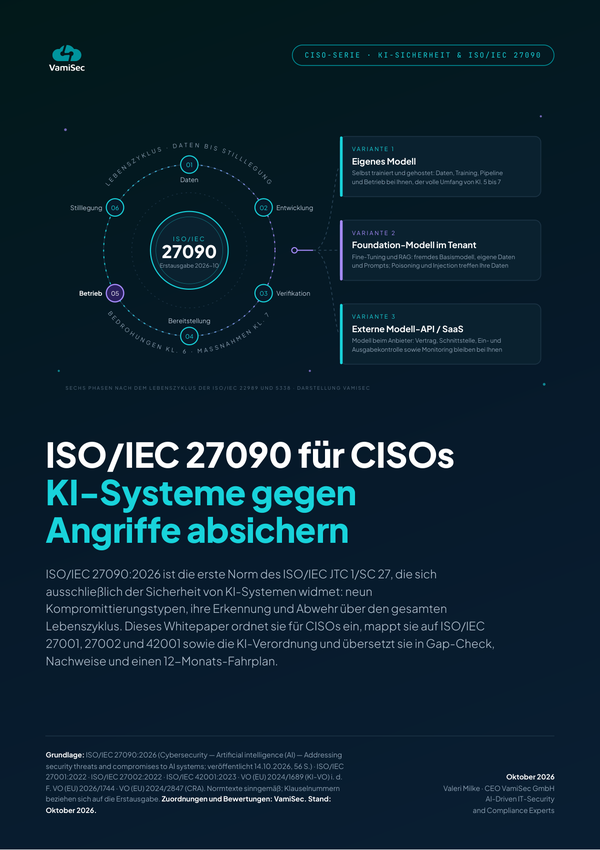
- Management summary and key statements for the board paper — guidance standard rather than certificate, status, structure and the DACH situation
- Nine threat profiles with detection and mitigation, life-cycle mapping and a real-world case table from 2023 to 2026
- Mapping matrix to ISO/IEC 27002, 42001 Annex A, Art. 15 AI Act, NIST AI 100-2, MITRE ATLAS, OWASP and ETSI — with a DORA and BaFin column
- Self-assessment grid, SoA templates, audit questions for internal audit and certification audit, evidence matrix, KPIs and a 12-month roadmap with a 90-day start
What the whitepaper “ISO/IEC 27090 for CISOs” contains
Standard, context, recommendation — cleanly separated
Management summary and key statements for the board paper, status and development history with all stage dates from 2022 to 2026, the complete table of contents with a reading guide per clause and annex, the DACH status with no German-language edition, and the delineation from ISO/IEC 27091, 42001, 27001/27002, 23894, 22989 and 5338.
Nine threats as profiles
Every compromise type from Clause 6 with description, consequences, detection and mitigation in our own words, mapped to life-cycle phase, asset and protection goal, supplemented by Annex B and the cross-cutting topics from 6.11 and Clause 7 — plus a real-world case table from 2023 to 2026, from PoisonGPT via EchoLeak to the litellm incident of 21/10/2026.
Mapping matrix with a DORA column
The 27090 mitigation families against ISO/IEC 27002:2022, ISO/IEC 42001 Annex A, NIST AI 100-2, MITRE ATLAS v2026.09, OWASP LLM Top 10 2026, Agentic Top 10 and MCP Top 10, ETSI EN 304 223 and Art. 15(5) AI Act — plus a DORA and BaFin column for financial entities. A VamiSec working interpretation, not an official crosswalk.
Roadmap and audit readiness
A 90-day start and a 12-month roadmap, the self-assessment grid with nine threats by four dimensions, SoA templates for the Statement of Applicability, audit questions for internal audit and certification audit, an evidence matrix, KPIs for AI security, and answers to typical objections from the board discussion.
AIMS first: 27090 supplies the security mitigations, 42001 the management framework
ISO/IEC 42001 sets certifiable requirements for an AI management system; ISO/IEC 27090 describes concrete attacks on AI systems, their detection and mitigation – the two complement each other. The standard itself draws this line: Clause 5.2 describes the AI governance programme with inventory and risk analysis and refers to ISO/IEC 42001 for implementation; Clause 5.1 cites its Annex A controls A.6.2.3 and A.6.2.6. In our conviction, anyone who wants to govern AI security verifiably first needs the framework of governance, roles and risk process that 42001 sets out in the AIMS and 27001 in the ISMS, and then fills it with the threats and mitigations of 27090.
- ISO/IEC 42001:2023 has been published since 18/12/2023; no revision or amendment is registered at ISO.
- The European adoption EN ISO/IEC 42001:2026 is available, DIN EN ISO/IEC 42001:2026-08 in German; there is no German-language edition of 27090.
- The accreditation basis for 42001 certifications is ISO/IEC 42006:2025; in Germany, no DAkkS-accredited body was listed as of 22/10/2026.
- 27090 anchors itself in 42001 Annex A via A.6.2.3 (documentation of design and development) and A.6.2.6 (operation and monitoring).
ISO/IEC 27090 cites ISO/IEC 42001:2023 only in the bibliography; an “ISO 27090” certificate does not exist — the audit benchmark remains 27001 and 42001.
Glossary: terms of ISO/IEC 27090 and its context
26 terms in citable short definitions, in our own words and with references to clauses of the standard, the AI Act and complementary frameworks; synonyms and alternative designations included.
- AI systemArtificial intelligence system
- Technical system that generates outputs such as predictions, content or decisions from inputs by means of models; ISO/IEC 27090 adopts the term from the normatively referenced ISO/IEC 22989. The standard treats AI systems as integrated software components carrying all classic vulnerabilities plus new, data-driven threats (5.1).
- Foundation modelBase model, pre-trained model
- Large model pre-trained on broad data that can be adapted to many tasks; defined in ISO/IEC 27090 as term 3.27, alongside LLM (3.28) and generative AI (3.29). Whoever sources a foundation model inherits its training history as a supply chain risk under 5.5.
- Fine-tuningPost-training, adaptation
- Further training of a pre-trained model with your own data. It shifts responsibility: your own data becomes the attack surface for Data Poisoning (6.2), the pipeline needs protection like a development environment (7.6), and under Art. 25 AI Act a deployer can become a provider.
- RAGRetrieval Augmented Generation
- Technique in which a language model retrieves matching documents from a knowledge base before answering. ISO/IEC 27090 names RAG explicitly in 5.3: every document retrieval should be individually authenticated and authorised; the knowledge base is at the same time a target for poisoning.
- AI agentAgentic system, agentic AI
- LLM-based system that autonomously invokes tools, executes actions and plans sub-goals; ISO/IEC 27090 does not define the term, agents appear only in 5.3 with individual authorisation per agent action. Taxonomies for agent risks are provided by OWASP Top 10 for Agentic Applications and MITRE ATLAS.
- Data PoisoningTraining data poisoning
- Manipulation of training data to corrupt model behaviour in a targeted or untargeted way; type 6.2 and the longest clause of the standard. Detection is considered an open research question; provenance (6.11.4) and data limitation (6.11.2) are the levers.
- Direct Model PoisoningModel poisoning, backdoor attack
- Direct tampering with the parameters or architecture of a model, in development or operation (6.7, term 3.18); the backdoor attack under 3.24 is defined generically. Mitigation: protection of the development environment (7.6), integrity verification of sourced models (5.5).
- Evasion AttackAdversarial Attack, Adversarial Example
- Manipulated inputs at inference time that lead the model to wrong decisions, often imperceptible to humans (6.3, term 3.14); Art. 15(5) AI Act names the same case as “adversarial examples or model evasion”. Countermeasures are adversarial training and input filters under 7.7.2.
- Membership InferenceMembership inference attack
- Attack that infers from model responses whether a specific record was part of the training data (6.4, term 3.15); what is affected is the confidentiality of the training data. Mitigated by output limitation, differential privacy and data limitation; ISO/IEC 27091 deepens the privacy side.
- Model ExfiltrationModel Stealing, Model Extraction
- Replication of a model through many legitimate queries without access to the weights (6.5, term 3.16; Model Stealing and Model Extraction are treated as synonyms). According to the Introduction, this succeeds despite intact standard controls; on our reading, throttling (7.8), logging (7.5) and model size (7.9) from Clause 7 apply here.
- Model InversionModel inversion attack
- Reconstruction of training data or its characteristics from model outputs (6.6, term 3.17); unlike Membership Inference, the attack targets the content of the data. The countermeasures overlap: output limitation, differential privacy, data limitation under 6.11.2.
- Sensitive Model OutputSensitive information disclosure
- Model output that discloses confidential training data or earlier inputs (6.8, term 3.22); the typical case is an assistant that carries internal documents outside through its answer. Mitigation: output filters, data limitation under 6.11.2, classification of the data before integration.
- Prompt Injectiondirect / indirect
- Attack in which content is injected as or into an input instruction (6.9, term 3.23); the definition covers the indirect variant via documents, web pages or e-mails. Countermeasures: input filters under 7.7, separation of instruction and data, human approval.
- Output containing injection attacksOutput contains injection attacks, improper output handling
- Model output that itself contains malicious code, commands or exfiltration instructions for downstream systems (6.10); OWASP LLM10 describes the same case. Mitigation from application security: output encoding, allowlists, no unverified execution.
- JailbreakJailbreaking
- Circumvention of a model's behavioural rules through role play, task decomposition or rephrasing so that it delivers blocked content or actions. ISO/IEC 27090 has no dedicated clause for it; on our reading, the case sits between Prompt Injection (6.9) and undesired model behaviour in operation (6.11.3).
- Zero trust for AI systemsZero trust principles (5.3)
- Transfer of the zero trust principles from ISO/IEC 27002 8.27 to AI in 5.3 with five examples: protection of training data, model access controls including RAG, boundaries of the AI application, agent action verification and monitoring. They feed into all mitigations 6.x.4.
- Red teamingAdversarial testing
- Targeted attack simulation against an AI system to test detection and defence before operation (5.7); the standard lists red teaming as a practice, not as an obligation, and 7.2 recommends testing all mitigations together. NIST AI 100-2 names tools in Section 3.6: AgentDojo, Garak, PyRIT.
- AI-BOMAI Bill of Materials, model supply chain
- Bill of materials of an AI system: models, datasets, libraries, tools, prompt templates and services with provenance and version. ISO/IEC 27090 devotes Clause 5.5 to the supply chain; the AI-BOM is the practical evidence instrument for it.
- ISMSInformation security management system, ISO/IEC 27001
- Management system for information security under ISO/IEC 27001:2022, certifiable. ISO/IEC 27090 builds on it: controls under ISO/IEC 27002 are to be implemented on a risk basis (5.1), and risk treatment under 27001 Clause 6.1 permits controls from any source.
- AIMSAI management system, ISO/IEC 42001
- AI management system under ISO/IEC 42001:2023, certifiable on the basis of ISO/IEC 42006:2025; 27090 refers in 5.2 to 42001 for the governance programme and in 5.1 to controls A.6.2.3 and A.6.2.6. A 42001 certificate evidences governance, not resilience against the nine attack types.
- SoAStatement of Applicability
- Statement under ISO/IEC 27001 that records which controls were selected and why. Because Annex A is not exhaustive, mitigations from ISO/IEC 27090 (such as 6.9.4 or 7.8) can be entered as additional controls with their source cited.
- High-risk AI systemAnnex I / Annex III AI system (AI Act)
- AI system under Annex III (obligations from 02/12/2027) or as a safety component of regulated products under Annex I (from 02/08/2028) of the AI Act. Art. 15(5) requires for these, as appropriate, resilience against the attack classes described in 27090; the standard does not create a presumption of conformity.
- Provider / DeployerRoles under the AI Act
- Roles of the AI Act: the provider develops and places on the market, the deployer uses under its own responsibility; ISO/IEC 27090 does not define these roles, every assignment is interpretation. Under Art. 25 AI Act a deployer can become a provider through branding, substantial modification or change of intended purpose.
- MITRE ATLASAdversarial Threat Landscape for AI Systems
- Knowledge base of adversarial tactics, techniques and case studies against AI systems; release v2026.09 with 16 tactics, 120 techniques, 40 mitigations and 73 case studies. ISO/IEC 27090 cites ATLAS in the bibliography; there is no official mapping.
- NIST AI 100-2 E2025Adversarial Machine Learning: A Taxonomy and Terminology
- Taxonomy and terminology of adversarial attacks on predictive and generative AI, final since 24/03/2025, with Section 3.5 on the security of agents and 3.6 on benchmarks. 27090 does not cite the document; it complements the standard on attack variants and agent questions.
- ETSI EN 304 223ETSI TS 104 223, Securing Artificial Intelligence
- European standard for securing AI (EN V2.1.1, 2025-12; predecessor TS 104 223 of April 2025) with 13 principles and 72 provisions across five phases from design to end of life. ISO/IEC 27090 names EN 304 223 in 5.1 as an example of an AI security standard; the two are not harmonised.
Frequently asked questions about ISO/IEC 27090
Short answers to typical questions from the CISO office, AI engineering, compliance and internal audit — with clause references for further reading.
ISO/IEC 27090:2026 is an ISO/IEC guidance standard published on 14 October 2026 (56 pages, JTC 1/SC 27) that describes nine AI-specific attack types together with their detection and countermeasures – it is not certifiable. It was developed by Working Group WG 4 of Subcommittee SC 27; its title is “Cybersecurity — Artificial intelligence (AI) — Addressing security threats and compromises to AI systems”. The standard addresses organisations of every kind and size that develop or use AI systems and extends ISO/IEC 27001 and 27002 with threats such as Data Poisoning, Evasion, Model Exfiltration and Prompt Injection.
Yes. ISO/IEC 27090:2026 has been published as an International Standard since 14/10/2026 (stage code 60.60, first edition, 56 pages, English only). The route there: project start in September 2022, Committee Draft in January 2024, DIS ballot from April 2025, FDIS ballot from 23/06 to 19/08/2026. The standard is available from ISO (CHF 204), in the IEC Webstore (publication 117332) and from national distributors such as DIN Media; the ISO catalogue page is authoritative for the status.
No. ISO/IEC 27090 is not certifiable: it extends ISO/IEC 27001 and 27002 with AI-specific threats and the AI management system under ISO/IEC 42001 with concrete descriptions of attacks and defences. It is a guidance standard with the status of an International Standard, not a management system standard; an “ISO 27090 certificate” or an “audit against 27090” does not exist. What remains certifiable are the ISMS under 27001 and the AIMS under 42001, in which 27090 serves as a source of controls in the Statement of Applicability and as a threat catalogue. VamiSec note: offers that advertise “27090 conformity” confuse a guidance standard with a requirements standard.
ISO/IEC 42001 sets certifiable requirements for an AI management system; ISO/IEC 27090 describes concrete attacks on AI systems, their detection and defence – the two complement each other. ISO/IEC 42001:2023 demands governance: roles, risk assessment, impact assessment, life cycle processes, supplier management; its Annex A lists security controls but names no attacks. 27090 refers in 5.2 to 42001 for the governance programme and in 5.1 to controls A.6.2.3 and A.6.2.6. 42001 thus answers who is accountable for AI and how decisions are made, 27090 which attacks a system must withstand and how to recognise them. A 42001 certificate therefore evidences governance, not resilience; in Germany, as at 22/10/2026, there is no DAkkS-accredited 42001 certification body.
It neither replaces the two standards, nor is a certificate a prerequisite; 27001 and 27002 are, however, the foundation. ISO/IEC 27090 assumes in 5.1 that controls such as those from ISO/IEC 27002 are implemented on a risk basis, and cites 27002:2022 Clauses 5 to 8, the control attributes in 4.2, logging and monitoring in 8.15 and 8.16, zero trust in 8.27 and 27001 Clause 6.1. Anyone starting without an ISMS must first build inventory, risk analysis, access control and logging before the AI-specific mitigations can take effect. VamiSec recommendation: carry 27090 mitigations as additional controls in the existing Statement of Applicability; an AI amendment to ISO/IEC 27002:2022 is not registered.
ISO/IEC 27090 covers nine compromise types in Clause 6: Data Poisoning, Evasion, Membership Inference, Model Exfiltration, Model Inversion, Direct Model Poisoning, Sensitive Model Output, Prompt Injection and Output containing injection attacks. Each type follows the same pattern: description, malfunctions, detection, mitigation. Clause 6.11 adds data limitation, undesired model behaviour in operation and provenance; Annex B adds AI variants of conventional attacks such as Direct Model Theft, Direct Training Data Leak and Model Input Leak and, according to draft reviews, DoS and supply chain attacks; Annex C covers federated learning. Out of scope are deepfakes, AI-assisted phishing, AI as a defensive tool, safety (ISO/IEC TR 5469) and privacy (ISO/IEC 27091). Authoritative for the count are the nine Clauses 6.2 to 6.10, not the divergent figures in secondary sources.
The standard has no numbered control catalogue; mitigations are set out per attack type in Clauses 6.x.4 and across the board in Clause 7. Clause 5 lays the practical foundation: an AI governance programme with inventory and risk analysis (5.2), zero trust with protection of training data, model access controls, application boundaries, agent action verification and monitoring (5.3), software engineering practice with reference to the NIST SSDF (5.4), supply chain management (5.5), threat modelling (5.6) and red teaming (5.7). Clause 7 addresses interactions between mitigations, continuity across the life cycle, the decay of model and mitigations, logging and monitoring, protection of the development environment, input filters, throttling and model size. The common thread is defence in depth: no single measure, but a combination that is tested together before deployment.
For LLMs and Prompt Injection yes, for agents only in part. The standard defines foundation model, LLM and generative AI in 3.27 to 3.29, devotes dedicated clauses to Prompt Injection in 6.9 (including indirect injection) and output containing injection attacks in 6.10, and treats RAG in 5.3 with individual authorisation per document retrieval. Agentic AI appears in the freely accessible parts only in 5.3 under “Agent action verification”: every action individually verified and authorised, just-in-time access, rights expiring after the task. There is no dedicated compromise type for tool misuse, memory poisoning or rug pulls, the Model Context Protocol appears neither in the abbreviations nor in the bibliography, and heise speaks of a treatment “only in passing”. Therefore supplement it with OWASP Top 10 for Agentic Applications 2026, OWASP MCP Top 10, MITRE ATLAS v2026.09 and the NSA guidance on the Model Context Protocol of May 2026.
ISO/IEC 27090 creates no presumption of conformity under the AI Act or the Cyber Resilience Act; that role is reserved for the harmonised standard prEN 18282 from CEN/CENELEC JTC 21, which is still at draft stage. The standard is not mandatory; the obligations for high-risk AI follow from Art. 9 and 15 AI Act, after the Digital Omnibus from 02/12/2027 for Annex III and from 02/08/2028 for Annex I. Art. 15(5) names Data Poisoning, Model Poisoning, Adversarial Examples or Model Evasion as well as Confidentiality Attacks and Model Flaws, exactly the terms from Clause 6; 27090 is therefore a robust implementation aid, but not a harmonised standard. prEN 18282 was rejected in the enquiry (consultation until 30/07/2026) by the majority of national standards bodies; DIN EN 18282:2026-11 is open for comment until 09/12/2026. What is actually available is the route via Art. 42(3) AI Act: high-risk AI within the scope of the CRA is deemed compliant with Art. 15 as regards cybersecurity if CRA Art. 12 is fulfilled.
Yes. The scope covers organisations that develop or use AI systems; 5.1 speaks of actors along the entire supply chain. As a pure user you do not control training and weights: on our reading, Data Poisoning and Direct Model Poisoning become supply chain questions under 5.5 (model provenance, the provider's handling of your inputs, notice of model changes), while Sensitive Model Output, Prompt Injection and output injection under 6.8 to 6.10 sit within your integration. The zero trust examples in 5.3, boundaries of the AI application and individual authorisation of RAG retrievals, fit precisely this constellation. Under the AI Act you remain the deployer as long as you do not substantially modify or repurpose the system (Art. 25 AI Act); financial entities classify the same constellation under DORA Art. 28 to 30.
ISO/IEC 27090 addresses security threats against AI systems, ISO/IEC 27091 the protection of privacy in AI systems, and 27091 is not yet published. 27091 (ISO ID 56582, 35 pages at FDIS stage) is being developed in SC 27 WG 5 and has been at Stage 50.00 since 13/07/2026; as of 22/10/2026 the FDIS ballot had no date yet, and publication in early 2027 is merely a projection. In substance the standards overlap on Membership Inference, training data extraction and Model Inversion: 27091 treats them as a privacy risk with privacy engineering across the life cycle, 27090 as a confidentiality attack with technical detection and defence. 27090 cites 27091 in the bibliography; a back-reference from 27091 to 27090 is not documented.
There is no German version of ISO/IEC 27090: DIN Media and SNV distribute only the English ISO original, no ÖNORM adoption is known; a British adoption BS ISO/IEC 27090:2026 is announced for 31 October 2026. DIN Media lists the ISO original ISO/IEC 27090:2026-10 at EUR 218.32 net, SNV at CHF 215, ISO itself at CHF 204 as PDF, ePub or print. A free PDF of the full version does not exist; only previews are freely accessible (iTeh sample with Clauses 1 to 4 and 5.1 to 5.3, IEC preview with table of contents and bibliography). The German companion title in the DIN Media catalogue is a catalogue translation of the old CD title; in the responsible DIN working committee NA 043-04-27-04 AK no adoption project is listed as at 22/10/2026.
DORA applies directly, not 27090; the standard does, however, supply the AI-specific threat vocabulary that DORA and the BaFin guidance presuppose. The BaFin guidance on ICT risks in the use of AI (18/12/2025, non-binding) names Data Poisoning, Evasion Attacks, Prompt Injection and model drift explicitly, speaks of “inference attacks” and “stealing models”, but does not mention AI agents. DORA anchors for the 27090 topics are the ICT risk management framework in Art. 5 to 15, the testing programme in Art. 24 and 25 and third-party risk in Art. 28 to 30. VamiSec maps the 27090 clauses to these provisions in a dedicated DORA column, as a working interpretation, not as an official mapping.
With the inventory: record all AI systems as assets with model source, training and fine-tuning data, RAG sources, tool permissions and providers, as the governance programme in 5.2 envisages. Then take the nine compromise types per system into the risk assessment under ISO/IEC 27001 Clause 6.1 using threat modelling under 5.6, select mitigations from 6.x.4 and Clause 7, and cite 27090 as the source in the Statement of Applicability. Extend supplier assessment under 5.5 to model providers, and repeat red teaming under 5.7 at every change of model, system prompt or retrieval source. Auditors under 27001 or 42001 will want to see exactly this evidence: inventory with owners, risk entries per attack type, SoA justifications, logging of inference and tool calls, test reports and an incident process with AI tagging.
Standards & Sources
The content on this page is based on the following publicly available guides and studies.
ISO/IEC 27090:2026 — Cybersecurity — Artificial intelligence (AI) — Addressing security threats and compromises to AI systems (preview)
Primary source of this page — iTeh sample PDF with cover sheet, table of contents, Foreword, Introduction, Clauses 1 to 4 and 5.1 to 5.3; full version (56 pages) available only against payment
ISO catalogue page ISO/IEC 27090:2026 (ID 56581)
Life cycle with stage codes (60.60 on 14/10/2026), FAQ and benefits; citable reference for status and scope
IEC Webstore, publication 117332: ISO/IEC 27090:2026
Edition 1.0 of 14/10/2026, 56 pages; second official source with preview (table of contents, Introduction, bibliography)
ISO/IEC 27090 explained
Official explainer, FDIS-based; on 22/10/2026 still carrying the status note “currently under publication” — useful for scope and the distinction from ISO/IEC 42001; use the catalogue page for the status
BS ISO/IEC 27090:2026 (BSI Knowledge)
British adoption, publication date 31/10/2026 (announced), identical to ISO/IEC 27090; reference list with normative and informative references
ISO/IEC 27090:2026-10 at DIN Media
Distribution of the English ISO original in Germany (EUR 218.32 net); no DIN version, the German companion title is a catalogue translation
SC 27 Journal 2026, Issue 2 — “ISO/IEC 27090: A foundational standard for securing artificial intelligence systems”
Article by Milan Patel (pp. 30–34, September 2026): positioned as the first SC 27 standard dedicated to the security of AI systems
ISO/IEC JTC 1/SC 27 — Information security, cybersecurity and privacy protection
Committee page with structure and working groups; WG 4 “Security controls and services” is responsible for ISO/IEC 27090
ISO/IEC FDIS 27091 — Cybersecurity and Privacy — Artificial Intelligence — Privacy protection (ID 56582)
Sister standard on privacy in AI systems, Stage 50.00 since 13/07/2026, FDIS ballot without a date as of 22/10/2026 — not published
ISO/IEC 27090 soll KI-Systeme sicher machen (in German)
Specialist report of 19/10/2026; classifies agentic AI as treated “only in passing”
AI Act, Art. 15 — Accuracy, robustness and cybersecurity
Art. 15(5) names Data Poisoning, Model Poisoning, Adversarial Examples or Model Evasion, Confidentiality Attacks and Model Flaws — terms covered by Clause 6 of ISO/IEC 27090
Digital Omnibus on AI — Regulation (EU) 2026/1744
In force since 27/07/2026; high-risk obligations for Annex III from 02/12/2027, Annex I from 02/08/2028; Art. 42(3) (presumption via CRA Art. 12)
Regulation (EU) 2024/2847 — Cyber Resilience Act
Reporting obligations under Art. 14 since 11/09/2026, main obligations from 11/12/2027; Art. 12 governs the relationship between high-risk AI and the CRA
DIN EN 18282:2026-11 — Artificial intelligence — Cybersecurity specifications for AI systems (draft)
German-English edition of prEN 18282 (CEN/CLC/JTC 21), comment deadline 09/12/2026; rejected in the enquiry (consultation until 30/07/2026) by the majority of national standards bodies; the intended harmonised standard for Art. 15 AI Act, as yet without legal effect
ETSI EN 304 223 V2.1.1 — Securing Artificial Intelligence (SAI); Baseline Cyber Security Requirements for AI Models and Systems
European standard (2025-12) with 13 principles and 72 provisions; named by ISO/IEC 27090 in 5.1 as an example of an AI security standard
NIST AI 100-2 E2025 — Adversarial Machine Learning: A Taxonomy and Terminology of Attacks and Mitigations
Final since 24/03/2025; taxonomy for predictive and generative AI, Section 3.5 Security of Agents, 3.6 Benchmarks — not cited by 27090, used as a complement
MITRE ATLAS — Release v2026.09
Release of 15/09/2026 (16 tactics, 120 techniques, 40 mitigations, 73 case studies); reference state of the ATLAS IDs in the VamiSec mapping — no official mapping to 27090
OWASP GenAI LLM Top 10 2026
Published in August 2026; LLM01 Prompt Injection to LLM10 Improper Output Handling — reference for the VamiSec mapping of types 6.8 to 6.10
OWASP Top 10 for Agentic Applications 2026
Published on 09/12/2025; ASI01 Agent Goal Hijack to ASI10 Rogue Agents — complements the agentic AI that is tangible in 27090 only in 5.3
Orientierungshilfe zu IKT-Risiken beim Einsatz von KI in Finanzunternehmen (BaFin guidance on ICT risks in the use of AI in financial undertakings)
As at 18/12/2025, 38 pages, non-binding; basis of the DORA column in the VamiSec mapping — names Data Poisoning, Evasion Attacks and Prompt Injection, but no AI agents
Securing your AI systems in line with ISO/IEC 27090?
VamiSec supports you with AI inventory and threat modelling, with integrating the 27090 mitigations into ISMS and AIMS, with red teaming and agentic AI pentests, and with supplier and model provider assessments — as implementation of a guidance standard, not as certification.