

The guidance describes itself as “non-mandatory advice”, states that it does “not constitute a binding interpretation of DORA by BaFin” and does not define any supervisory expectations (Ch. I). It is based, among other things, on discussions with financial entities and is intended as a living document that can be adapted to reflect technological progress and new regulatory developments (Ch. I.3). It is meant to support CRR institutions and Solvency II insurance undertakings in particular, and is therefore aimed primarily at BaFin-supervised entities that must comply with ICT risk management under Art. 5 to 15 DORA. According to BaFin, the simplified framework under Art. 16 DORA must be considered separately and is out of scope. Still, non-binding does not mean a free pass: the obligations arise directly from DORA, the RTS RMF and the RTS Subcontracting — the guidance shows how they translate to AI systems. Chief Executive Director Nikolas Speer summed it up when announcing the guidance on 4 December 2025: “Not a new rulebook, but a helping hand.” BaFin’s 2025 annual report phrases it differently: BaFin states that it communicated its “updated expectations” in the form of the guidance (both quotes: our translation) — read this as a signal of supervisory practice, not as an additional legal obligation.
BaFin AI guidance: managing ICT risks at financial entities under DORA
On 18 December 2025, BaFin published its non-binding guidance on ICT risks in the use of AI at financial entities. It is designed to help implement DORA’s requirements on ICT risk management and ICT third-party risk management for AI systems as well — along the entire AI lifecycle and with a case study on an LLM-based AI assistant. Throughout, this page separates what DORA and the RTS require, what BaFin describes as proven practice and what we recommend on top.
You will receive the download link immediately on the page and by email.
- 01Data
- 02Development
- 03Integration
- 04Operation
- 05Maintenance
- 06Retirement
According to BaFin, financial entities use AI along their entire value chain — from predicting customer migration in sales and supporting claims adjustment to the AI assistant that creates texts, presentations and program code. The legal framework is in place: DORA has applied since 17 January 2025; BaFin’s sector-specific IT circulars KAIT, VAIT and ZAIT have been repealed, and the BAIT no longer apply to DORA entities and will be repealed in full at the end of 31 December 2026. The guidance creates no new obligations — it details selected DORA requirements for AI systems: governance, the ICT risk management framework, development and testing, operation and retirement, cloud outsourcing, cyber and data security, and incident reporting. In parallel, since 29 July 2026 BaFin has been the market surveillance authority under the KI-MIG (Germany’s AI Act market surveillance and innovation act) for AI systems directly connected with regulated financial activities. This page makes the 38 pages actionable: the Scope Check clarifies what control depth is appropriate for your AI system, the Lifecycle Navigator and the Variant Lab translate the chapters and the case study into audit questions and evidence, and the Citation Navigator opens up all 97 citations by our count. The AI Resilience Check shows your maturity level per action area — and the whitepaper “KI unter DORA für CISOs” (“AI under DORA for CISOs”, in German) provides a roadmap, audit questions and an evidence matrix for the board and internal audit.
From the BDAI principles to high-risk AI
The milestones that set the framework for AI systems at German financial entities — from supervisory practice through DORA to the AI Act.
BaFin principles on big data and AI
BaFin publishes its principles paper “Big data and artificial intelligence: Principles for the use of algorithms in decision-making processes”.
Supervisory statement on cloud outsourcing
BaFin publishes its supervisory statement on outsourcing to cloud service providers as a joint assessment with the Deutsche Bundesbank — the revised version of its guidance of November 2018. Chapter IV.2 of the AI guidance draws on it.
AI Act enters into force
Regulation (EU) 2024/1689 enters into force. The guidance adopts its definition of an AI system in Art. 3(1); Chapters I and II of the AI Act have applied since 2 February 2025.
DORA applies
DORA (in force since 16 January 2023) becomes applicable. KAIT, VAIT and ZAIT were repealed at the end of 16 January 2025; since then, DORA entities have been excluded from the scope of the BAIT.
Announced by Nikolas Speer
In his keynote “IT supervision in the financial sector: the first year of DORA”, Chief Executive Director Nikolas Speer announces the guidance: “Not a new rulebook, but a helping hand.” (our translation)
Guidance published
BaFin publishes the German original of its “Guidance on ICT Risks in the Use of AI at Financial Entities” (Division CTF 5, 38 pages) with a news release — expressly as non-mandatory advice.
English version
The translation “Guidance on ICT Risks in the Use of AI at Financial Entities” is published (version date 23 January 2026, 35 pages). The German original remains authoritative.
KI-MIG enters into force
BaFin becomes the market surveillance authority for AI systems directly connected with regulated financial activities (section 2(3) KI-MIG); otherwise, the Federal Network Agency (Bundesnetzagentur) is responsible.
BAIT fully repealed
The BAIT are repealed in full at the end of the day. DORA entities have already been excluded from their scope since the end of 16 January 2025.
High-risk AI under Annex III
Following the postponement by Regulation (EU) 2026/1744, the high-risk obligations for Annex III apply — including creditworthiness assessment of natural persons (point 5(b)) and risk assessment and pricing in life and health insurance (point 5(c)). Where such systems are placed on the market, put into service or used in direct connection with the regulated financial activities of supervised entities, BaFin is the market surveillance authority (section 2(3) KI-MIG).
Nine key messages of BaFin’s guidance on ICT risks in the use of AI
Click a card to read the key message with citations — the order follows the structure of the guidance, from scope to incident reporting.
Lifecycle Navigator: six phases of the AI lifecycle, two cross-cutting topics
Select a phase from BaFin’s case study or a cross-cutting topic. For each, you will see typical risks, the citations in DORA and the RTS RMF, the measures the guidance describes as proven, an audit question and evidence for internal audit and supervisory dialogue. The measures in the guidance are illustrative; only the obligations under DORA and the RTS RMF referenced in the legal anchors are binding. The mapping of citations to phases, the risk ratings, audit questions and evidence are VamiSec’s own assessments.
Data acquisition & preparation
A significant risk the case study identifies for every infrastructure variant: the AI application processes data that has not been approved for it. The case study therefore describes comprehensive classification by confidentiality level as essential — Ch. VI notes that this may require significant effort. Data quality beyond integrity, by contrast, is not governed by DORA; the guidance places it within AI governance.
CitationGuidance, Ch. IV.1 and V.2; case study, Phase 1
Typical risks
- AI application processes data that has not been approved or classified for it (high)
- Manipulated or corrupted data impairs model performance and security (data integrity) (high)
- Inference attacks: deducing personal data through multiple queries (medium)
- Unclear provenance, storage locations and ownership of training data (medium)
- Data bias and quality defects — beyond integrity, not governed by DORA (low)
Legal anchors
Proven measures per the guidance
- Detect confidential data automatically wherever possible and classify it by confidentiality level.
- Zero-trust policy: the AI application retrieves only authorized data; users access data through a role-based model.
- Provide in-depth user training on the AI application and on selecting and processing data.
- Use differential privacy wherever possible to protect personal data from inferences drawn across multiple queries.
- Tokenize sensitive data before the AI assistant processes it.
- Validate and cleanse data before use — automatically or by manual sampling — to detect and avoid bias.
- Record training data sets as information assets: document provenance, storage location across the lifecycle and responsibilities in a traceable way (Art. 4(2)(b) RTS RMF).
- Encrypt data in line with its classification — at rest, in transit and, where necessary, in use (Art. 6(2) RTS RMF).
Can you show, for every AI use case, which data classes it may process — and technically prevent unapproved data from getting in?
Evidence you can present
- Data classification policy with confidentiality levels and approval rules per AI application
- AI data inventory: training, fine-tuning and RAG sources with provenance, storage location and owner
- Access authorization model (RBAC) for the AI application and data sources, with recertification records
- Records of data validation and cleansing (validation rules, samples)
- Training records for the AI application’s user groups
Model development & training
Anyone who fine-tunes models, feeds them corporate knowledge via retrieval-augmented generation or sources open-source models from shared repositories faces, according to the case study, the risk of data, knowledge or model poisoning. The guidance anchors the defense in the standard processes of the RTS RMF: project management, specifications, change management and testing — explicitly also for end-user computing and AI-generated code.
CitationGuidance, Ch. III.1; case study, Phase 2
Typical risks
- Data poisoning during (re-)training alters model behavior unexpectedly (high)
- Knowledge poisoning through unvetted content in the RAG knowledge base (high)
- Model poisoning and backdoors in open-source models or models from shared repositories (high)
- Malicious code or unmaintained open-source libraries in training and development (medium)
- AI-generated code invokes unknown AI functions; EUC developments bypass standard processes (medium)
Legal anchors
Proven measures per the guidance
- Source training and test data only from trustworthy sources; (re-)train models only with verified and validated entity data.
- Verify and validate the RAG knowledge base (context, grounding) before integration; a data governance team can approve data for AI processing.
- Document and version the entire training process; version control for models enables rollback after a malfunction or faulty training.
- Review the source code of publicly available models for backdoors and malicious code and ensure the integrity of repositories and model providers; use only libraries without known vulnerabilities.
- Run security analyses for hidden manipulation in model and training data; for pre-trained models, use an auditing framework with XAI, anomaly detection, penetration testing and red teaming.
- Maintain technical specifications with security requirements such as protection against manipulation, and describe algorithms, data and parameters (Art. 16 RTS RMF).
- Robust project management from planning to operation, an isolated development and test environment, and changes with independent review and fall-back procedures (Art. 15 and 17 RTS RMF).
- Check AI-generated code with static code analysis for unknown AI function calls; run EUC developments through the same processes (Art. 16(3) and (9) RTS RMF).
Who approves training, fine-tuning and RAG data — and can you reproduce or roll back every production model version together with its data state?
Evidence you can present
- Approval records for training, fine-tuning and RAG data (data governance team)
- Versioned model and training history with tested rollback
- Review reports on open-source models and libraries: provenance, vulnerabilities, backdoor checks
- Technical specification covering algorithms, data, parameters and security requirements
- Static code analysis results for AI-generated code and EUC applications
Model deployment & integration
If the AI assistant is not implemented securely, the case study warns, attackers can gain unauthorized access to internal systems or exfiltrate model information. Before go-live, the testing and approval obligations of the RTS RMF apply (Art. 16(2), (3) and (8)); the guidance singles out one particular challenge here: recognizing whether an application integrates external AI models via API and thus becomes an AI system without this having been planned.
CitationGuidance, Ch. III.2; case study, Phase 3
Typical risks
- Insecure implementation opens the door to unauthorized access to internal systems (high)
- Undetected integration of external AI models via API turns software into an AI system unnoticed (high)
- Exfiltration of model information, up to and including model theft (medium)
- Overload (denial-of-service) attacks on the API layer (medium)
- Unannounced changes to models obtained from third parties make testing harder (medium)
Legal anchors
Proven measures per the guidance
- Develop and document tests according to criticality; verify that the AI system is appropriate for its intended purpose (Art. 16(2) RTS RMF).
- Test source code statically and dynamically before production; analyze proprietary, third-party and open-source software in advance (Art. 16(3) and (8) RTS RMF).
- Identify during testing whether applications integrate external AI models via APIs; check open-source functions for unknown AI functionality.
- Depending on criticality, adversarial testing (e.g. data poisoning, evasion), adversarial penetration tests and stress tests; for GenAI, use-case-specific test procedures.
- For purchased AI systems, involve the manufacturer in testing and obtain evidence that the tests were performed.
- Deploy AI assistants in an isolated cloud environment without direct internet access and separate them from other ICT systems through containerization.
- Multi-factor authentication and conditional access policies: only authorized users with company-owned devices can access the AI assistant.
- Critically review interfaces to corporate systems (human-in-the-loop, e.g. approval by the data owner); encrypt APIs, apply rate limiting and DDoS protection.
Did you check before go-live which external AI models your applications call via API — and is the assistant deployed in isolation and adversarially tested?
Evidence you can present
- Test strategy and test records by criticality, incl. adversarial and stress tests
- SAST/DAST reports and analysis of third-party and open-source code before go-live
- Go-live approval record (production acceptance)
- Interface and data flow documentation incl. isolation, MFA and conditional access
- Manufacturer’s test evidence for purchased AI systems
Operation & use
For ongoing operation, the case study identifies three ICT risks: extraction of confidential information, including via prompt injection; disclosure of confidential data to unauthorized users; and access to connected systems via LLM APIs. It explicitly classifies hallucinations as not directly ICT-related. In legal terms, operation rests on the inventory, capacity management, detection and business continuity requirements of DORA and the RTS RMF.
CitationGuidance, Ch. IV.1; case study, Phase 4
Typical risks
- Prompt injection, including indirectly via websites containing hidden instructions for the LLM (high)
- Compromised or malfunctioning assistant discloses confidential data to unauthorized users (high)
- Access to connected corporate systems through the LLM’s API connections (high)
- Extraction of confidential training data from fine-tuned, publicly accessible LLMs (medium)
- Capacity bottlenecks and outages jeopardize AI-supported processes (medium)
Legal anchors
Proven measures per the guidance
- Provide explainability tools that let users understand why the AI gives a particular answer.
- Provide AI security training against misinterpretation and careless use; investigate which prompts trigger which effects, and define restrictions.
- Monitor AI interactions in a situation-specific way and identify abnormal activity in the assistant environment.
- Assign access rights appropriately and review the isolation of LLMs; restrict LLM use for critical or important functions where appropriate.
- Human-in-the-loop: introduce a human review requirement for security-critical AI responses and recommendations.
- Review resource requirements and performance regularly; monitor the AI infrastructure automatically to avoid capacity bottlenecks (Art. 9 RTS RMF).
- Log AI decisions, model versions and training data on a risk basis, to the extent permitted by data protection law; for critical or important functions, define thresholds for anomalous behavior (Art. 10 DORA).
- Include AI systems in business continuity plans according to their criticality, incl. RTO/RPO, test at least annually and involve ICT third-party service providers (Art. 11, 12 and 28 DORA).
Would you detect today if your AI assistant disclosed confidential data to unauthorized users or were being steered via prompt injection — and who would step in?
Evidence you can present
- AI inventory with criticality, owner, model version and dependencies (Art. 8(4) DORA)
- Monitoring plan with thresholds, alert criteria and analysis of AI interactions
- Business continuity plan with RTO/RPO for AI systems and a documented annual test
- Capacity and performance reports for the AI infrastructure
- Usage policy with prompt restrictions, plus training records
Maintenance, updates & incident response
Particularly with open-source LLMs, outdated or misconfigured software versions can open up security gaps, according to the case study. The legal basis here is vulnerability and patch management (Art. 10 RTS RMF) and the ICT-related incident management process (Art. 17 DORA), whose policy, per the guidance, should ideally also address AI systems. The obligation to report major ICT-related incidents (Art. 19 DORA) may also cover incidents in AI systems.
CitationGuidance, Ch. IV.1, V.1 and V.3; case study, Phase 5
Typical risks
- Outdated or misconfigured software versions, especially with open-source LLMs (high)
- Manipulation of AI systems can cause significant operational harm within a short time (high)
- AI incidents are not detected, not flagged or not reported in time (high)
- Unmaintained libraries with known, unresolved vulnerabilities (medium)
- Unannounced model changes by the provider, such as retraining or a changed model structure (medium)
Legal anchors
Proven measures per the guidance
- Control updates of the AI assistant automatically via a suitable tool; use patch management tools to close security gaps quickly.
- Run regular automated vulnerability scans of libraries, frameworks and source code; set clear patch deadlines and escalation processes (Art. 10 RTS RMF).
- Introduce a security incident response plan (SIRP) for AI assistant-specific incidents; simulate cyberattacks to test response times.
- Define approval and assessment processes for emergency changes to AI systems that allow changes to be made at short notice (Art. 17(1)(f) and (g) RTS RMF).
- Flag AI incidents, identify AI-specific threats such as manipulated training data, assess impact and severity levels, and integrate them into the general incident response policy.
- For AI in the cloud, make arrangements for incident reporting and provide qualified internal resources for assessment and response.
- After incidents, carry out a detailed root cause analysis and feed the findings back into systems, models and processes (Art. 13(3) DORA).
- Regular external audits and a central compliance dashboard showing model version, risk assessments and responsibilities.
How quickly do you close a critical vulnerability in your AI stack — and does your incident process flag AI incidents and check the reporting obligation under Art. 19 DORA?
Evidence you can present
- Patch and vulnerability reports for the AI stack with evidence that deadlines were met
- SIRP for AI assistants and record of the latest attack simulation
- Incident register with AI flag, severity level and root cause analysis
- Compliance dashboard (model version, risk assessment, owners) and external audit reports
- Contractual reporting arrangements with cloud and AI providers
Retirement & end of life
Uncontrolled continued use or unsafe retirement can lead to historical data and models being misused or leaked. The case study therefore treats the retirement of LLMs and associated data sources as a planning task, as with all ICT assets; Ch. IV.1 links deinstallation specifications to Art. 8(2)(a)(i) RTS RMF, and Ch. IV.2 links the exit strategy for AI applications supporting critical or important functions to Art. 28(7) and (8) DORA.
CitationGuidance, Ch. IV.1 and IV.2; case study, Phase 6
Typical risks
- Misuse or leaks of historical data, AI interactions and models after retirement (high)
- Obsolete model versions remain active or continue to be used without control (medium)
- Former employees and expired accounts retain access to the AI assistant (medium)
- Models, training data and configuration cannot be exported on a change of provider or exit (medium)
Legal anchors
Proven measures per the guidance
- Govern deinstallation in policies and procedures; remove AI models irretrievably after deletion (Art. 8(2)(a)(i) RTS RMF).
- Govern the deactivation of obsolete model versions to prevent misuse.
- Plan the retirement of LLMs and associated data sources as with all ICT assets.
- Delete all data used and historical AI interactions in compliance with the GDPR.
- Use cryptographic wiping to securely remove stored corporate data.
- Block the AI assistant for expired user accounts and former employees.
- For cloud AI, clarify in advance the formats in which models, training data and metadata can be exported; store data periodically in a provider-independent location (Art. 28(8) DORA).
- VamiSec recommendation: document retirement as a change with formal acceptance and obtain deletion confirmations from providers for models, data and interaction history.
For every retired AI system, is there evidence that models, data and interaction history have been irretrievably deleted and all access has been blocked?
Evidence you can present
- Retirement and deinstallation procedure for AI systems in the operations policy
- Deletion logs incl. cryptographic wiping and GDPR deletion evidence
- List of deactivated model versions with date and owner
- Evidence of account blocking for former users (recertification)
- Exit plan with agreed export formats and provider-independent data backup
Governance, organization & ICT risk management framework
Ch. II lays the foundation for all phases: like other ICT systems, AI systems are assessed by risk profile, complexity and the functions they support, and integrated into the ICT risk management framework. Binding obligations under DORA are the management body’s ultimate responsibility (Art. 5(2)(a) DORA) and the review of the framework at least once a year (Art. 6(5) DORA). The guidance describes an AI strategy approved by the management body — stand-alone or integrated into an overarching strategy, possibly based on a technology roadmap — as common practice, not an obligation.
CitationGuidance, Ch. II.1 to II.3
Typical risks
- AI systems missing from the ICT risk management framework and the inventory (high)
- Unclear responsibility for AI-generated results in decision-making processes (high)
- Management body and staff lack sufficient AI knowledge (medium)
- Strategic dependence on a small number of AI and cloud service providers (medium)
- Control functions and internal audit involved too late or not independently (medium)
Legal anchors
Proven measures per the guidance
- Align the AI strategy, possibly based on a technology roadmap, with the overall, risk, ICT and digital operational resilience strategy and have it approved by the management body.
- Before implementation, check whether all relevant processes are designed for AI; document the AI steps in the process from strategy to retirement.
- Define responsibilities according to function, e.g. for the use of AI-generated results in decision-making processes.
- Train the management body and staff according to their tasks, build expert teams and foster interdisciplinary collaboration between IT and business units (Art. 5(4) and Art. 13(6) DORA).
- Set risk-based usage requirements depending on the criticality of the data and the location of storage and processing.
- Involve the ICT risk management function, control functions and internal audit according to criticality — independently and free of conflicts of interest.
- Integrate AI systems into the ICT RMF: identify vulnerabilities in training, data pipelines and inference; document adversarial training methods and model drift monitoring (Art. 8 and 9 DORA).
- Review the ICT RMF at least once a year (Art. 6(5) DORA); supplement the review report under Art. 27 RTS RMF with AI-specific information where needed.
Is every production AI system covered by the ICT risk management framework — and can your management body demonstrate that it understands AI risks and has decided on the AI strategy?
Evidence you can present
- AI strategy or AI section of the digital operational resilience strategy approved by the management body
- Roles and responsibilities matrix for AI systems and AI-supported decisions
- Training records for the management body and staff working with AI (Art. 5(4) and Art. 13(6) DORA)
- Annual ICT RMF review report with an AI section (Art. 27 RTS RMF)
- Records showing the involvement of the ICT risk management function, control functions and internal audit in AI roll-outs
Cyber & data security
AI systems are attractive targets because they process sensitive data and may be included in decision-making processes; according to the guidance, cyber and data security apply to all elements of the AI lifecycle. DORA requires ICT security policies (Art. 9(2) DORA) — per the guidance, these should adequately consider AI systems. The RTS RMF specifies classification, encryption, network segmentation, access rights and logging.
CitationGuidance, Ch. V.1 and V.2
Typical risks
- Conventional attacks on the AI infrastructure and unauthorized access to models and data (high)
- Data leakage, including to the cloud service provider, and unauthorized harvesting of AI data (high)
- Adversarial inputs and injection attacks manipulate the AI system’s results (high)
- Unauthorized modification of models that are neither encrypted nor signed (medium)
- Denial-of-service attacks on AI systems from the internet (medium)
Legal anchors
Proven measures per the guidance
- Firewalls, IDS/IPS and zero-trust models against attacks on the AI infrastructure; DLP mechanisms against harvesting of AI data.
- Segment and harden networks by criticality: web proxies, web application firewalls, API gateways, DDoS protection, automatically terminated remote sessions (Art. 13 RTS RMF).
- Strict authentication, RBAC and logging of all data access and modifications (Art. 9(4)(c) DORA, Art. 21(a) RTS RMF).
- Monitor AI systems in real time for anomalous behavior; log relevant events, outputs and API calls in tamper-proof form (Art. 12 RTS RMF).
- Protective mechanisms against adversarial inputs (e.g. filters) and injection attacks; rate limiting against denial of service; specialized AI resilience tests.
- Classify data by confidentiality, integrity and availability; the classification determines how and where data can be processed and stored.
- Encrypt data at rest, in transit and, where necessary, in use, including key management; otherwise use a separate, protected processing environment (Art. 6 and 7 RTS RMF).
- Encrypt and sign models, use secure containers, apply zero trust to AI services; secure and monitor data transfers between AI components (Art. 14 RTS RMF).
Are queries, outputs, model versions and API calls logged and monitored so that you can detect data leakage or manipulation promptly and prove it forensically?
Evidence you can present
- ICT security policy with AI-specific provisions (Art. 9(2) DORA)
- Network and data flow diagram showing segmentation of AI components
- Cryptography policy with key management, certificate register (Art. 7 RTS RMF) and signature evidence for model artifacts
- Logging policy with retention periods, tamper protection and integration into security monitoring
- Reports from specialized AI resilience tests (adversarial inputs, injection)
Data acquisition & preparation
AI assistant case study: three infrastructure variants compared — where do control and risk lie?
The case study in the guidance examines an LLM-based AI assistant that helps employees of a financial services entity handling sensitive financial and customer data to create texts, emails and presentations — in three archetypal variants: on-premises, cloud in the entity’s own tenant, and cloud outside the tenant. Hybrid forms are possible; the case study leaves investment and operating costs aside. The measures are illustrative — the case study explicitly does not express any supervisory expectations.
The financial entity has full control over the ICT assets of the AI application, but bears all the risks of developing, operating and, above all, maintaining the hardware and software. According to the case study, the strategic risk to the business model and the operational risk of the ICT system stand out.
Control and responsibility are concentrated in-house: the entity implements, maintains, trains and operates the LLM itself.
Risk profile
- Strategic dependencemedium
- Skills requiredhigh
- Capacity & scalinghigh
- Data leakagelow
- Vendor lock-inlow
- Operating & maintenance burdenhigh
VamiSec’s assessment based on the case study — not a BaFin rating.
What BaFin highlights
- Own storage and processing capacities: AI software developed partially or fully in-house runs on the entity’s own hardware — for example an LLM that the entity implements, maintains, trains and operates itself.
- Full control over the ICT assets, but all the risks of development, operation and, above all, maintenance; the specific risks show up mainly in model development and operation.
- Implementing and maintaining open-source models in particular requires sufficient skills — the availability of suitable staff is a strategic risk.
- If the AI assistant is not implemented securely and kept continuously updated, there is a risk of unauthorized access to internal systems and exfiltration of model information.
- No scaling at will without expanding the hardware — unlike in the cloud variants: the infrastructure has to be tailored to the expected computing power, regularly checked and adapted if necessary.
Measures
- Closely controlled access management — according to the case study, the effects of uncontrolled access are much greater with AI than without it.
- Secure implementation and continuous updating of the AI assistant, with automated updates and patch management (case study, Phase 5).
- Capacity management: size computing power in advance, monitor resource requirements automatically and expand hardware in good time (Art. 9 RTS RMF).
- Build up the skills needed to implement and maintain open-source models in a targeted way and keep them current through training (Art. 13(6) DORA).
- Review the source code of publicly available models for backdoors and malicious code and ensure the integrity of repositories (case study, Phase 2).
- VamiSec recommendation: limit key-person risk with an operations manual, deputy arrangements and documented recovery procedures for the model.
The main risk is strategic in nature: there is a high degree of dependency on the model operator if no open-source implementation is used. Added to this are the skills required, especially for open-source software, and capacity management challenges, as the AI application cannot always be scaled within the tenant.
The financial entity controls the tenant, configuration and data flows, while the cloud service provider supplies the infrastructure — ICT third-party risk remains part of the entity’s own ICT risk management framework (Art. 28(1) DORA).
Risk profile
- Strategic dependencehigh
- Skills requiredmedium
- Capacity & scalingmedium
- Data leakagemedium
- Vendor lock-inmedium
- Operating & maintenance burdenmedium
VamiSec’s assessment based on the case study — not a BaFin rating.
What BaFin highlights
- The entity has its own tenant in a cloud environment, in which the AI assistant runs — for example an internally implemented open-source model.
- Although the data flows take place in the cloud, they remain exclusively within the entity’s tenant.
- Main risk is strategic: a high degree of dependency on the model operator if no open-source implementation is used.
- Using several models from different providers can serve as mitigation — albeit with higher operating and maintenance effort.
- Staff need appropriate skills, especially for open-source software; as scaling within the tenant is not always possible, early capacity planning is one possible countermeasure.
Measures
- Consider several models from different providers to reduce dependency on the model operator — and plan for the higher operating and maintenance effort.
- Early capacity planning; for critical or important functions, SLAs that also cover latency and computing capacity (Art. 30(3)(a) DORA).
- Before signing the contract: a risk assessment that includes future model changes by the service provider, due diligence and a check for conflicts of interest (Art. 28(4)(c)–(e) DORA).
- Secure the ability to exit: clarify export formats for models, training data and configuration scripts in advance and assess vendor lock-in explicitly (Art. 28(8) DORA).
- Build up skills for cloud operation and open-source software and provide regular training (Art. 13(6) DORA).
- VamiSec recommendation: secure the tenant boundary technically (private network connectivity, no public model endpoints) and regularly verify that data flows really do not leave the tenant.
The main risk is that data leaves the tenant and flows to the model provider. This typically happens when a large language model from the cloud service provider is accessed via an API or called up as an AI assistant from standard software — possibly without users being aware of it.
The model and processing sit with the provider; the financial entity exercises control through contracts and upstream technical controls such as the Governance Shield — ICT third-party risk remains part of its ICT risk management framework (Art. 28(1) DORA).
Risk profile
- Strategic dependencehigh
- Skills requiredlow
- Capacity & scalinglow
- Data leakagehigh
- Vendor lock-inhigh
- Operating & maintenance burdenlow
VamiSec’s assessment based on the case study — not a BaFin rating.
What BaFin highlights
- Typical case: a large language model from the cloud service provider is accessed via an API or called up as an AI assistant from standard software — possibly without the user’s knowledge.
- Main risk: data leaves the tenant and flows to the model provider; this should be counteracted by contractual and technical measures.
- Technical measures: restrict functionality for certain user groups (including limiting uploads), filter confidential inputs (Governance Shield), present the AI application’s terms of use before each use.
- A lower data clearance level for the AI application is conceivable — meaning it only processes less sensitive data; care must be taken to ensure that users cannot override this restriction on their own.
- Technical control of IT operations and information security should follow the Cloud supervisory statement by analogy.
Measures
- Restrict functionality for user groups, limit uploads and present the AI application’s terms of use before each use.
- Operate a Governance Shield: a filter that checks inputs for confidential content before they are transmitted.
- Assign the AI application only a lower data clearance level and ensure technically that users cannot exceed this restriction of their own accord.
- Include the risk of unauthorized data leakage — including to the cloud service provider — in the risk assessment and due diligence (Art. 28(4) DORA); clarify processing locations (Art. 30(2)(b) DORA).
- Govern subcontracting contractually (Art. 30(2)(a) DORA); for critical or important functions, secure audit rights vis-à-vis subcontractors as well (Art. 4(1)(j) RTS Subcontracting).
- VamiSec recommendation: actively inventory AI features in standard software and keep them disabled by default until data classes, contract and Governance Shield have been approved.
On-premises
Which data may go into which variant?
Select a data class. The traffic light shows how VamiSec rates the case study’s three infrastructure variants for this class — deliberately conservative and subject to your own data classification, ICT risk assessment and contracts.
Information that has been published or approved for publication, e.g. product information, press releases, publicly available legal texts.
Acceptable: all data flows remain within the entity’s own infrastructure; the usual operational and access controls apply.
Acceptable: data flows remain within the entity’s own tenant, provided cloud controls in line with the Cloud supervisory statement are in place.
Acceptable, provided the AI application’s terms of use are presented before each use and uploads of internal documents are limited.
Information for internal use with no reference to customers or individuals, e.g. policies, internal presentations, process descriptions.
Acceptable with role-based data access and a zero-trust policy, so that the AI application retrieves only authorized data (case study, Phase 1).
Acceptable with a clean tenant configuration, role-based access and due diligence on the cloud service provider (Art. 28(4) DORA).
Only with additional measures: Governance Shield, restricted functions per user group, contractual rules on the provider’s use of data, clarified processing locations.
Customer and personal data, contract documents, non-public financial information — leakage would cause noticeable harm to customers or the entity.
Acceptable if the Phase 1 measures are in place (classification, tokenization, role-based access) and access management and updates are closely controlled.
Only with additional measures: encryption incl. key management (Art. 6 and 7 RTS RMF), tokenization, an assessed risk of leakage to the cloud service provider, clarified processing locations.
Only by exception after a case-by-case review, with contractual and technical leakage controls and tokenization; for this very variant, the case study mentions a lower data clearance level as a conceivable mitigation.
Data requiring particularly high protection, e.g. inside information, security and access credentials, special categories of personal data, core data of critical or important functions.
Only with additional measures: strict purpose limitation, segmentation, encryption, complete logging and approval by the data owner (human-in-the-loop).
Only after a documented case-by-case risk analysis: a separate, protected processing environment, strict purpose limitation and approval by the data owner and information security.
Not recommended: the main risk of this variant is data leakage to the model provider — in our view, strictly confidential data does not belong in an AI application outside the tenant.
Confidential
VamiSec’s indicative assessment based on Ch. V.2 and the case study (including the “lower data clearance level” for Variant 3) — not a BaFin specification; your own data classification and risk analysis are decisive.
Risks that apply in every variant
Regardless of the infrastructure, the case study describes risks that are significant in every variant — shown here for each lifecycle phase, together with the countermeasures it cites as examples.
- 01Data acquisition & preparation
The AI application processes data that has not been approved for it. Countermeasures per the case study: classification by confidentiality level, a zero-trust policy, role-based data access, tokenization and, wherever possible, differential privacy.
- 02Model development & training
Manipulated training or RAG data (data or knowledge poisoning) distorts the assistant’s behavior; open-source models and models from shared repositories may be poisoned. Countermeasures: verified data only, version control with rollback, backdoor reviews, penetration testing and red teaming.
- 03Model deployment & integration
Insecurely implemented assistants open up access to internal systems or allow model information to be exfiltrated. Countermeasures: isolated deployment, containerization, MFA and conditional access, encrypted APIs, rate limiting and DDoS protection.
- 04Operation & use
Prompt injection, extraction of confidential information, disclosure to unauthorized users and access via LLM APIs. Countermeasures: explainability tools, training, prompt restrictions, anomaly detection, isolation and human-in-the-loop review for security-critical responses.
- 05Maintenance, updates & incident response
Outdated or misconfigured software versions, especially with open-source LLMs, open up security gaps. Countermeasures: automated updates and patch management, a SIRP for AI incidents, attack simulations, external audits and a compliance dashboard.
- 06Retirement & end of life
Historical data and models are misused or leaked. Countermeasures: plan retirement as with all ICT assets, delete data and AI interactions in compliance with the GDPR, cryptographic wiping, block the accounts of former employees.
Citation Navigator: the provisions BaFin’s guidance draws on for AI
By our count, the guidance refers to 97 distinct citations — from DORA and the RTS RMF through the RTS Subcontracting and the ITS on the register of information to the AI Act and the Cloud supervisory statement. Each row gives the official heading, what the guidance derives for AI, and the chapter; citation quirks are noted neutrally. Filter by legal act and action area, and export your selection as a checklist.
Counting and mapping: VamiSec, as of October 2026. Under our counting rule, the guidance contains 97 distinct citations: 54 DORA, 31 RTS RMF, 3 RTS Subcontracting, 1 ITS on the register of information, 1 AI Act, 1 Commission Guidelines C(2025) 5053, 6 Cloud supervisory statement (points cited together are counted separately, quote boxes count as separate entries). In this list, the six DORA quote boxes are merged with the article they quote, and references to an act as a whole are listed as separate rows — hence 91 rows. Headings follow the official English versions of the legal acts (Cloud supervisory statement: our translation of the German original); chapter references follow the German original version (as of 18 December 2025), whose numbering the English version shares. Action areas, notes on how precisely the citations fit, and the additional anchors marked “in our reading” (not cited by the guidance) are VamiSec’s classification, not legal advice. The guidance is non-binding — obligations arise from DORA, the RTS and the ITS, not from the guidance; the Cloud supervisory statement and the Commission Guidelines are themselves non-binding as well.
The guidance in detail: 16 chapters from governance and cloud to incident reporting
16 chapters cover legal status, the AI system concept, the lifecycle, governance, the ICT risk management framework, development, testing, operation and retirement, cloud and third parties, cyber and data security, incident reporting, the AI assistant case study, the context of the AI Act, KI-MIG and MaRisk, and the 12-month roadmap — each with citations and clearly separated into obligation under DORA and the RTS, practice per the guidance, and VamiSec recommendation.
What the guidance is — and what it is not
On 18 December 2025, BaFin did not publish new regulation but a reading aid for existing law: it shows how DORA and the associated technical standards can be applied to AI systems. Classifying the document correctly avoids two mistakes — treating it as a catalog of obligations, or ignoring it because it is non-binding.
Origins: from keynote to publication
The guidance was announced by Nikolas Speer, BaFin’s Chief Executive Director of Banking Supervision, on 4 December 2025 in his keynote “IT-Aufsicht im Finanzsektor: Das erste Jahr DORA” (IT supervision in the financial sector: the first year of DORA) — summed up in the line “Not a new rulebook, but a helping hand.” (our translation) On 18 December 2025, BaFin followed with the news release “Artificial intelligence: BaFin publishes guidance on ICT risks”. It was issued by Division CTF 5 of the Cyber Risks and Technology in the Financial Sector directorate. The German version (as of 18 December 2025, 38 pages) is the original; the English translation, “Guidance on ICT Risks in the Use of AI at Financial Entities” (version date 23 January 2026, 35 pages), was published on 30 January 2026.
Legal status: non-binding, but no free pass
The guidance describes itself as “non-mandatory advice”, is based among other things on discussions with financial entities, does “not constitute a binding interpretation of DORA by BaFin” and “does not define any supervisory expectations” (Ch. I and I.2); the measures in the case study are likewise expressly presented as examples. DORA, the RTS RMF and the RTS Subcontracting remain binding. BaFin’s 2025 Annual Report, however, refers to “updated expectations” (our translation) that were communicated in the form of the guidance. No obligations follow from this — but as a signal of supervisory practice, the wording deserves to be taken seriously.
| Chapter | Content | Key citations |
|---|---|---|
| I Introduction | Definition of an AI system, subject matter, structure; use cases from banking and insurance | Art. 2, 3(2), 4, 5–15, 16 DORA; Art. 3(1) AI Act |
| II ICT risk management and AI | ICT risks resulting from the use of AI, governance and organization, ICT risk management framework | Art. 5, 6, 8–11, 13, 14 DORA; Art. 27 RTS RMF |
| III Development and testing | Software development, end-user computing, AI-generated code, testing AI | Art. 15–17 RTS RMF; Art. 5(4), Art. 13(6) DORA |
| IV Operation and retirement | Processes for operation and deinstallation; cloud-specific aspects | Art. 8(4), Art. 9(3), Art. 10–13, 28–30 DORA; Art. 4, 5, 8–10, 21, 25 RTS RMF; RTS Subcontracting; Cloud supervisory statement |
| V Cyber and data security | Cybersecurity, data security, reporting of major ICT-related incidents | Art. 9, 17, 19, 24, 25 DORA; Art. 2, 5, 6, 7, 11–14, 17, 21, 22 RTS RMF |
| VI Conclusions and outlook | Key messages and outlook | No citations of its own |
| Case study | LLM-based AI assistant: six lifecycle phases, three infrastructure variants | No DORA citation; refers to the Cloud supervisory statement |
Selection per chapter; all 97 citations (by our count) are in the Citation Navigator.
Addressees and limits
The guidance is aimed at financial entities within the meaning of Art. 2(2) in conjunction with Art. 2(1)(a) to (t) DORA, in particular CRR institutions and Solvency II insurance undertakings; it is addressed primarily to BaFin-supervised entities that must comply with Art. 5 to 15 DORA. According to the guidance, the simplified framework under Art. 16 DORA must be considered separately and is not covered. In substance, it deals exclusively with ICT risks and their treatment under DORA and the supplementing RTS; mathematical modeling methodology, including data, development and validation, is out of scope (Ch. I.1).
The guidance describes itself as a “living document” (Ch. I.3); the versions currently authoritative are those of 18 December 2025 (DE) and 23 January 2026 (EN). BaFin already refers to it in “Risks in Focus 2026” of 28 January 2026 — which lists, among other AI risks, dependencies on third-party providers of cloud services and AI models as well as data and model poisoning — and in the BaFinJournal interview of 29 July 2026 on the KI-MIG (Germany’s AI Act market surveillance and innovation act).
Defining an AI system: the AI Act meets DORA
The guidance adopts the AI Act’s definition and translates it into the language of DORA. The result is simple and far-reaching: an AI system is a combination of ICT assets and ICT infrastructure — and therefore belongs squarely in the inventory, the risk assessment and the controls.
Three steps to the definition (Ch. I.1)
- Art. 3(1) AI ActAdopt the legal definition
An AI system is a machine-based system that is designed to operate with varying levels of autonomy, that may exhibit adaptiveness after deployment, and that, for explicit or implicit objectives, infers from the input it receives how to generate outputs such as predictions, content, recommendations or decisions that can influence physical or virtual environments.
- C(2025) 5053 final, para. 11Interpret “machine-based”
AI systems are developed with the help of machines and run on them. According to the Commission Guidelines of 29 July 2025, the machine comprises hardware (processing units, memory, network devices, input/output interfaces) and software (including computer code, operating systems and applications).
- Art. 3(2) DORAPlace it within DORA
AI systems are thus a subset of network and information systems. What is meant is a combination of ICT assets and ICT infrastructure in which a complex mathematical model is implemented; the model itself is an ICT asset (software).
The AI Act elements of autonomy and adaptiveness are not considered, nor is the mathematical modeling methodology, including the data used, its development and validation. The guidance therefore does not ask how well a model computes, but how secure and resilient the system it runs in is. The nature and scope of an AI system depend on the individual case and must correspond in particular to the business purpose, the risk situation and the relevant context.
Hidden AI: when software quietly becomes an AI system
Ch. III.2 describes the challenge of identifying during testing whether applications integrate external AI models, for example via APIs — software originally planned as a non-AI application can thus become an AI system. Ch. III.1 adds that AI-generated code may invoke AI functions unknown to the user. According to the case study (Variant 3), AI assistants in standard software may be invoked without users’ knowledge; the conclusions note that they are often included in standard software.
| Component | Classification | What the inventory should capture |
|---|---|---|
| Model implementation incl. version and parameters | ICT asset (software) | Identifier, owner, supported functions, criticality — Art. 4(2)(b), Art. 5 RTS RMF |
| Training and test data sets, RAG knowledge base | Information asset | Provenance, storage location within the lifecycle, responsibility — Art. 4(2)(b) RTS RMF (Ch. IV.1) |
| Software libraries, frameworks, internally and externally developed software | ICT asset (software) | Vulnerability scans and patch deadlines — Art. 10 RTS RMF |
| Hardware and infrastructure, e.g. GPUs, storage, network | ICT asset or ICT infrastructure | Location, interdependencies, capacity — Art. 4(2)(b), Art. 9 RTS RMF |
| External AI via API or in standard software | Can turn the application into an AI system | Identify, flag as an AI component, check the third-party dimension — Ch. III.2, IV.2 |
Components per Ch. IV.1: training data sets, model implementations, software libraries, hardware, internally and externally developed software. Test data, RAG knowledge base, frameworks and column mapping: VamiSec classification.
The consequence for the inventory: a policy and procedures for managing information and ICT assets are an obligation (Art. 8(4) DORA in conjunction with Art. 4 and 5 RTS RMF). According to Ch. IV.1, the components of AI systems are also to be identified, classified, documented and continuously monitored. If you inventory only “AI projects”, you will miss the AI that arrives with the next standard software update or through an API.
Citation note: in text extracts of the German PDF, the Commission Guidelines are cited as “para. 116”; this refers to para. 11 with footnote 6.
Lifecycle rather than value chain — and proportionality
Whether AI runs in sales or in claims settlement says little about its ICT risks. What matters is how the system is integrated into the ICT landscape and which phase of its lifecycle it is in. The control depth is then determined by Art. 4 DORA.
Why the lifecycle is the better organizing framework
According to Ch. I.2, specific ICT risks are not related to where an AI system sits in the value chain; they arise from its integration into the ICT landscape. The guidance therefore follows the AI lifecycle — from data acquisition through model development and deployment to ongoing operation and retirement. The security and resilience of the AI system should be ensured in every phase, and AI systems are to be included in the existing ICT risk management framework. Figure 1 maps five attack vectors: data and the AI model (Ch. III), input, output and the ICT system itself (Ch. IV); cyber and data security apply across the board (Ch. V).
Use cases per Ch. I
| Area | Use per the guidance | Criticality check (VamiSec) |
|---|---|---|
| Bank · Sales | Predicting customer churn | Which customer data flows in, and who uses the result? |
| Bank · Lending | Supporting the review of annual financial statements | Integration into credit decisions, final human review |
| Bank · Fund management | Summarizing large volumes of analyst reports | Influence on investment decisions |
| Insurer · Sales and customer communication | Chatbots provide information on product features | External exposure, data leakage, output manipulation |
| Insurer · Pricing and underwriting | Dynamic pricing or telematics, potentially with real-time data; risk assessment | Availability and integrity of the data feed |
| Insurer · Claims and benefits | Automated input management (document routing), support for claims settlement, e.g. automatic payment of small claims, fraud detection | Automated payment initiation without case-by-case review |
| Cross-cutting | Compliance monitoring, social media posts, risk models for capital requirements, AI assistants | Spread via standard software, influence on capital calculation |
Current focus per Ch. I: customer communication, claims management and claims processing, where the greatest efficiency gains can be achieved. Third column: VamiSec classification, not a BaFin statement.
Proportionality under Art. 4 DORA
Art. 4 DORA requires ICT risk management to be applied proportionately, in line with size, overall risk profile and the nature, scale and complexity of services and activities. The guidance translates this for AI: applications integrated into critical or important functions need more extensive security and control measures than, say, AI-based self-service assistants that are completely under human supervision and not involved in decision-making processes (Ch. I.2). AI systems are assessed in the same way as ICT systems by risk profile, complexity and the functions they support (Ch. II.1). The guidance explicitly differentiates by criticality at these points:
- AI strategy: becomes more significant when AI supports critical or important functions (Ch. II.2).
- Control functions and internal audit: involvement in the roll-out depends on the criticality of the AI system (Ch. II.2).
- Testing: scope commensurate with criticality (Art. 16(2) RTS RMF); adversarial testing and stress tests “depending on criticality” (Ch. III.2).
- Detection: risk-based logging; thresholds and indicators of anomalous behavior where critical or important functions are supported (Ch. IV.1).
- Cloud: SLAs, exit strategy, contingency testing and audit rights covering the entire subcontracting chain where critical or important functions are supported (Ch. IV.2).
AI strategy, management body, skills
According to the guidance, risk management begins at the strategic level. The conclusions turn this into a sequence: first, appropriate governance and organizational structures are to be defined to mitigate ICT risks arising from AI systems.
AI strategy and technology roadmap
According to Ch. II.2, financial entities “often” develop an AI strategy aligned with their overall strategy, risk strategy and, where applicable, ICT strategy and digital operational resilience (DOR) strategy, and have it approved by the management body — either as a stand-alone strategy or integrated into an overarching one. Its significance grows above all when AI supports critical or important functions. It can be based on a technology roadmap that defines the ICT resources, capacities and investments for AI deployment; continuous innovation management helps to evaluate new AI technologies. It makes sense to cover and document all steps, from strategy through development to retirement, along a single process. According to the guidance, it is important to check before implementation whether the relevant processes are designed for AI and whether there is awareness of how to handle information assets.
Obligation and practice at a glance
| Topic | Obligation under DORA | Practice per the guidance |
|---|---|---|
| Responsibility | Ultimate responsibility of the management body for managing ICT risk (Art. 5(2)(a) DORA) | Often, approval of the AI strategy by the management body |
| Management body knowledge | Keep knowledge and skills up to date through regular specific training (Art. 5(4) DORA) | A sufficiently deep understanding of AI to assess risks arising from software development (Ch. III.1) |
| Staff skills | Awareness and training programs appropriate to the area of responsibility (Art. 13(6) DORA) | AI training, talent development, expert teams, knowledge transfer, collaboration between IT and business units |
| Rules | ICT risk management framework with strategies, policies and procedures (Art. 6 DORA) | Risk-based usage rules depending on the criticality of the data and the location of storage and processing |
| Control functions | Not cited by the guidance here; starting point Art. 6(4) DORA (VamiSec interpretation) | Involvement of the ICT risk management function, control functions and internal audit depending on criticality, while maintaining independence |
| Responsibility for AI outputs | No citation of its own in the guidance | Define responsibilities per function, e.g. for the use of AI-generated results in decision-making processes |
According to Ch. II.2, the management body also bears overall responsibility for the DOR strategy and for allocating adequate budgetary resources to the ICT risk management framework.
According to Ch. II.2, it is helpful to formulate general requirements that are consistent with the DOR strategy and with the information security policies and guidelines. Specific arrangements for ICT third-party service providers and their services should ideally take into account a risk assessment, information from the provider and the entity’s own risk reduction measures. The general requirements should be tailored to the use case, together with a review of whether additional AI-specific measures are necessary.
Skills anchor: the guidance bases its skills requirements on Art. 5(4) and Art. 13(6) DORA, not on Art. 4 AI Act. The AI Act’s AI literacy rule has applied in parallel since 2 February 2025; Regulation (EU) 2026/1744 has softened it: instead of ensuring, to their best extent, a sufficient level of AI literacy, measures are now to be taken to support the development of AI literacy.
AI in the ICT risk management framework
The ICT risk management framework under Art. 6 DORA lies at the heart of ICT risk management for AI systems. The guidance creates no special track: like other ICT assets, AI systems are to be integrated into the existing framework — and, according to the conclusions, DORA specifies “sufficient requirements” for this.
Art. 6(1) DORA requires a sound, comprehensive and well-documented ICT risk management framework as part of the overall risk management system. The guidance highlights this provision in a quote box and lists, among the components of the framework: identification, protection and prevention, detection, response and recovery, learning and evolving, and communication (Art. 8 to 11, 13 and 14 DORA). On this basis, integrating AI systems includes identifying vulnerabilities, for example in model training, data pipelines or inference, and assessing quantitative and qualitative risk criteria (Ch. II.3).
What the guidance derives for each DORA building block
| DORA | Building block | AI-specific derivation in the guidance |
|---|---|---|
| Art. 8 | Identification | Vulnerabilities in training, data pipelines and inference; inventory incl. AI components (Art. 8(4), Ch. IV.1) |
| Art. 9 | Protection and prevention | Document and regularly review measures such as adversarial training methods or monitoring of model drift; in operation, technical safeguards against adversarial attacks, model poisoning and inference attacks (Art. 9(3), Ch. IV.1) |
| Art. 10 | Detection | Continuous monitoring; thresholds and indicators of anomalous behavior where critical or important functions are supported (Ch. IV.1) |
| Art. 11, 12 | Response, recovery, backup | AI systems included in business continuity plans according to criticality; recovery times and recovery points; backups of model artifacts and data sets (Ch. IV.1) |
| Art. 13 | Learning and evolving | AI training (Art. 13(6)); lessons from incidents feed into systems, models, processes and the ICT risk assessment (Art. 13(3)) |
| Art. 14 | Communication | Named as a building block, without an AI-specific derivation |
Ch. II.3 cites Art. 8 and Art. 9 DORA in general terms; the AI examples are the guidance’s own elaborations. Art. 12 DORA appears only in Ch. IV.1.
Important for drawing the line: the case study classifies hallucinations as not directly ICT-related (Phase 4). Of the various aspects of data quality, only integrity is a DORA protection objective; the regulation contains no provisions on the others (Ch. V.2). Monitoring of model drift appears as a treatment measure to be documented, not as an ICT risk in its own right. The guidance places data quality requirements among the typical components of governance structures for AI — high data quality, especially for training data, remains a key prerequisite for deploying AI.
Annual review and report
The ICT risk management framework must be reviewed at least once a year and after major ICT-related incidents, supervisory instructions or findings from testing and audits (Art. 6(5) DORA). Upon request of the competent authority, a report on the review must be submitted; Art. 27 RTS RMF prescribes a searchable electronic format for it. The mandatory content under Art. 27(2) RTS RMF includes a summary of the current and near-term ICT risk profile and the threat landscape, the date of approval by the management body, findings with their severity, and remediation measures with deadlines and owners. The guidance adds that the report can, if required, be supplemented with specific information on AI systems.
Development, end-user computing and AI-generated code
When financial entities develop AI themselves, they usually do so within their standard processes — with full control over software and models, but also with all the obligations under Art. 15 to 17 RTS RMF. What is new is the breadth: AI assistants can turn business units outside the ICT function into developers in their own right.
Skills: who needs to know what
According to Ch. III.1, staff with AI-related tasks face the challenge of acquiring skills on how the AI systems work, their risks and the specifics of cloud and on-premises operation; the more technical the task, the more specific the knowledge required. Given the rapid pace of progress, the guidance considers regular training and continuous monitoring of developments necessary. For the management body and management, it refers to Art. 5(4) and Art. 13(6) DORA. Where business units build their own applications with AI assistants, it cites Art. 16(9) RTS RMF — that provision anchors the equal treatment of end-user computing, while the skills obligations themselves follow from DORA.
Obligation and practice in the development process
| Topic | Obligation under the RTS RMF | Practice per the guidance |
|---|---|---|
| Project management | Policy covering objectives, governance, project risk assessment, testing and approval before go-live; reporting to the management body on projects affecting critical or important functions (Art. 15) | Robust project management across planning, development, testing, roll-out and operation |
| Specification | Technical specifications and ICT security requirements, protection against manipulation (Art. 16(1)) | In addition, a description of the algorithms, data and parameters used |
| Changes | Change management with independent approval, testing, fall-back procedures and emergency changes (Art. 17(1)) | Every change to the software or hardware of AI systems is typically subject to strict change management with independent review |
| Versioning | No explicit obligation; Art. 17(1)–(2) is cited, the operative points being documentation (point (d)) and fall-back procedures (point (e)) | Version control and systematic archiving of all model versions and parameters |
| End-user computing | Paragraphs 1–8 also apply, on a risk-based approach, to ICT systems developed or managed by users outside the ICT function (Art. 16(9)) | Where AI development outside the ICT function is unavoidable, it follows the same processes |
| Development environment | Protection of data in non-production environments (Art. 16) | Secure, isolated environment for experiments and testing; unit tests, integration tests, code reviews |
The guidance mostly cites “Art. 16 RTS RMF” or “Art. 17 RTS RMF” in general terms; the paragraph references are VamiSec refinements. It cites no provision for the isolated development environment — mapping it to Art. 16 RTS RMF is VamiSec’s classification.
Training process: four approaches that, per the guidance, have proven helpful
- Training and test data come from trustworthy sources.
- (Open-source) libraries and software packages used in training contain no known vulnerabilities.
- The entire training process is documented and versioned.
- Security analyses uncover hidden manipulations in the model or the training data.
According to Ch. III.1, open-source libraries — in the extreme case an open-source model implemented, trained and operated on the entity’s own hardware — bring two additional risks: injected malicious code, and libraries that are no longer maintained after a few years and leave identified but unresolved vulnerabilities behind. AI-generated code is subject to the same rules as human-written code. The challenge lies in checking whether it invokes AI functions unknown to the user; among other things, this can be established through static code analysis (Art. 16(3) RTS RMF). Deeper source code analyses can provide additional assurance, and appropriate documentation has proven advisable for downstream testing.
Testing AI: from source code review to adversarial testing
AI systems developed internally and externally must be analyzed and tested according to the same standards — so the conclusions state. The core obligations are set out in Art. 16 RTS RMF; the guidance shows where testing reaches its limits with AI and which forms of testing have proven suitable.
What the RTS RMF makes binding
Financial entities must develop, document and implement tests. The scope of testing must be commensurate with the criticality of the business procedures and ICT assets concerned and must verify that new ICT systems — and hence AI systems — are appropriate for their intended purpose (Art. 16(2) RTS RMF). Before deployment to production, source code must be checked for anomalies using static and dynamic testing, including security testing of internet-exposed systems (Art. 16(3) RTS RMF). Proprietary software and, where feasible, source code from ICT third-party service providers and open-source projects must be analyzed and tested before going live (Art. 16(8) RTS RMF).
Three AI-specific challenges (Ch. III.2)
Hidden AI
One challenge is to identify whether applications integrate external AI models, for example via APIs — software planned as a non-AI application can thus become an AI system. For open-source libraries, it makes sense to ensure that they contain no AI functionality with unknown or unmitigable risks (Art. 16(3) RTS RMF).
Generative AI
LLMs with billions of parameters are suited to general purposes and are therefore harder to test than software built for a specific purpose. Tests can draw on the internal structure (probabilities of a token stream for a given prompt) or be agnostic (test questions assessed by humans or by another model).
Unannounced model changes
Models obtained from third parties can change without notice. Ch. IV.2 adds: the risk assessment before entering into a contract with a cloud service provider (Art. 28(4)(c) DORA) should also consider retraining or changes to the model structure, even if these are made solely by the service provider.
Testing components by criticality
| Testing component | Basis | No critical or important function | Critical or important function |
|---|---|---|---|
| Testing and approval before use and after maintenance | Obligation: Art. 16(2) RTS RMF | Fitness-for-purpose test with documented approval | Full test depth, regression tests after every model change |
| Source code review, third-party and open-source code | Obligation: Art. 16(3) and (8) RTS RMF | Before go-live, incl. search for hidden AI functions | Additionally, deeper manual reviews |
| Use-case-specific GenAI tests | Practice: case study, Phase 2 | Catalog of test questions with agnostic assessment | Structure-based and agnostic methods combined |
| Adversarial testing, e.g. data poisoning, evasion attacks | Practice: Ch. III.2 | As needed | Regularly and before major changes |
| Adversarial penetration testing, red teaming | Practice: Ch. III.2; case study, Phase 2 | Where externally reachable | Regularly, coordinated with the cloud service provider where applicable |
| Stress tests: shifted data distributions, overload | Practice: Ch. III.2 | Where scaling risks exist | Regularly |
| Involving the manufacturer | Practice: Ch. III.2 | Request test evidence | Agree test participation and evidence contractually |
| Digital operational resilience testing program | Obligation: Art. 24, 25 DORA | Risk-based, within the testing program | At least annually (Art. 24 DORA) |
Columns three and four: VamiSec’s gradation based on Art. 4 DORA and Art. 16(2) RTS RMF — not a BaFin statement. The testing program under Art. 24 DORA applies to entities other than microenterprises; the guidance explicitly does not cover advanced testing based on TLPT (Art. 26, 27 DORA) (Ch. V.1).
Operation: inventory, capacity, detection, continuity
Processes must be defined for operating ICT systems — for AI, ideally taking into account whether an LLM from a cloud service provider is connected or internally developed software runs in the entity’s own data center. Ch. IV.1 works through the operational obligations under DORA and the RTS RMF one by one for AI.
Operating processes should cover the entire lifecycle — development, installation, operation and deinstallation — and document all operating activities, such as log files from model inference processes (Art. 8 RTS RMF). Information and ICT assets, including AI components, are to be identified, classified, documented and continuously monitored (Art. 8(4) DORA in conjunction with Art. 4 and 5 RTS RMF; see Chapter 2). The guidance describes role-based access rights to AI models and training data as an effective tool that is to be regularly verified and documented; Art. 21 RTS RMF requires least privilege and a review of access rights at least once a year, and at least every six months for systems supporting critical or important functions.
Operational building blocks at a glance
| Building block | Legal anchor | AI specifics per Ch. IV.1 |
|---|---|---|
| Capacity and performance | Art. 9 RTS RMF | Regularly review resource requirements and performance; automated monitoring of the efficiency and scalability of the AI infrastructure |
| Protection in operation | Art. 9(3) DORA | Technical measures against adversarial attacks, model poisoning and inference attacks |
| Detection | Art. 10 DORA | Continuous monitoring to detect deviations from expected behavior early |
| Vulnerabilities and patches | Art. 10 RTS RMF | Automated scanning of libraries, frameworks and source code; clear patch deadlines and escalation |
| Logging and thresholds | Art. 10(1), second subparagraph, in conjunction with Art. 10(2) DORA | Risk-based logging of AI decisions, model versions and training data, to the extent permitted by data protection law; thresholds for anomalous behavior where critical or important functions are supported |
| Business continuity | Art. 11(4) and (6)(a), Art. 12(6), Art. 28 DORA; Art. 25 RTS RMF | AI systems included in the plans according to criticality; recovery times and recovery points; testing at least once a year; involve ICT third-party service providers from which AI is obtained |
| Backup and redundancy | Art. 12(1) to (4) and (7) DORA | Backups of model artifacts and data sets according to criticality and confidentiality; redundancy in line with business needs; for API-based use, usually the provider’s role |
| Learning | Art. 13(3) DORA | Lessons from incidents and plan activations feed into systems, models, processes and the ICT risk assessment |
The wording shows how much of this is obligation and how much is practice: the plans “must” be tested at least once a year (Art. 11(6)(a) DORA), and Art. 10 RTS RMF prescribes automated vulnerability scans at least weekly for assets supporting critical or important functions. Continuous monitoring, comprehensive logging of AI decisions and AI-specific thresholds for anomalous behavior, by contrast, are described by the guidance as useful, advisable or beneficial — the general obligation to have detection mechanisms with alert thresholds (Art. 10(1) and (2) DORA) remains unaffected. For the operation and maintenance of an AI assistant (Phases 4 and 5), the case study adds situation-specific monitoring of AI interactions, automated updates, a security incident response plan (SIRP) and a compliance dashboard showing model version, risk assessments and responsibilities. Chapter 9 covers deinstallation.
Evidence you can present (VamiSec)
- AI inventory with components, criticality, owner, data provenance and vendors’ end-of-support dates, including deprecation dates for model versions
- Capacity planning and monitoring reports for the AI infrastructure
- Logging policy with thresholds and evidence of effectiveness testing
- Recertification of access rights to models and training data
- Test records for business continuity plans covering AI outage scenarios
Deinstallation and end of life: retiring AI systems securely
Retirement determines whether models, training data and interaction logs disappear in a controlled way once an AI system reaches its end — or live on unsupervised. The guidance covers this phase in two places: as an operating process in Ch. IV.1 and as Phase 6 of the case study. The legal anchor is brief but binding: Art. 8(2)(a)(i) RTS RMF.
The guidance already identifies the risk in Ch. II.1: the uncontrolled reuse or unsafe disposal of AI applications can jeopardize sensitive model or company data. The case study is more specific — historical data and models can be misused or unintentionally disclosed to the public. It concludes that the retirement of LLMs and associated data sources is to be planned “as with all ICT assets”. Ch. II.2 already suggests covering and documenting all AI-relevant steps in a single process, from strategy through to retirement.
Obligation, practice, recommendation — clearly separated
| Level | Content | Citation |
|---|---|---|
| Obligation | Policies for ICT operations govern the secure installation, maintenance, configuration and deinstallation of an ICT system — and therefore of an AI system, too. | Art. 8(2)(a)(i) RTS RMF |
| Obligation | The asset policy governs the lifecycle of ICT assets; the records include, among other things, owners, interdependencies and the end dates of support by ICT third-party service providers. | Art. 4, in particular Art. 4(2)(b) RTS RMF |
| Obligation | Access rights are withdrawn without undue delay when people leave and are reviewed at least once a year — at least every six months for systems supporting critical or important functions. | Art. 21 RTS RMF |
| Practice per the guidance | Cover deinstallation in policies and procedures, irretrievably remove AI models after deletion, govern the deactivation of obsolete model versions — “in order to prevent misuse”. | Ch. IV.1 |
| Practice per the case study | Delete all data used and historical AI interactions in accordance with the GDPR, use cryptographic wiping, block the AI assistant for expired accounts and former employees. | Case study, Phase 6 |
| Supplementary anchor (VamiSec interpretation) | Secure deletion of data and disposal of storage media; key management through to key destruction. | Art. 11(2) RTS RMF; Art. 7 RTS RMF |
For deinstallation, the guidance cites only Art. 8(2)(a)(i) RTS RMF; it uses Art. 4 and 21 RTS RMF in Ch. IV.1 for the inventory and access rights, and Art. 7 and 11 RTS RMF in Ch. V.
An AI system leaves behind more than an application. The information and ICT assets listed in the guidance include training data sets, model implementations, software libraries, hardware, and internally and externally developed software (Ch. IV.1); for deletion, the case study adds historical AI interactions. In our experience, RAG knowledge bases, model copies in backups, and API keys and service accounts belong on the same list.
Retirement runbook (VamiSec recommendation)
- Define trigger and scope
Retirement, version changes and provider changes trigger the same process. Derive all artifacts from the AI inventory: model versions, training data, knowledge bases, logs, interfaces, accounts.
- Cut dependencies
Deactivate interfaces, service accounts and API keys; block user access (Art. 21 RTS RMF). Deactivate obsolete model versions deliberately — don’t just take them out of routing.
- Weigh retention against deletion
Logs are subject to the retention periods set under Art. 12 RTS RMF; interactions containing personal data are subject to the GDPR. Resolve the conflict, and document how, before deleting anything.
- Delete irretrievably
Delete models, data and copies — including in backups and at the provider; where possible, use cryptographic wiping by destroying the keys (Art. 7 RTS RMF).
- Document evidence and close the inventory entry
File the deletion log and the provider’s confirmation, set the inventory status to “retired” and feed the lessons learned back into the ICT risk assessment.
The case study’s measures are illustrative; what is binding is the deinstallation requirement in the RTS RMF. For cloud AI, we believe deletion at the provider belongs in exit planning (Chapter 10).
Cloud and third parties: due diligence, subcontracting, exit
Many AI systems cannot be operated without cloud services — which makes ICT third-party risk correspondingly important (Ch. II.1). Ch. IV.2 of the guidance therefore applies five topics from the Cloud supervisory statement of 1 February 2024 to AI and anchors them primarily in Art. 28 to 30 DORA.
The structural template is the supervisory statement on outsourcing to cloud service providers — the joint assessment by BaFin and the Deutsche Bundesbank, which revises the November 2018 guidance on cloud outsourcing. Some of its aspects “can also be applied to AI systems” (Ch. IV.2). One terminological difference remains: the supervisory statement thinks in terms of (material) outsourcing, DORA in terms of critical or important functions.
| Building block (Cloud supervisory statement) | AI-specific application per the guidance | Legal anchor |
|---|---|---|
| Risk assessment and due diligence (Ch. III.2) | Risk assessment and risk inventory of the AI application before signing the contract (materiality, data sensitivity, technical requirements); include model changes made by the provider, such as retraining; verify the provider’s suitability; assess data leakage — including to the provider — and conflicts of interest. | Art. 28(4)(c), (d) and (e) DORA |
| Cyber and information security (Ch. IV.2) | Identify attack vectors such as adversarial attacks and data poisoning in externally hosted training or inference environments; evaluate providers on security standards, certifications and data protection; for critical or important functions, consider the most up-to-date and highest-quality standards. | Art. 28(5) DORA (security standards) |
| Contracts and subcontracting (Ch. III.5) | Clearly govern whether and under what conditions the provider may use subcontractors (sub-delegation); for AI-specific subcontracting supporting critical or important functions (ML libraries, GPU farms, AI security services), know at all times who processes data where and how long subcontracting chains play out; SLAs that also cover latency and computing capacity. | Art. 30(2)(a) and (b), Art. 29(2), Art. 30(3)(a) and (c) DORA; Art. 3(6) ITS on the register of information |
| Audit and inspection rights (Chapters III.5 and III.5.3) | Audit and inspection rights without gaps, including vis-à-vis subcontractors, e.g. for insight into AI logs, training environments and security measures; check whether the provider meets “regulatory expectations”; right of the supervisor and the financial entity to audit the cloud service provider. | Art. 3(1)(c), (d) and (j) and Art. 4(1)(j) RTS Subcontracting; Art. 30(3)(e) DORA |
| Exit strategy (Ch. IV.4) | Ensure that models, training data and configuration scripts can be exported; agree export formats (e.g. Docker images, storage snapshots) before signing the contract; store data periodically in a provider-independent location; assess vendor lock-in; test emergency scenarios such as a cloud outage. | Art. 28(7) and (8), Art. 30(3)(f) DORA |
In Ch. IV.2, Art. 28(5) DORA supports only the security standards, not the sentence on attack vectors.
Where the obligation begins
What is binding is DORA itself: before entering into any contractual arrangement on ICT services, financial entities must assess the risks and carry out due diligence (Art. 28(4) DORA); the minimum content under Art. 30(2) DORA applies to all contracts. Additional contractual provisions (Art. 30(3)), exit strategies (Art. 28(8)) and the RTS Subcontracting apply only to critical or important functions. In our view, a writing assistant with no role in decision-making therefore needs a leaner set of contracts than a scoring model in a critical or important function — but the classification must still be documented (Art. 8(1) DORA).
Three citation subtleties
- Art. 3(6) ITS on the register of information governs the identifier of subcontractors (LEI or EUID); the obligation to record them is in Art. 3(2)(b).
- Art. 28(8), third subparagraph, DORA concerns the testing of exit plans; Art. 11(4) DORA, which the guidance cites in Ch. IV.1, is the more precise basis for emergency tests of outsourced critical or important functions (VamiSec interpretation).
- For the return of data and its format, Art. 30(2)(d) DORA is the more precise basis; BaFin does not cite it (VamiSec interpretation).
Cybersecurity for AI systems: policies, networks, access, testing
AI systems are attractive targets because they process sensitive data and may be included in decision-making processes (Ch. V.1). The guidance does not invent a new security architecture for them — it works through the existing DORA and RTS obligations for AI and adds five practical measures tailored to AI.
The starting point is Art. 9(2) DORA: financial entities must design, procure and implement ICT security policies, procedures, protocols and tools. According to the guidance, AI systems should be adequately considered in these — with measures for network security, data transmission (Art. 2(1) RTS RMF) and protection against data misuse. For AI, this means that, besides model access, the data exchange between training data, model components and end users should also be secured.
| Action area | What the guidance lists for AI | Anchor |
|---|---|---|
| System security | Firewalls, IDS/IPS and zero-trust models; data loss prevention against unauthorized access to AI data; specialized resilience tests against adversarial attacks and data set manipulation | Art. 11 RTS RMF |
| Network security | Segmentation by criticality, firewall rules, encrypted network communication; risk-based physical and/or technical protection of network access | Art. 9 DORA; Art. 13, in particular Art. 13(a), RTS RMF |
| Network hardening | Web proxies that also cover encrypted traffic, web application firewalls and API gateways, DDoS protection, VPN access with automatic termination of remote sessions | Art. 13(g), (k) and (l) RTS RMF (VamiSec mapping) |
| Authorization | Authentication and authorization, role-based access control (RBAC), comprehensive logging of all data access and modifications | Art. 9(4)(c) DORA; Art. 21(a) RTS RMF |
| Logging | Record all relevant events and activities in AI systems — for traceability and the detection of anomalous activity; Art. 12 RTS RMF explicitly requires the logs to be protected against tampering | Art. 12 RTS RMF |
| Emergency changes | Dedicated approval and assessment processes for changes to AI systems at short notice | Art. 17(1)(f) and (g) RTS RMF |
| Resilience testing | Regular digital operational resilience testing; at this point, the guidance does not consider TLPT under Art. 26 and 27 DORA | Art. 24 and 25 DORA |
Five proven measures for AI systems
- Continuous real-time monitoring for anomalous behavior, e.g. unexpected decision patterns
- Protective mechanisms against adversarial inputs, such as filters
- Logging of relevant output and API calls for subsequent analysis
- Regular updates of the AI system to counter new threats
- Contingency plan for security incidents in the AI system
Important for your evidence: the guidance names these five measures as proven practice immediately after its reference to Art. 24 and 25 DORA — they are not backed by those articles. The testing program is the obligation; how it is designed for AI is practice. The binding minimum frequencies are set out in the legal text:
The guidance views AI primarily as a target. With ESRB warning ESRB/2026/3 of 25 June 2026 and the ECB letter of 7 July 2026, AI is now also in focus as an attack tool: the ESRB describes frontier models that find vulnerabilities and generate working exploits; the ECB has asked significant institutions to submit an action plan to their Joint Supervisory Team by 31 October 2026. In our view, both are aimed mainly at an area that Art. 10 RTS RMF already governs — vulnerability and patch management, only at a much faster pace.
Data security and data quality: classification first
Financial entities process confidential data — and AI systems multiply the paths along which that data is read, copied and transmitted. Ch. V.2 of the guidance therefore puts classification first and draws a clear line on what DORA governs: data integrity, yes; the other aspects of data quality, no.
According to the guidance, classification by confidentiality, integrity and availability is the “most important basis” for secure processing and storage: it determines how and where data can be processed and stored — and, per Ch. V.2, is a valuable addition when AI is operated in the cloud. The guidance cites Art. 5(2)(b) and Art. 11(2)(k) RTS RMF. Strictly speaking, point (b) sets criteria for assessing the criticality of assets and point (k) sets requirements for assets operated by ICT third-party service providers; in our reading, the general obligation to classify information and ICT assets is found in Art. 8(1) DORA.
| Topic | Obligation (RTS RMF) | Application to AI per the guidance |
|---|---|---|
| Encryption | Policy based on approved data classification and ICT risk assessment: data at rest, in transit and — where necessary — in use; where that is not possible, processing in a separate, protected environment or equivalent measures (Art. 6(2)) | Encrypt AI systems in line with classification and risk assessment |
| Key management | Lifecycle of cryptographic keys from generation to destruction; register of certificates (Art. 7) | Secure communication channels between AI components with managed keys |
| Transmission | Availability, authenticity, integrity and confidentiality in transit; prevent and detect data leakage; monitor compliance (Art. 14) | Secure transfers between AI components and to external services, e.g. against data leaks |
| Third-party operation | Resilience requirements for assets operated by ICT third-party service providers in line with classification and risk assessment (Art. 11(2)(k)) | Cited for the classification of all data; relevant above all for AI operated in the cloud |
Proven practices — adaptable to each entity
- Encryption and signing of models against unauthorized modification
- Operation in secure environments, e.g. containers
- Zero-trust model for access to AI services
- Protection against injection attacks; rate limiting against denial of service
For LLM assistants, the case study starts protection at the source: automated detection of confidential data, differential privacy against inferences from multiple queries, tokenization of sensitive data before processing — and, for Variant 3, a lower data clearance level that users cannot exceed of their own accord (case study, Phase 1 and Variant 3).
Data quality: only integrity is a DORA protection objective
According to the guidance, data quality typically covers completeness, accuracy, validity, consistency, appropriateness or representativeness, and integrity. Only integrity is a DORA protection objective; the regulation contains no provisions on the other aspects. Even so, the accuracy, reliability and performance of AI depend on them, especially where training data is concerned — which is why data quality requirements typically belong in AI governance. Fittingly, the case study counts hallucinations among the challenges that are not directly ICT-related.
Ch. V.2 relies exclusively on the RTS RMF (Art. 5, 6, 7, 11 and 14); the guidance cites no DORA articles in this section.
Detecting, classifying and reporting AI incidents
If an incident in an AI system compromises the security of network and information systems, impairs the availability, authenticity, integrity or confidentiality of data, or adversely affects the services provided, it is an ICT-related incident — with the same obligations for recording, handling and, if it is major, reporting as any other. Ch. V.3 of the guidance adds what makes AI incidents special: the manipulation of AI systems can cause significant operational harm within a short time, so rapid response mechanisms are needed.
The figures come from BaFin’s analysis of the 2025 ICT incidents reported under DORA and from the BaFinJournal article “Vernetzung vervielfacht IT-Risiken” (“Interconnectedness multiplies IT risks”, in German) of 16 July 2026, which presents that analysis. They cover all reported ICT incidents; BaFin does not publish AI-specific figures. The third-party share is instructive nonetheless: in our view, anyone sourcing a model via an API also depends on their provider’s incident record.
| Provision | Obligation | Application to AI per the guidance |
|---|---|---|
| Art. 17 DORA | Define, establish and implement an ICT-related incident management process: record all incidents, identify root causes, classify, escalate | Record as ICT-related incidents any incidents caused by or connected with AI systems that compromise security, the availability, authenticity, integrity or confidentiality of data, or services; flagging them as AI-related is advisable |
| Art. 22 RTS RMF | Incident management policy including technical, organizational and operational mechanisms | Ideally, the policy also addresses AI systems |
| Art. 19 DORA | Report major ICT-related incidents to the competent authority with initial, intermediate and final reports; inform clients without undue delay where their financial interests are affected | The reporting obligation may also cover incidents in AI systems |
Not every ICT-related incident in an AI system has to be reported — but every one has to be recorded (Art. 17 DORA). Whether an incident is major is determined by the classification criteria under Art. 18 DORA, which the guidance itself does not cite. Significant cyber threats may be notified on a voluntary basis (Art. 19 DORA).
Proven measures per the guidance
- Identify AI-specific threats
Identify AI-specific threats in a targeted way, e.g. the manipulation of training data.
- Detect AI incidents
Detect model errors, data loss or performance problems in a way that allows immediate action.
- Analyze impact, classify severity
Impact analysis, e.g. of data loss, and classification of severity levels.
- Integrate into incident response
Integrate incidents from AI systems into the general incident response policy — with the roles and the communication and escalation paths that Art. 17 DORA requires in any case.
- Analyze root causes and learn
Detailed root cause analysis to remedy systematic weaknesses in models and processes and to prevent recurrences for good.
For AI in the cloud, the guidance also recommends arrangements for reporting ICT incidents that arise in AI systems, as well as sufficient qualified internal resources for assessment and response. For AI assistants, the case study adds a security incident response plan (SIRP) and simulated cyberattacks to test response times (Phase 5).
Outlook: the Commission’s Digital Omnibus proposal of 19 November 2025 (COM(2025) 837 final) — not to be confused with the Digital Omnibus Regulation on AI, Regulation (EU) 2026/1744, which has already entered into force — provides, among other things, for routing reports under Art. 19(1) DORA through a single entry point. It is only a proposal; Art. 19 DORA as currently in force remains authoritative.
AI assistant (LLM) case study: six phases, three variants
The annex to the guidance walks through a use case that BaFin observes across the sector: an LLM-based AI assistant that helps employees create texts, emails and presentations — at an entity that works with sensitive financial and customer data. The case study explicitly expresses no supervisory expectations; all measures are illustrative.
It examines three infrastructure variants (Figure 2): on-premises, cloud with the AI application in the entity’s own tenant, and cloud with the AI application outside its own tenant. Hybrid forms are explicitly possible; the risk discussion should then be adjusted accordingly. The case study does not consider investment or operating costs. Financial entities should implement the measures best suited to their specific risk situation.
Six phases: risks that apply in every variant
| Phase | Core risk per the case study | Illustrative measures |
|---|---|---|
| 1 Data acquisition and preparation | The application processes data that has not been approved for it | Classification by confidentiality level, automated where possible; training; zero-trust policy and role-based data access; differential privacy; tokenization; data checks against bias |
| 2 Model development and training | Data poisoning, knowledge poisoning in RAG, model poisoning, backdoors | Only verified and validated data, possibly a data governance team; validate the knowledge base; version control with rollback; use-case-specific tests; review the source code of publicly available models for backdoors and malicious code; ensure repository integrity; auditing with explainable AI; anomaly detection; penetration testing and red teaming |
| 3 Model deployment and integration | Unauthorized access to internal systems, exfiltration of model information | Isolated cloud environment without direct internet access; containerization; MFA; conditional access with company devices; review interfaces with human-in-the-loop approval; encrypted APIs; rate limiting and DDoS protection |
| 4 Operation and use | Extraction of sensitive information, prompt injection, disclosure to unauthorized users, access to connected systems | Explainability tools; AI security training; investigate and restrict the effects of prompts; situation-specific monitoring and anomaly detection; access rights and isolation; restrict LLM use for critical or important functions; human-in-the-loop |
| 5 Maintenance, updates, incident response | Outdated or misconfigured versions, especially with open-source LLMs | Automated updates, patch management; SIRP; attack simulation; external audits; compliance dashboard |
| 6 End-of-life management | Misuse or leakage of historical data and models | GDPR-compliant deletion; cryptographic wiping; blocking access for expired accounts and former employees |
Three variants, three risk profiles
| Variant | Data flows | Main risk | Countermeasures per the case study |
|---|---|---|---|
| 1 On-premises | entirely within the entity’s own infrastructure | Full control, but all the risks of development, operation and, above all, maintenance (strategic and operational); availability of skilled staff; attacks if updates are not continuous; no scaling at will | Closely controlled access management; design the infrastructure for the expected computing power and review it regularly |
| 2 Cloud, own tenant | in the cloud, but exclusively within the entity’s own tenant | Dependence on the model operator if no open-source implementation is used; skills; limited scalability | Several models from different providers (higher effort); early capacity planning |
| 3 Cloud, outside the tenant | across the tenant boundary: LLM via API or assistant in standard software | Data leaves the tenant and flows to the model provider | Contractual and technical: restrict functions and uploads; Governance Shield; present terms of use before each use; lower data clearance; technical control by analogy with the Cloud supervisory statement |
The case study and Ch. VI contain no DORA citations. Anyone linking the case study’s measures to legal anchors is making their own mapping — the obligations themselves derive from DORA and the RTS RMF.
Context: AI Act, KI-MIG, MaRisk, xAIT and EU supervision
The guidance deals exclusively with ICT risks under DORA. Yet when banks and insurers use AI, further frameworks apply — with different protection objectives, authorities and deadlines. This chapter shows which framework governs what.
| Framework | What it governs for AI | Status / deadlines | Relation to the guidance |
|---|---|---|---|
| DORA, RTS RMF, RTS Subcontracting | ICT risk and ICT third-party risk management, incident reporting, resilience testing — binding | DORA and RTS RMF applicable since 17 January 2025; RTS Subcontracting in force since 22 July 2025 | The reference framework the guidance explains for AI |
| AI Act (Regulation (EU) 2024/1689) | Prohibitions, AI literacy, transparency, high-risk obligations | Art. 4 and 5 since 2 February 2025; general application since 2 August 2026; Annex III from 2 December 2027 | The guidance adopts only the definition of “AI system” (Art. 3(1) AI Act) |
| KI-MIG (Germany’s AI Act market surveillance and innovation act) | National market surveillance under the AI Act: BaFin for AI systems directly connected with regulated financial activities (section 2(3)), otherwise the Federal Network Agency (section 2(1)) | in force since 29 July 2026 (BGBl. 2026 I No. 223) | A separate task alongside DORA supervision; the guidance does not cover it |
| MaRisk (Circular 06/2026 (BA)) | AT 4.3.4 “Use of models” — including AI; para. 6 calls for sufficient explainability | in force since 30 June 2026; transitional period for additional requirements until 1 January 2027; significant institutions under ECB supervision excluded (AT 2.1 para. 1) | The guidance leaves model methodology and validation aside |
| xAIT | KAIT, VAIT and ZAIT repealed as of the end of 16 January 2025; DORA entities excluded from the scope of BAIT | BAIT to be repealed in full as of the end of 31 December 2026 | IT requirements for DORA entities follow from DORA |
| ISO/IEC 42001:2023 | Certifiable AI management system that can be combined with ISO/IEC 27001 | voluntary | A management framework — does not replace any DORA obligation |
AI Act and KI-MIG: where banks and insurers are directly affected
Under Annex III, point 5(b) AI Act, systems used to evaluate the creditworthiness of natural persons or establish their credit score are high-risk — except those used to detect financial fraud — as are, under point 5(c), systems used for risk assessment and pricing in relation to natural persons in life and health insurance. Under the Digital Omnibus Regulation on AI (Regulation (EU) 2026/1744), the high-risk obligations (Chapter III, Sections 1–3 AI Act) apply to these systems from 2 December 2027 instead of the original date of 2 August 2026.
Under section 2(3) KI-MIG, BaFin supervises AI systems that are directly connected with a regulated financial activity and are placed on the market, put into service or used by supervised entities — according to BaFin, for example, customer chatbots, creditworthiness assessments and risk assessment in life and health insurance. AI in human resources remains with the Federal Network Agency. BaFin’s focus here is on prohibited practices (Art. 5), transparency obligations (Art. 50) and AI literacy (Art. 4 AI Act); from 2 December 2027, the high-risk systems under Annex III, points 5(b) and (c) will be added. In the BaFinJournal interview on the KI-MIG of 29 July 2026, BaFin explicitly refers to the guidance.
EU supervision: same direction, different emphases
- EIOPA, Opinion of 6 August 2025 (EIOPA-BoS-25-360): explains to national supervisory authorities, in a risk-based and proportionate manner, how the IDD, Solvency II and DORA apply to AI at insurers — without introducing new requirements; prohibited and high-risk AI under the AI Act is excluded.
- EBA, factsheet of 21 November 2025: maps the AI Act’s high-risk requirements (with a focus on creditworthiness) against the CRD/CRR, DORA and other banking supervisory law — no significant contradictions; the EBA does not consider new EBA guidelines necessary.
- ESMA, public statement of 30 May 2024: AI in investment services for retail clients must comply with MiFID II obligations; responsibility remains with the management body.
- EBA, EIOPA and ESMA, statement JC 2026 25 of 31 July 2026: DORA and the AI Act as a sound basis for addressing ICT risks from frontier AI models; prevention includes a complete asset inventory that covers AI/ML components.
The explainability requirement for AI models is not new in the 9th MaRisk amendment; it was already contained, with identical content, in AT 4.3.5 of the 7th amendment (Circular 05/2023 (BA)).
The 12-month roadmap for CISOs
The guidance is non-binding — DORA is not. The following roadmap uses the DORA obligations as its foundation and BaFin’s practical examples as its blueprint. The phases, metrics and target values are VamiSec recommendations.
- Phase 0 · Month 1Clarify mandate and scope
The management body confirms its ultimate responsibility (Art. 5(2)(a) DORA) and provides a budget; check whether Art. 5–15 or the simplified framework under Art. 16 DORA applies; name the people accountable for AI outputs in each function.
- Phase 1 · Months 1–3Create transparency
Build an AI inventory — including AI consumed via API and embedded in standard software (Art. 8(4) DORA in conjunction with Art. 4 and 5 RTS RMF); record criticality, infrastructure variant, data classes and owner for each system.
- Phase 2 · Months 3–6Adapt the framework
AI strategy or an AI section in the DOR strategy; embed AI in the ICT risk management framework, security policies (Art. 9(2) DORA), incident policy (Art. 22 RTS RMF) and third-party contracts (Art. 28–30 DORA).
- Phase 3 · Months 6–9Harden and test
Pre-production tests proportionate to criticality (Art. 16(2) RTS RMF), supplemented by adversarial testing for AI in critical or important functions; thresholds for anomalous AI behavior in critical or important functions (Art. 10(1), second subparagraph, in conjunction with Art. 10(2) DORA); Governance Shield for Variant 3; test business continuity plans (Art. 11(6)(a) DORA, Art. 25 RTS RMF).
- Phase 4 · Months 9–12Demonstrate effectiveness
Annual review of the ICT risk management framework (Art. 6(5) DORA) with an AI section in the report under Art. 27 RTS RMF; feed in lessons learned (Art. 13(3) DORA); test exit plans (Art. 28(8) DORA); document training (Art. 5(4), Art. 13(6) DORA).
Metrics the board understands
| Metric | Type | Example target | Anchor |
|---|---|---|---|
| AI systems in the inventory with owner, criticality and variant | KPI | 100% | Art. 8(4) DORA |
| AI calls found without an inventory entry (code scans, proxy logs) | KRI | Trending toward zero | Art. 16(3) RTS RMF |
| AI systems supporting critical or important functions with a documented pre-production test | KPI | 100% | Art. 16(2) RTS RMF |
| Critical vulnerabilities in AI components past the patch deadline | KRI | 0 | Art. 10 RTS RMF |
| Governance Shield hits per 1,000 inputs (Variant 3) | KRI | Set a threshold, report the trend | Case study, Variant 3 |
| AI-related incidents with a completed root cause analysis | KPI | 100% | Art. 17 DORA |
| AI services for critical or important functions with a tested exit plan | KPI | 100% | Art. 28(8) DORA |
| Management body and staff working with AI with up-to-date training | KPI | 100% per year | Art. 5(4), Art. 13(6) DORA |
Target values are VamiSec examples for internal steering, not supervisory requirements.
Proportionality applies to the roadmap, too: an AI-based self-service assistant that is entirely under human supervision and not involved in decision-making processes does not need the same control depth as AI in a critical or important function (Art. 4 DORA, Ch. I.2). Starting with the inventory allows you to scale that depth on a reasoned basis — and to document the reasoning.
The guidance is non-mandatory advice, not a binding interpretation of DORA by BaFin. What is binding are DORA, the RTS RMF and the RTS Subcontracting. The roadmap is a VamiSec recommendation and does not constitute legal advice.
AI Resilience Check: How resilient is your use of AI under DORA?
Up to 31 questions across seven action areas, each anchored in DORA, the RTS RMF or the RTS Subcontracting. Four profile questions determine which questions apply to you and which target level is proportionate — the focus is on effectiveness and evidence, not paperwork. The maturity levels and target levels are VamiSec’s own classification. Obligations arise solely from DORA and the RTS — the legal anchor shows where a question applies, not that every measure it asks about is mandatory; the guidance itself is non-binding.
0 / 31 questions answered
Your assessment
Not all questions have been answered yet — the results are provisional.
Not all questions have been answered yet — the results are provisional.
The button takes you to the form, where you can optionally include your result.
Your answers stay in your browser. Nothing is stored or transmitted unless you send it yourself via the form.
KI unter DORA für CISOs — putting BaFin’s guidance into practice
The whitepaper (in German) translates the guidance of 18 December 2025 into a program for the CISO and ICT risk management: in four parts, from context through governance, lifecycle and third parties to audit questions, evidence and roadmap — with a citation register.
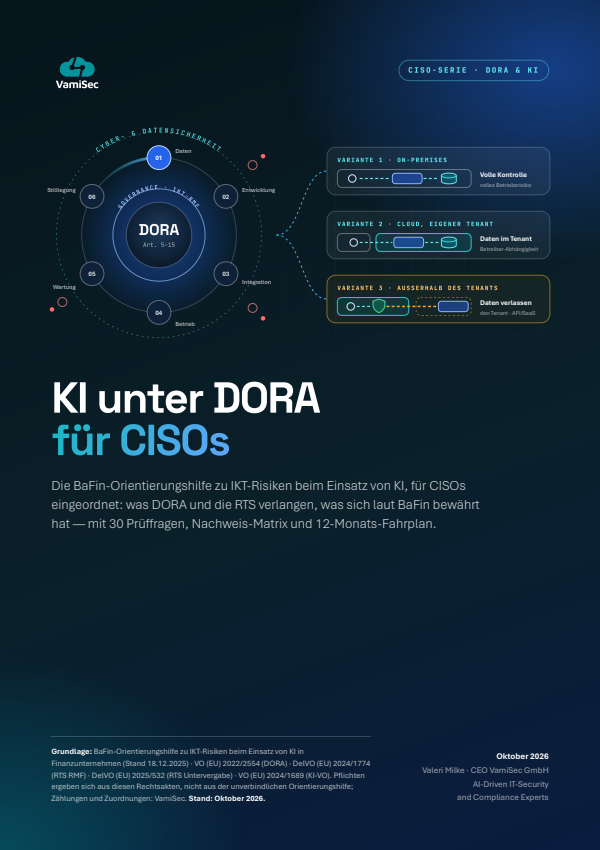
- Management summary and ten key messages for the board paper — obligation, practice and recommendation clearly separated
- Governance RACI, AI in the ICT risk management framework and a testing matrix by criticality with citations from DORA and the RTS RMF
- Three infrastructure variants as data flows, a data class × variant matrix and threat mapping to OWASP LLM 2025 and MITRE ATLAS
- 30 audit questions, evidence matrix, KPIs and KRIs, and a 12-month roadmap with a 100-day start
What the whitepaper “KI unter DORA für CISOs” contains
Obligation, practice, recommendation — clearly separated
Management summary and ten key messages for the board paper, an assessment of legal nature and addressees, and a citation register with all 97 citations in the guidance by our count — DORA, RTS RMF, RTS Subcontracting, ITS on the register of information, AI Act, the Commission Guidelines on the AI system definition and the Cloud supervisory statement.
Governance, ICT RMF and testing
RACI for the management body, ICT risk management function, control functions and internal audit, AI within the framework under Art. 6 to 14 DORA, development including end-user computing and AI-generated code, and a testing matrix by criticality up to adversarial testing.
Three variants, one threat picture
The case study’s infrastructure variants as data flows with the tenant boundary, a data class × variant matrix, a clause checklist for cloud and AI providers and a VamiSec mapping of AI threats to the OWASP Top 10 for LLM Applications 2025 and MITRE ATLAS — a subject-matter mapping, not an official crosswalk.
Roadmap and audit readiness
A 12-month roadmap with a 100-day start, 30 audit questions with citations for internal audit and supervisory dialogue, an evidence matrix, KPIs and KRIs for AI resilience, and answers to six typical objections from board discussions.
DORA first: the guidance builds on your ICT risk management
The guidance creates no new obligations but applies the requirements of DORA, the RTS RMF and the RTS Subcontracting to AI systems. Anyone who wants to operate AI in line with DORA therefore first needs a robust ICT risk management framework, a complete asset inventory and functioning third-party and incident management. Our DORA deep dive puts the regulation as a whole into context; BaFin’s news release of 18 December 2025 leads to the original version of the guidance.
- The management body bears ultimate responsibility for managing ICT risks (Art. 5(2)(a) DORA).
- The ICT risk management framework is reviewed at least once a year (Art. 6(5) DORA).
- Entities other than microenterprises must test systems supporting critical or important functions at least once a year (Art. 24 DORA).
- Major ICT-related incidents must be reported to the competent authority (Art. 19 DORA).
The German version (dated 18 December 2025) is authoritative; the English translation bears the version date 23 January 2026.
Glossary: terms used in BaFin’s guidance on AI
22 terms in concise, quotable definitions — English terms as used in the official translation, with the German original terms and abbreviations as alternatives.
- AI systemKI-System
- Legally defined in Art. 3(1) AI Act. For the purposes of the guidance, a combination of ICT assets (hardware and software) and ICT infrastructure in which a complex mathematical model is implemented — a subset of network and information systems under Art. 3(2) DORA.
- ICT assetIKT-Asset
- Hardware or software component of a financial entity’s network and information systems. In the AI context, the guidance considers the model itself an ICT asset (software) and, for asset management, lists model implementations, software libraries, hardware and training data sets, among others; these are to be identified, classified and documented under Art. 8(4) DORA in conjunction with Art. 4 and 5 RTS RMF.
- ICT risk management frameworkICT RMF, IKT-Risikomanagementrahmen
- Sound, comprehensive and well-documented framework under Art. 6 DORA, part of overall risk management and to be reviewed at least once a year (Art. 6(5) DORA). According to the guidance, AI systems are to be integrated into it in the same way as other ICT assets.
- Critical or important functionkritische oder wichtige Funktion
- A function whose disruption would materially impair the financial performance of a financial entity, the soundness or continuity of its business, or its compliance with the conditions of its authorization (Art. 3(22) DORA). According to the guidance, AI in such functions needs more extensive security and control measures.
- RTS RMFDelegated Regulation (EU) 2024/1774
- Regulatory technical standards on ICT risk management tools, methods, processes and policies and on the simplified framework. By our count, the guidance contains 31 distinct citations from it, mainly on development, testing, operation and data security.
- RTS SubcontractingRTS Untervergabe, Delegated Regulation (EU) 2025/532
- Regulatory technical standards on subcontracting ICT services supporting critical or important functions: due diligence and risk assessment (Art. 3), contractual conditions (Art. 4), material changes (Art. 5) and termination (Art. 6).
- Register of informationInformationsregister
- Register of all contractual arrangements on the use of ICT services provided by ICT third-party service providers under Art. 28(3) DORA; the templates are set out in the ITS on the register of information (Implementing Regulation (EU) 2024/2956). For AI-specific subcontracting, the guidance cites Art. 3(6) ITS on the register of information, which governs the identifier (LEI or EUID) of the subcontractors recorded.
- Tenant
- An organization’s segregated area within a cloud environment. In the case study, it marks the decisive boundary: in Variant 2, data flows remain within the entity’s own tenant; in Variant 3, they extend beyond it to the model provider.
- Governance Shield
- Filter that checks whether input data is confidential. The case study lists it as a technical measure for Variant 3, where the AI application is located outside the entity’s own tenant — alongside upload restrictions and upfront terms of use.
- Data poisoningDatenvergiftung
- Use of manipulated data in training or fine-tuning, which can lead to unexpected or altered model behavior. As a countermeasure, the case study proposes using only verified and validated entity data; a data governance team that controls data release can be helpful (Phase 2).
- Model poisoningModellvergiftung
- Attack in which attackers modify the behavior or even the structure of a trained model — particularly with open-source models and models from shared repositories. Countermeasures per the case study: review source code for backdoors and malicious code, and ensure the integrity of repositories and model providers.
- Knowledge poisoningWissensvergiftung
- Manipulation of the knowledge base provided to an LLM as context or grounding via retrieval-augmented generation. According to the case study, this data is also to be verified and validated before it is integrated.
- Prompt injection
- Malicious input that forces an LLM to behave in an unintended way — for example by linking to websites that contain hidden instructions (case study, Phase 4). Chapter V.2 identifies securing AI systems against injection attacks as a proven measure.
- Adversarial testing
- Simulation of attacks on AI systems, such as data poisoning or evasion attacks. According to Chapter III.2, useful depending on criticality, complemented by adversarial penetration testing, where appropriate in coordination with the cloud service provider.
- Inference attackInferenzangriff
- Attack that draws conclusions about training or query data from model responses. The guidance mentions inference attacks alongside adversarial attacks and model poisoning as threats during operation (Ch. IV.1). To protect personal data from inferences drawn from multiple queries, the case study cites differential privacy (Phase 1).
- Model driftModelldrift
- Change in model performance or behavior over time, for example because the data or environment have changed since training. The guidance lists monitoring of model drift as a measure to be documented and reviewed regularly (Ch. II.3).
- Human-in-the-loop
- Human review and approval loop: according to the case study, as a human review requirement for security-critical AI responses and recommendations (Phase 4) and when examining interfaces to other systems within the entity, for example through approval by the data owner (Phase 3).
- Differential privacyDifferentielle Privatsphäre
- Technique that maximizes the accuracy of responses to database queries while minimizing the likelihood that individual records in the underlying data can be identified. The case study mentions it in Phase 1 to protect personal data.
- TokenizationTokenisierung
- Replacing sensitive data with placeholders before the AI assistant processes it. The case study lists it in Phase 1 under data minimization and masking.
- Cryptographic wipingKryptografisches Löschen
- Secure removal of all stored data of the entity when an AI assistant is retired; the case study uses the term “cryptographic wiping” (Phase 6). Technically, this is usually done by destroying the keys with which the data is encrypted.
- End-user computingEUC, IDV
- Applications developed or operated outside the ICT function, known in German practice as “individuelle Datenverarbeitung” (IDV). According to the guidance, DORA does not distinguish on this basis; Art. 16(9) RTS RMF extends the development and testing requirements to them on a risk-based basis.
- Security incident response planSIRP, Sicherheitsvorfall-Reaktionsplan
- Plan for responding to security incidents. In Phase 5, the case study proposes a SIRP for security incidents specific to AI assistants as a measure, complemented by simulated cyberattacks that test the entity’s response times.
Frequently asked questions on BaFin’s guidance on AI
Short answers to typical questions from the CISO office, ICT risk management and internal audit — with citations for further reading.
BaFin’s “Guidance on ICT Risks in the Use of AI at Financial Entities” is non-binding advice published on 18 December 2025 (38 pages in German; English translation with version date 23 January 2026). It shows how financial entities can apply DORA’s requirements on ICT risk management and ICT third-party risk management to AI systems — along the AI lifecycle from governance, development, testing and operation to cloud outsourcing, cyber and data security and incident reporting. A case study walks through an LLM-based AI assistant in three infrastructure variants. It creates no new obligations; its main audience is CRR institutions and Solvency II insurers applying the full DORA framework under Art. 5 to 15 DORA.
Yes. AI systems consist of ICT assets and infrastructure and are therefore covered by ICT risk management under DORA — this is also how BaFin’s guidance frames them. In practice, AI systems belong in the ICT risk management framework (Art. 6 DORA) and the asset inventory (Art. 8(4) and (6) DORA); AI services obtained from third parties fall under ICT third-party risk management (Art. 28 to 30 DORA); and incidents in AI systems must be recorded as ICT-related incidents and, if major, reported (Art. 17 to 19 DORA). DORA contains no separate catalog of AI obligations; the guidance shows how the existing ones translate to the AI lifecycle.
No. Obligations arise from DORA and the associated regulatory and implementing technical standards (RTS and ITS); as “non-mandatory advice” and expressly without constituting a binding interpretation of DORA, the guidance shows how they can be implemented when using AI. For its case study, too, it makes clear that all measures presented are illustrative — what counts are the measures best suited to your entity’s specific risk situation. In practice, this means you do not have to adopt every example measure, but for each AI system you should be able to demonstrate in a traceable way how you meet the relevant DORA obligations. VamiSec recommendation: document where and why you deviate from the practice examples, each with reference to the citation — this makes internal audit and supervisory meetings easier.
It depends on which DORA framework you apply. The guidance mentions banks and insurers only as examples (“in particular”); what matters is whether your entity must comply with the full ICT risk management framework under Art. 5 to 15 DORA. In our view, payment institutions, UCITS management companies or AIF managers within this full framework can therefore equally use it as a benchmark. Entities applying the simplified framework under Art. 16 DORA, such as small and non-interconnected investment firms, exempted payment and e-money institutions or institutions exempted under the CRD, are expressly out of scope. In addition, from 1 January 2027, further institutions will have to apply DORA under the simplified framework pursuant to the FinmadiG, Germany’s Financial Market Digitalization Act (section 1a(2) KWG). VamiSec recommendation: use the lifecycle and the case study as a review grid there too — proportionately.
The guidance does not name any products but describes the case precisely: a cloud service provider’s language model is accessed via API or called up as an AI assistant from standard software, possibly without users’ knowledge — Variant 3 of the case study. The main risk is that data leaves the tenant and flows to the model provider. As technical measures, BaFin mentions restricted functions and uploads for certain user groups, a filter for confidential input (Governance Shield) and upfront terms of use; a lower data clearance level for the AI application, which users cannot exceed of their own accord, is also conceivable. Technical control is to follow the Cloud supervisory statement by analogy; contractually, Art. 28 to 30 DORA apply.
Not the AI system as such. The register of information under Art. 28(3) DORA covers contractual arrangements on the use of ICT services provided by ICT third-party service providers. If you source a model via API, as a cloud service or as a feature of standard software, the underlying arrangement belongs in the register. Every AI system, by contrast, belongs in the asset inventory (Art. 8(4) and (6) DORA in conjunction with Art. 4 RTS RMF) — including one operated in-house without a provider. For AI-specific subcontracting that supports critical or important functions, you should, according to Chapter IV.2, maintain an overview at all times of which parties are involved in data processing and where. VamiSec recommendation: with every newly activated AI feature, check whether the service description or the subcontracting chain changes.
The guidance takes only the definition of an AI system from the AI Act (Art. 3(1) AI Act) and deals exclusively with ICT risks under DORA. The AI Act sets out its own obligations: prohibitions and AI literacy have applied since 2 February 2025, the transparency obligations under Art. 50 since 2 August 2026, and the high-risk obligations for Annex III — including creditworthiness assessment of natural persons and risk assessment and pricing in life and health insurance — will apply from 2 December 2027 following the postponement by Regulation (EU) 2026/1744. Since 29 July 2026, BaFin has been the market surveillance authority under section 2(3) KI-MIG (Germany’s AI Act market surveillance and innovation act) for AI systems directly connected with regulated financial activities; otherwise, the Federal Network Agency (Bundesnetzagentur) is responsible. Both regimes run in parallel.
For DORA financial entities, the switch has already taken place: KAIT, VAIT and ZAIT were repealed at the end of 16 January 2025, and institutions within the DORA framework have been excluded from the scope of the BAIT since then. The BAIT will be repealed in full at the end of 31 December 2026. The benchmark for the ICT requirements for AI systems is therefore the DORA rulebook together with its technical standards; the guidance puts it into context for AI. For the institutions covered, model risks continue to be addressed by the MaRisk: AT 4.3.4 of the 9th MaRisk amendment (Circular 06/2026 (BA)) also applies to AI models and requires sufficient explainability — identical in substance to AT 4.3.5 of the 7th MaRisk amendment (Circular 05/2023 (BA)).
For LLMs, Chapter III.2 describes two testing approaches: structure-based tests that consider, for example, the probability of a token stream for a given prompt, and agnostic tests in which a human or another model assesses the answers to test questions. Because generative AI can be used for general purposes, the case study recommends separate, use-case-specific testing procedures for each application (Phase 2). For cloud models, adversarial penetration tests can be coordinated with the cloud service provider. According to Chapter III.2, another challenge for testing is unannounced changes to models obtained from third parties. VamiSec recommendation: maintain a versioned test set of business and attack prompts and rerun it after every known model change and additionally at fixed intervals.
Only if it is major. Art. 19 DORA requires major ICT-related incidents to be reported; according to the guidance, this obligation may also include incidents in AI systems. Whether an incident is major is determined by the classification under Art. 18 DORA, which the guidance itself does not cite. Irrespective of this, incidents occurring due to or in connection with AI systems that impair the availability, authenticity, integrity or confidentiality of data or impair services must be recorded as ICT-related incidents (Art. 17 DORA); BaFin recommends flagging them as AI incidents. For scale: in 2025, financial entities reported 733 ICT incidents to BaFin — BaFin does not publish AI-specific figures.
DORA does not prescribe a separate AI strategy, but it does require a digital operational resilience (DOR) strategy as part of the ICT risk management framework (Art. 6 DORA); the management body bears overall responsibility for setting and approving it (Art. 5(2) DORA). Whether AI appears there as a section or gets its own document is left open by the guidance — it considers both possible. In our view, the content is what counts: approved use cases and data classes, the necessary resources, capacities and investments, how provider dependencies are handled and how the control functions are involved. VamiSec recommendation: integrate AI into the DOR strategy first and spin it off as a separate strategy as soon as AI supports critical or important functions — according to the guidance, that is when an AI strategy becomes particularly significant.
ISO/IEC 42001:2023 is the first international management system standard for AI: it governs the establishment, operation, monitoring and improvement of an AI management system, is certifiable and can be combined with ISO/IEC 27001. The guidance does not mention the standard. A certificate therefore does not replace any DORA obligation, but it can provide the organizational framework in which AI strategy, roles, inventory and lifecycle processes are managed. VamiSec recommendation: map the standard’s requirements to the DORA citations and maintain a joint AI inventory. For auditing individual AI systems, the audit criteria catalog AICRIV Finanz from Germany’s Federal Office for Information Security (BSI, v2.0, 18 June 2026) offers a template — although its mapping to DORA is only thematic.
Standards & Sources
The content on this page is based on the following publicly available guides and studies.
Orientierungshilfe zu IKT-Risiken beim Einsatz von KI in Finanzunternehmen (German original)
Primary source for this page — German original version dated 18 December 2025, 38 pages; Chapters I–VI and case study on the LLM-based AI assistant
Guidance on ICT Risks in the Use of AI at Financial Entities (English version)
English translation, version date 23 January 2026, published on 30 January 2026, 35 pages — the German version is authoritative
Artificial intelligence: BaFin publishes guidance on ICT risks
News release of 18 December 2025 (in German) — non-binding advice, aimed primarily at CRR institutions and Solvency II insurers
Regulation (EU) 2022/2554
DORA — in force since 16 January 2023, applicable since 17 January 2025; by our count 54 citations in the guidance, focusing on Chapters II and IV.1 (Art. 5–14) and Chapter IV.2 (Art. 28–30); Art. 16 only to delimit the scope (Ch. I)
Commission Delegated Regulation (EU) 2024/1774
RTS RMF — tools, methods, processes and policies for ICT risk management and the simplified framework; 31 citations by our count
Commission Delegated Regulation (EU) 2025/532
RTS Subcontracting — subcontracting of ICT services supporting critical or important functions; cited in Chapter I and Chapter IV.2 (Art. 3(1)(c), (d) and (j); Art. 4(1)(j))
Commission Implementing Regulation (EU) 2024/2956
ITS on the register of information — templates for the register of information under Art. 28(3) DORA; the guidance refers to Art. 3(6) without naming the regulation (LEI/EUID identifier of subcontractors)
Regulation (EU) 2024/1689
AI Act — definition of an AI system in Art. 3(1); high-risk deadlines amended by Regulation (EU) 2026/1744 (Annex III from 2 December 2027)
Supervisory statement on outsourcing to cloud service providers
Published on 1 February 2024 (German version linked), revised version of the guidance of November 2018; Chapters III.2, III.5, III.5.3, IV.2 and IV.4 are taken up in Chapter IV.2 of the AI guidance
Risks in Focus 2026 — trend: digitalization
Published on 28 January 2026 (German page linked); refers to the guidance under the digitalization trend — the AI risks it names include dependencies on cloud and AI providers as well as data and model poisoning
KI-MIG (Germany’s AI Act market surveillance and innovation act), section 2
In force since 29 July 2026; section 2(3): BaFin as market surveillance authority for AI systems directly connected with regulated financial activities, otherwise the Federal Network Agency (section 2(1))
Circular 06/2026 (BA) — Minimum Requirements for Risk Management (MaRisk)
9th MaRisk amendment of 30 June 2026, transitional period for additional requirements until 1 January 2027; AT 4.3.4 also covers AI models and requires sufficient explainability (identical in substance to AT 4.3.5 of the 7th amendment)
ESA Statement: Toward a consistent and risk-based approach for ICT risks from frontier AI models (JC 2026 25)
Statement of 31 July 2026 — DORA and the AI Act as a sound basis; prevention, detection and management, to be implemented proportionately
OWASP Top 10 for LLM Applications 2025
Reference for the VamiSec mapping of the AI threats in the guidance — a subject-matter mapping, not an official crosswalk
MITRE ATLAS
Release 2026.09 of 15 September 2026 — reference version for the ATLAS mappings in the VamiSec threat mapping
NIST AI 100-2 E2025 — Adversarial Machine Learning: A Taxonomy and Terminology of Attacks and Mitigations
Published on 24 March 2025 — taxonomy of evasion, poisoning and privacy attacks as well as attack classes for generative AI
Want to set up your AI systems in line with DORA?
VamiSec supports financial entities with AI inventories, governance and ICT risk management, with testing up to adversarial testing and red teaming, and with third-party contracts — in line with DORA obligations and BaFin’s guidance.