
Runtime controlNew
Agent Defence Strategies & Tactics
Layered defence for AI agents — from runtime control with OWASP ACS to incident response.
LLM and agentic AI pentesting, Prompt Injection, OWASP LLM Top 10, MAESTRO Threat Modeling and AI governance: how to test AI systems, make them transparent and operate them in full regulatory compliance.
Agentic AI systems act instead of merely answering — with tool access, memory and their own decisions. This creates attack surfaces that classic security testing does not cover: Prompt Injection, Memory Poisoning, tool misuse and compromised Agent Skills. These knowledge pages combine offensive testing (OWASP LLM Top 10, agentic threats), engineering transparency (AI-SBOM, automated Threat Modeling) and governance (EU AI Act, ISO/IEC 42001) into one end-to-end approach. Runtime control based on the OWASP Agent Control Standard and evidence-based security testing from our ICSPIS 2026 paper make that protection verifiable.
Five topic areas at a glance — each with a short overview and the matching deep dives.
Layered defence for AI agents — from runtime control with OWASP ACS to incident response.
Securing Model Context Protocol deployments — from authorization to pentesting.
Attack your AI systems before someone else does — threat-model-guided and backed by evidence.
Understand the AI threat landscape, model threats systematically and build AI systems secure by design.
EU AI Act, ISO/IEC 42001 and AI frameworks — know your obligations and steer AI risks.
In-depth knowledge pages on the topics that currently raise the most questions — with verified sources and concrete measures.
ISO/IEC 27090:2026 is the guidance standard from ISO/IEC JTC 1/SC 27 on security threats and compromises to AI systems, published on 14/10/2026 as a first edition of 56 pages. The standard describes nine AI-specific attack types with their consequences, detection and mitigation across the entire AI life cycle and is not certifiable. This page puts the standard in context, shows threats by life-cycle phase, maps them to ISO/IEC 27001, 42001, the AI Act, NIST and OWASP, offers a Gap Check for self-assessment and the whitepaper "ISO/IEC 27090 for CISOs".
View knowledge pageThe OWASP Agent Control Standard (ACS) is an open specification under which a Guardian Agent checks an AI agent’s actions at defined hooks and, based on policy, allows, blocks, modifies, submits them for approval or defers them. This deep dive shows what version 0.1.0 delivers today — and where its limits lie.
View knowledge pageA shared trace only shows that events belong together. It does not show whether an AI agent respected approval, target, authorization and data provenance along the way. Our paper, accepted at ICSPIS 2026 (IEEE), shows which telemetry that requires. This page maps the results to the OWASP Agent Control Standard (ACS).
View knowledge pageAI-driven pentest platforms increasingly execute attack chains on their own — the OWASP Autonomous Penetration Testing Standard (APTS) is the first governance framework built for exactly that: 173 requirements, 8 domains, 3 compliance tiers, 4 autonomy levels.
View knowledge pageThe Model Context Protocol connects AI applications with tools, data, and systems – creating a new attack surface in the process. We put the current guidance from the NSA, OWASP, and Wiz into context and show how you can secure MCP servers and clients.
View knowledge pageThe ten key security risks of autonomous AI agents – from Agent Goal Hijack to Rogue Agents – based on the official OWASP publication (version 2026, December 2025).
View knowledge pageAutonomous AI agents act with legitimately granted privileges at machine speed. Zero Trust transfers proven principles — verify instead of trust, Least Privilege, assume breach — to agentic systems.
View knowledge pageOWASP, MITRE ATLAS, and NIST AI RMF look at AI security from three different perspectives. An overview of what each framework stands for — and how, in combination, they form a viable protection concept.
View knowledge pageThe ten most critical security risks for applications built on Large Language Models – and the mitigations that have proven effective in practice for each risk class.
View knowledge pageHow to vet, harden and govern packaged capabilities for AI agents – instructions plus executable code in the SKILL.md format – before deployment and across their lifecycle.
View knowledge pageHow to systematically test language models and AI applications for jailbreaks, prompt injection, data leakage and unsafe tool use – from scenario definition to a repeatable testing process.
View knowledge pageHow to systematically identify, assess and treat threats in systems of autonomous AI agents using the Cloud Security Alliance's seven-layer framework.
View knowledge pageWhy models, weights and training data belong in the bill of materials – and how CycloneDX ML-BOM and SPDX 3.0 make the AI supply chain documentable.
View knowledge pageEach whitepaper has its own page with details and a direct download form.
 AI SecurityAI OWASP LLM PenTesting: How to Truly Secure Your AI SystemsGo to whitepaper page
 AI SecurityLLM Pentesting & Prompt Injection: How to Truly Protect AI Systems from ManipulationGo to whitepaper page
 EU AI ActEU AI Act — Compliance Guide for CompaniesGo to whitepaper page
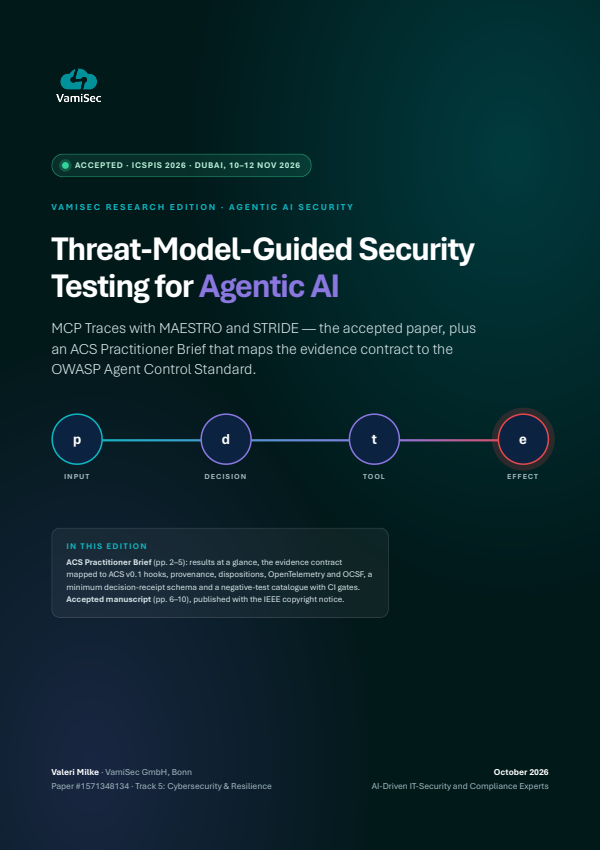 Agentic AI · Testing & ResearchThreat-Model-Guided Security Testing for Agentic AI — Research EditionGo to whitepaper page
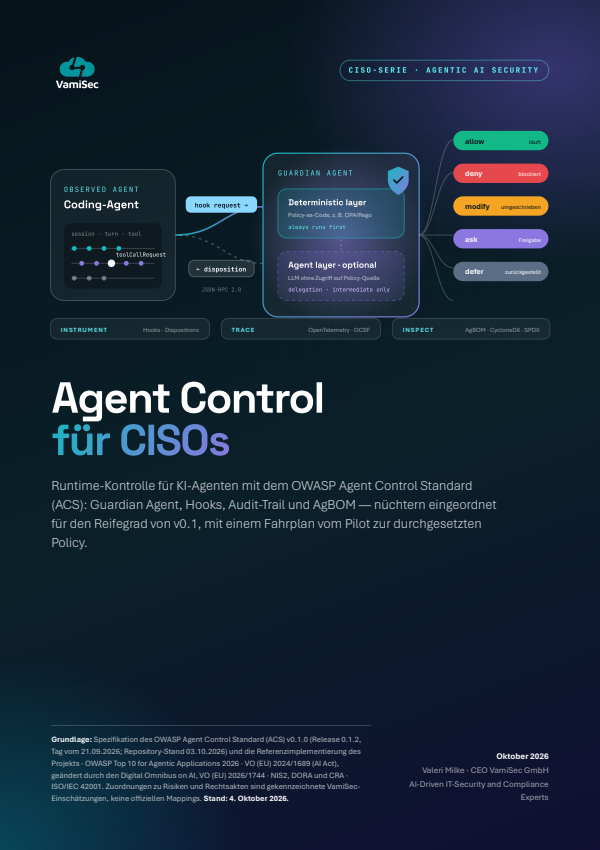 Agentic AI · Runtime controlAgent Control for CISOs — OWASP Agent Control Standard (ACS)Go to whitepaper page
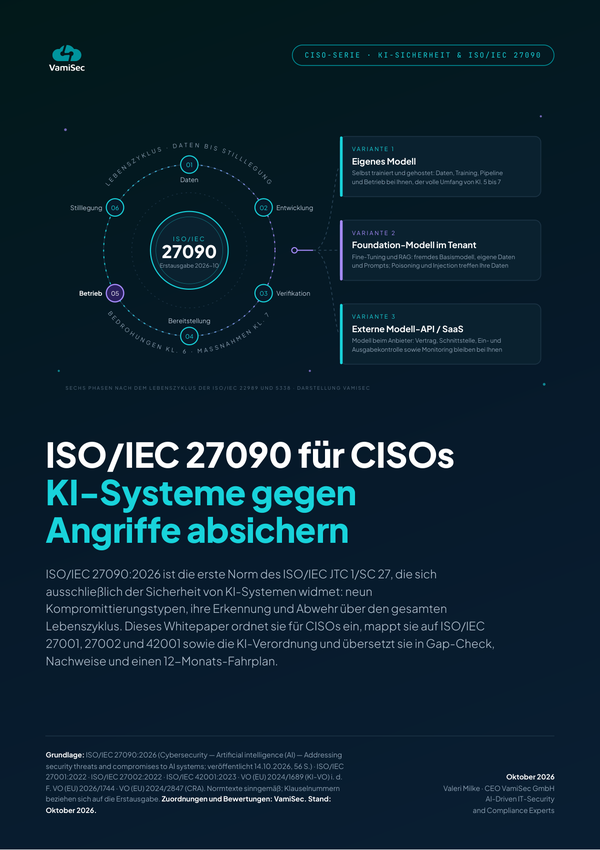 AI Security / ISO/IEC 27090ISO/IEC 27090 for CISOs — securing AI systems against attacksGo to whitepaper page
In an initial consultation, we clarify which of your AI systems should be tested — and how testing, transparency and governance work together.