
Research area · Securing AI agents Agentic
Agentic AI Security: When AI agents act, every action needs control
AI agents act: they call tools via MCP, load Agent Skills, use delegated permissions, and write to their memory. Vami Research examines how this shifts the attack surface — from prompt injection and Agent Goal Hijack to data leakage to AI assistants — and how agents can be controlled, assessed, secured, and monitored at runtime.
- Prompt injection
- Agent Goal Hijack
- MCP & Agent Skills
- Agent identities
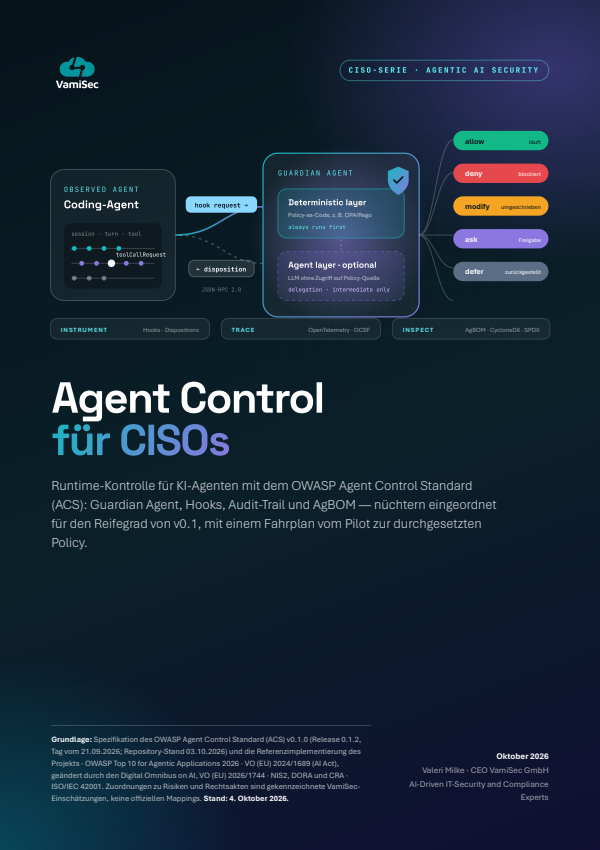
- Agent Control Standard
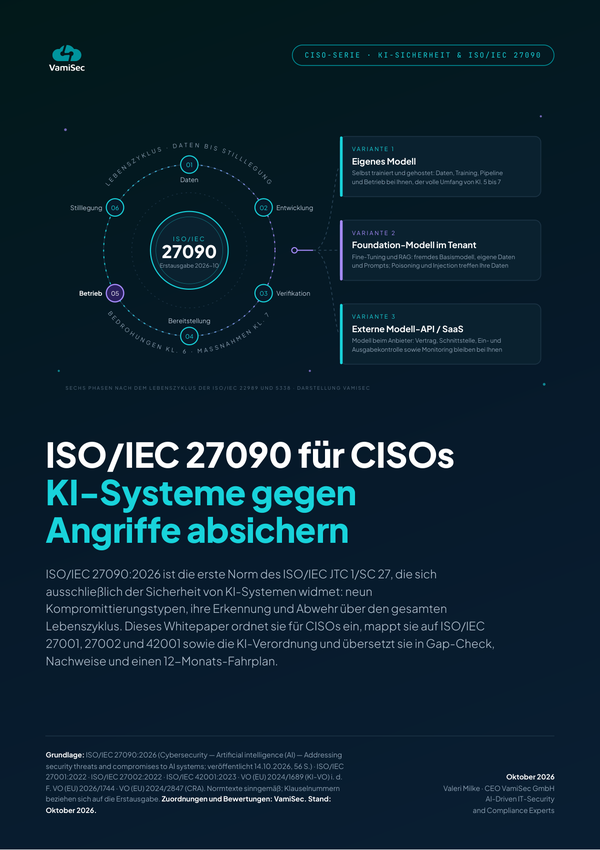
- ISO/IEC 27090
- Detection & Response
- Deep Dives
- 16
- Whitepapers
- 4
- Solutions
- 2
From assistant to actor: where control has to start
With AI agents, the attack surface shifts from the model to the action. Agents plan across multiple steps, choose tools themselves, and access repositories, mailboxes, and databases via the Model Context Protocol, often with delegated user permissions. A manipulated agent does not break in; it uses its legitimate permissions. Instructions in web pages, documents, tool descriptions, or skill files thus become a control channel that EDR and SIEM alone do not see.
The standards landscape grew denser in 2025 and 2026, but it is young. Since December 2025, the OWASP Top 10 for Agentic Applications has named ten risks, from Agent Goal Hijack to Rogue Agents; the OWASP MCP Top 10 is available as v0.1 (Beta); and the NSA and OWASP published hardening guidance for MCP in 2026. ISO/IEC 27090 was published on October 14, 2026, but addresses agents only in passing. The OWASP Agent Control Standard describes runtime control in version 0.1.0; conformance there is self-declaration without a test suite or assessment body.
Vami Research turns these sources into testing and operational practice: MCP assessments, skill reviews, detection & response for agents, and ISO/IEC 27090 in the ISMS. Two solutions complement this. VamiGuard, a free browser extension for Chrome and Edge, checks prompts locally and detects, by pattern and without a guarantee of completeness, data such as email addresses, API keys, and tokens; it replaces them only after confirmation. VamiRedteam tests AI applications following the OWASP AI Testing Guide, for example for prompt injection and system prompt leakage.
Open questions in practice
- 01
How can an AI agent's action be checked before it is executed?
Our approach
Not via the system prompt, but at control points outside the model. For this, the OWASP Agent Control Standard (ACS) describes a Guardian that, based on policy, allows, blocks, modifies, submits for approval, or defers actions at hooks. Because a Guardian that does not respond results in “proceed” by default, we define the failure posture first. ACS is an architectural goal, not a certificate.
- 02
What risks do MCP servers and Agent Skills from third-party sources bring?
Our approach
Both bring third-party instructions into the agent's context: tool descriptions that the model reads but humans never get to see, and skills that inherit the permissions of the executing agent. We treat them like privileged software: inventory, provenance checks, review of all files, signed manifests with version pinning, sandboxing, and a formal approval process before production use.
- 03
How do AI agents get a verifiable identity with minimal permissions?
Our approach
Agents are non-human identities that user- and perimeter-centric IAM models do not capture. Our approach is Zero Trust per action: a cryptographically anchored identifier per agent, short-lived, tightly scoped tokens instead of static API keys, just-in-time permissions, and Least Agency. For MCP, we check the OAuth 2.1 chain for audience binding and the absence of token passthrough.
- 04
How does a SOC detect that an agent is being misused within its legitimate permissions?
Our approach
With telemetry where agents make decisions: prompts, tool calls, execution paths, and memory operations in a unified event schema. On this basis, our Agentic AI Detection & Response service builds detections along the OWASP Top 10 for Agentic Applications, anchors write-protected audit trails outside the agent, and rehearses graduated responses up to a kill switch at the infrastructure level.
Key takeaways
- 01
ISO/IEC 27090 covers generative AI, agents only in passing
The standard describes prompt injection, including its indirect variant, and outputs that attack downstream systems. On agents, it provides only one principle: verify and authorize every action individually. Tool poisoning, memory poisoning, delegation, and MCP are missing as types in their own right; we recommend supplementing this layer with OWASP, MITRE ATLAS, and NIST, with the additions labeled as such.
Source: ISO/IEC 27090
- 02
System prompts do not control agent actions
Because agents execute commands and modify their memory, control has to sit outside the model's output path. For this, the OWASP Agent Control Standard defines hooks, dispositions, and an audit trail. Version 0.1.0 is early: if the Guardian stays silent, “proceed” applies by default, i.e., fail-open; conformance is self-declaration without a test suite or assessment body.
Source: Agent Control Standard (ACS)
- 03
MCP authorization is specified, but practice lags behind
Since June 2025, a protected MCP server has been an OAuth 2.1 resource server according to the specification, with mandatory metadata discovery, PKCE, and audience binding; token passthrough is prohibited. An audit of 5,200 MCP servers in October 2025 found only 8.5 percent OAuth usage. This raises two audit questions: Is there token passthrough, and how long does an agent token live?
Source: MCP & OAuth 2.1
- 04
Classic monitoring does not see what triggers agentic actions
EDR monitors processes, file access, and network traffic; the decisive telemetry of agents lies in prompts, decision paths, tool calls, and memory operations. Agents also act with valid credentials over legitimate API and MCP connections. Detection therefore needs dedicated sensors and audit trails that the agent cannot overwrite.
How we work
We read formal standards, industry standards, and specifications in the original, label what is binding and what we recommend, and translate the result into inventories, test catalogs, policies, and telemetry.
Agent inventory
Capture models, MCP servers, tools, skills, knowledge sources, and memory per agent — modeled on the AgBOM of the Agent Control Standard.
Threat mapping
Map risks to the OWASP Top 10 for Agentic Applications, the OWASP MCP Top 10 (v0.1, Beta), and the nine types of compromise in ISO/IEC 27090.
MCP and skill review
Check tool descriptions against actual runtime behavior and minimize token scopes; read skills in full and run bundled scripts in an isolated sandbox.
Policy and failure posture
Guardian policies as code, approvals for consequential actions, and a deliberately chosen failure posture instead of the default.
Agent telemetry and ADR
Capture prompts, tool calls, execution paths, and memory operations in one event schema and integrate detections into the SIEM and SOC.
GenAI DLP at the source
Check prompts locally before sending, for example with VamiGuard, and combine this with classic DLP such as Microsoft Purview: the two approaches complement each other.
How to get started
- 1Understand and inventoryCapture agents, tools, identities, and data flows; mark trust boundaries and the combination of data access, external communication, and third-party content.
- 2Assess and testClassify risks against OWASP catalogs and ISO/IEC 27090, conduct MCP and skill assessments, and test AI applications specifically for prompt injection.
- 3Control and monitorIntroduce runtime controls, Zero Trust identities, and agent telemetry, and track remaining risks in the ISMS risk register.
Deep dives, whitepapers, and analyses
Deep Dives 16
Whitepapers 4
Analyses & news
From research area to implementation


Related research areas
How well do you control your AI agents today?
In an initial consultation, we assess your agent landscape — from MCP servers and skills to identities and telemetry — and show which step will have an impact first.