

Automotive Cybersecurity
UN R155, ISO/SAE 21434 and the Auto-ISAC's Automotive Threat Matrix — how attacker behaviour against the vehicle is described, rated in the TARA and demonstrated in the pentest.
Secure coding, SSDLC, CI/CD pipeline security, supply chain security (SLSA, SBOM) and product regulation from CRA to IEC 62443: how secure products are built — from the first line of code to CE marking.
Secure products are not created in a pentest at the end, but in the development process itself: security requirements in design, secure coding and reviews in the code, SAST, SCA and secrets scanning in the build, signed artifacts and an SBOM in the release — plus vulnerability management across the entire product lifecycle. Especially in the AI era, where coding assistants write a substantial share of the code, the pipeline determines product security. These knowledge pages bundle our methodology from OWASP SAMM, ASVS and ISVS through SLSA and the OWASP Top 10 CI/CD Risks to CRA, IEC 62443, ISO/SAE 21434 and MDR — including free self-assessments for your maturity level.
Each topic leads to a dedicated knowledge page with deep dives, practical guides and the matching services.
UN R155, ISO/SAE 21434 and the Auto-ISAC's Automotive Threat Matrix — how attacker behaviour against the vehicle is described, rated in the TARA and demonstrated in the pentest.
Secure coding, SSDLC implementation and developer enablement — security as part of the craft, not an afterthought.
Harden build chains, control dependencies, sign artifacts — from SBOM and SLSA to AI-powered pipeline security.
CRA, IEC 62443, ISO/SAE 21434 and MDR — regulatory compliance from embedded systems to medical devices.
Where do you stand? OWASP-based self-assessments (SAMM, ISVS, SCVS) and our AppSec platform VamiAppSec.
Rule-based scanners reliably find syntax flaws. Broken authorization, business logic and wrongly assumed permissions have no signature at all. We bring rules, AI reasoning and exploit validation into an order your team can operate.
A consulting service — the knowledge pages above stay freely accessible.
In-depth knowledge pages on the topics that currently raise the most questions — with verified sources and concrete measures.
How the Auto-ISAC matrix describes attacker behaviour against the vehicle – and how it gives the TARA under ISO/SAE 21434, the evidence under UN R155, the OWASP testing catalogues and the Vehicle SOC a common language.
View knowledge pageHow to prevent vulnerabilities systematically: the current landscape of the CWE Top 25 and OWASP Top 10:2025, ASVS 5.0 as a requirements framework, and the practices that make the difference in day-to-day development.
View knowledge pageStatic code analysis is the most densely cross-referenced control point in the secure development lifecycle – and the tool with the greatest frustration potential. What SAST delivers technically, where its limits are proven, which standards require it, and what AI is changing about it right now.
View knowledge pageLanguage models triage findings, reason semantically across function boundaries and find real zero-days. What of that is evidenced, which tools exist in 2026 and where the new limits and risks lie — with sources instead of marketing.
View knowledge pageHow to systematically integrate security into every phase of software development – with the NIST SSDF as a practice catalog, OWASP SAMM as a maturity model, and security gates from requirements all the way to operations.
View knowledge pageTop 10, ASVS, Cheat Sheet Series, Developer Guide, WSTG, SAMM and tools such as Dependency-Track and ZAP: what each project delivers – and how these building blocks connect into an end-to-end process in everyday development work.
View knowledge pageEach whitepaper has its own page with details and a direct download form.
 EU CRAEU Cyber Resilience Act — Practical guide for digital productsGo to whitepaper page
  CI/CD SecurityCI/CD Pipeline Security: How Attackers Take Over Your Pipeline — and How You Take It BackGo to whitepaper page
  DevSecOpsOWASP Top 10 CI/CD Security Risks — Practical Guide with Compliance CrosswalkGo to whitepaper page
  Secure CodingSecure Coding in the AI Era: The CWE Top 25 (2025) and Secure-by-DesignGo to whitepaper page
 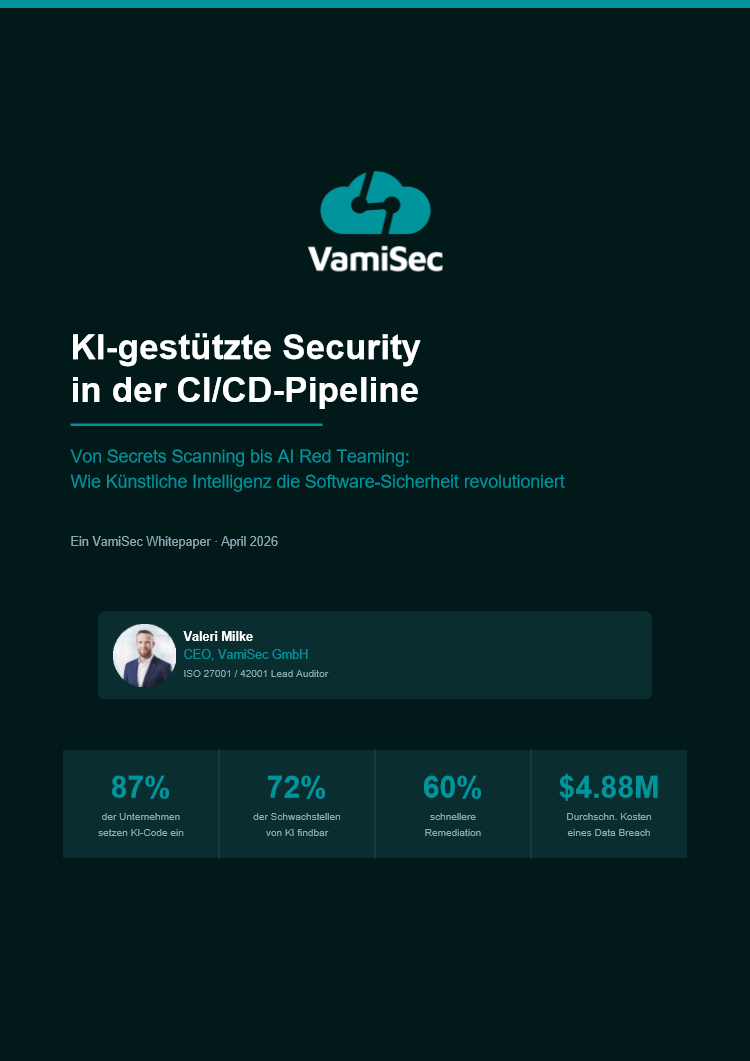 AI & CI/CD SecurityAI-Powered Security in the CI/CD PipelineGo to whitepaper page
  Automotive CybersecurityAutomotive Threat Matrix — ATT&CK for VehiclesGo to whitepaper page
 In an initial consultation, we assess your SSDLC maturity — and show you which measures in your pipeline, code and product approval offer the greatest leverage.